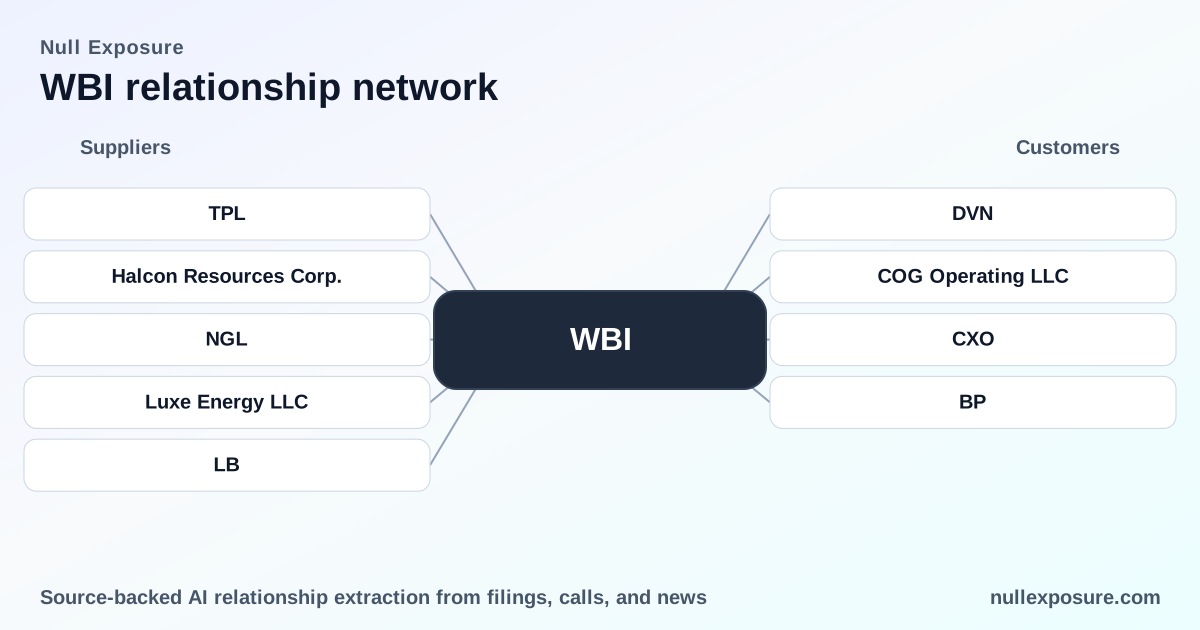
WaterBridge Infrastructure (WBI): Customer map and commercial posture investors need to know
WaterBridge Infrastructure operates and monetizes an integrated produced-water logistics and disposal network in the Permian and adjacent basins, capturing cash through long-term minimum volume commitments (MVCs), fixed-fee handling agreements and fee-for-service transportation and disposal contracts with major E&P operators. Revenue flows are driven by scale of midstream water pipes and pore-space access, and by multi-year commercial contracts that convert drilling programs into predictable cash receipts. Visit https://nullexposure.com/ for coverage and model-ready signals.
What the customer roster tells you about the business model
WaterBridge sells a service that upstream operators cannot easily replicate at scale: consolidated produced-water handling, long-haul transportation and subsurface disposal backed by owned surface and pore space. That commercial design produces three investment-relevant characteristics:
- Contracting posture: WBI relies heavily on long-duration commercial agreements and MVCs (10‑year MVCs are explicit in public filings), which convert upstream drilling into stable revenue streams and underpin capital recovery for infrastructure buildout.
- Revenue concentration and visibility: The top-five customers represented roughly 51% of pro forma water-related revenues for the six months ended June 30, 2025, with the largest customer at about 18%—a concentrated but diversified top bucket that gives high visibility into mid-cycle volumes.
- Operational criticality and maturity: Relationships with large, well-capitalized E&P names (Devon, Permian Resources, Chevron, EOG, etc.) are functionally critical; losing any large counterpart would have an outsized near-term earnings impact but the MVC structure limits immediate revenue volatility.
- Affiliate service governance: WBI provides and receives shared services with several affiliates under formal services agreements, indicating integrated management of operational and administrative functions across the corporate family.
These are company-level signals derived from WBI’s FY2025 public filing and recent investor materials; they apply across the customer base and are not attributed to any single counterparty absent an explicit naming in a constraint.
Line‑by‑line customer and affiliate relationships investors should track
-
Devon / Devon Energy Corporation / Devon Energy Production Company, L.P. (DVN) — WaterBridge reported meaningful fee revenue from Devon: $85.9 million in fees recognized in 2024 (transportation and handling), with additional fees for water solutions and solid waste services; the company also announced a long-term fixed-fee produced water handling agreement commencing in Q2 2027 over a 7.5‑year term. According to WBI’s FY2025 filing and 2025 earnings commentary, the strategic partnership formed in May 2023 materially increased volumes and cash flow.
Source: WBI FY2025 SEC filing and 2025 Q3 earnings comments. -
Permian Resources Corporation — Permian Resources individually comprised more than 10% of pro forma water-related revenues for the year ended December 31, 2024, and together with Devon represented 32% of total water-related revenues on a pro forma basis.
Source: WBI FY2025 SEC filing. -
Vital Energy, Inc. — Vital is listed among WBI’s top five pro forma customers for the six months ended June 30, 2025, contributing to the roughly 51% top-five concentration.
Source: WBI FY2025 SEC filing. -
APA Corporation (APA) — APA appears in WBI’s top-five customer list on a pro forma basis for the first half of 2025, reflecting multi-counterparty exposure to sizable operators.
Source: WBI FY2025 SEC filing. -
bpx energy / BPX Energy Inc. — WBI announced commercial agreements with bpx energy in January 2025 that include 10‑year MVCs to support Delaware Basin development; the Kraken project with BPX was brought online in mid‑2025 per company commentary.
Source: WBI FY2025 SEC filing and 2025 Q3 earnings commentary. -
Chevron Corporation (CVX) — Chevron is cited as one of the active, well-capitalized customers using WBI’s water services in the operating areas.
Source: WBI FY2025 SEC filing. -
EOG Resources, Inc. (EOG) — EOG appears on WBI’s customer roster as a major operator using WaterBridge’s produced-water handling and transport services.
Source: WBI FY2025 SEC filing. -
ConocoPhillips (COP) — WBI states that access to LandBridge surface and pore space has expanded its relationship footprint to include ConocoPhillips.
Source: WBI FY2025 SEC filing. -
Continental Resources, Inc. (CLR) — WBI cited expanded existing relationships with Continental Resources as part of the integration benefits from LandBridge asset access.
Source: WBI FY2025 SEC filing. -
Trinity Operating, LLC — Named among top-tier operators in WBI’s operating regions and part of the company’s customer list.
Source: WBI FY2025 SEC filing. -
TPL — WBI highlighted that pore- and surface-space access facilitated new long-term commercial agreements with TPL (in addition to Devon and bpx), supporting development plans.
Source: WBI FY2025 SEC filing. -
San Mateo Midstream — WBI entered a produced water handling agreement with San Mateo Midstream, the Matador/Five Point joint venture that operates Delaware Basin midstream assets.
Source: WBI FY2025 SEC filing. -
COG Operating LLC / Concho Resources Inc. (CXO) — In 2019 WBI entered a long-term produced-water management services agreement and acquired produced water assets from COG (a Concho subsidiary), securing management and disposal dedication across a large area of mutual interest in Reeves, Pecos and Ward counties.
Source: Energy‑Oil‑Gas news report (2019) and historical disclosures. -
WaterBridge NDB LLC (NDB) / DBR Land LLC / Desert Environmental LLC / WBR / Holdings — WBI and its subsidiaries are parties to services agreements with multiple affiliates (including NDB, DBR Land, Desert Environmental, WBR and Holdings), under which the company provides general, administrative and operating services to and from those affiliates—an organizational architecture that centralizes operations and G&A.
Source: WBI FY2025 SEC filing. -
DBR Land LLC — Identified specifically as an affiliate party to the company’s intercompany services agreements.
Source: WBI FY2025 SEC filing. -
Desert Environmental LLC — Named as an affiliate in WBI’s services agreements; these arrangements reflect internalized operations within the corporate group.
Source: WBI FY2025 SEC filing. -
WBR / WBRBF — WBR and related affiliate tickers are noted in the services‑agreement disclosures.
Source: WBI FY2025 SEC filing. -
BP / BPX (earnings commentary) — Management noted that the BPX Kraken project came online in early Q3 2025, reflecting delivered commercial momentum with BP-linked operations.
Source: WBI 2025 Q3 earnings commentary. -
REPX (Riley Exploration Permian) — External transcript coverage noted that Riley signed an agreement with WaterBridge effective September 2026, expanding the set of smaller regional operators contracting with WBI.
Source: Public transcript coverage (InsiderMonkey Q4 2025 earnings call transcript).
Investment implications and risk framing
- Major takeaway: WBI has engineered a commercial model that converts upstream drilling into midstream annuity-like cash flow through multi-year MVCs and fixed-fee handling agreements with marquee E&P names, producing strong revenue visibility for capital allocation.
- Key risks: Concentration among top customers (top five ≈ 51% pro forma H1 2025) creates counterparty sensitivity; however, MVCs and fixed-fee contracts materially reduce short‑term revenue volatility. Operational integration with affiliates increases governance complexity and warrants monitoring of related‑party cost allocations.
- What to watch next: Renewal and expansion of MVC terms, actual volumes versus MVC minimums, and any material changes in the composition of the top-five customers will drive near-term EBITDA trajectory and valuation multiple re‑rating.
If you want a structured extraction of WBI’s customer contract types and timelines for modeling, explore our coverage at https://nullexposure.com/.
Bottom line
WaterBridge’s customer relationships are the core asset: long-duration contracts with large E&Ps and strategic access to pore/surface space make the business a capital-intense but contract-protected midstream play. For investors, monitoring contract roll-forward, top-customer volume realization versus MVCs, and affiliate service economics will be decisive in forecasting cash recovery and valuation multiples.