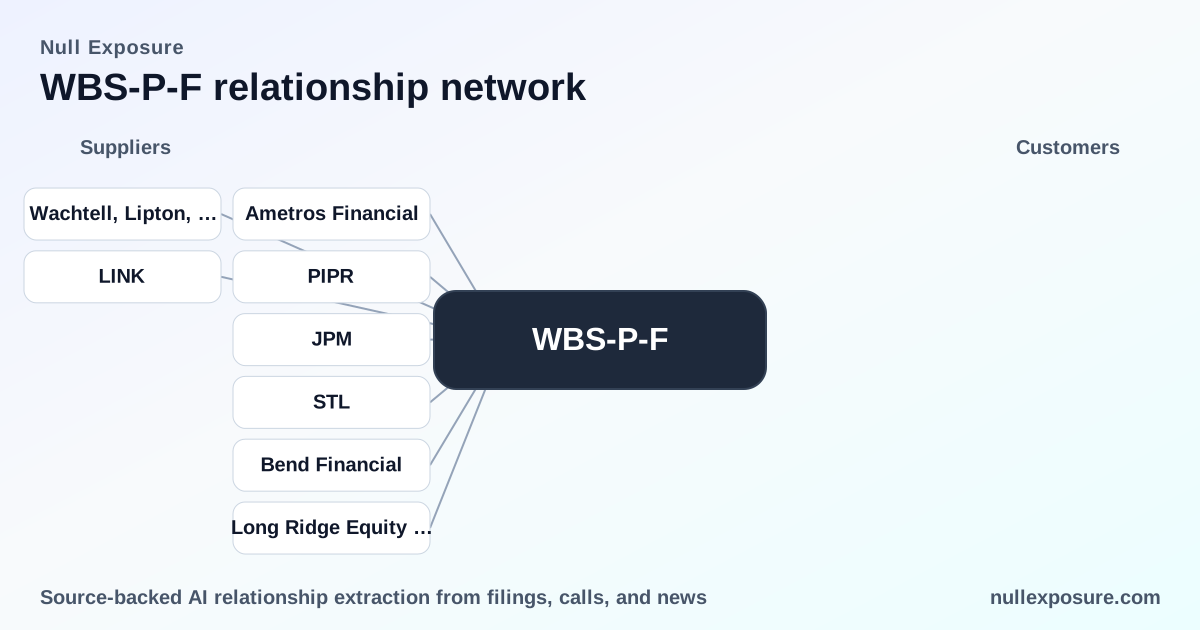
Webster Financial (WBS‑P‑F): What the Santander Deal Means for Counterparty Risk and Income Visibility
Webster Financial Corporation operates as a regional commercial bank focused on New England, monetizing through net interest income from lending and deposit spreads plus fee income from mortgage servicing, wealth management, and payment services. The Series F depositary shares give investors exposure to the bank’s preferred capital layer and reflect Webster’s role as a diversified regional lender whose balance sheet and client flows underpin the preferred security’s cash profile. For investors and operators evaluating customer relationships, the single most consequential development is Webster’s announced acquisition by Banco Santander — a change that redefines counterparty maps, contractual counterparty risk, and the long‑term strategic posture of the franchise.
If you want the collected counterparty view and integration tracking for this transaction, visit the NullExposure homepage for continuous updates: https://nullexposure.com/
A single, material relationship that rewrites the network
The relationship dataset for WBS‑P‑F contains one entry of material significance: Banco Santander. The entry reports an acquisition transaction, not a normal vendor or client tie, and that alters the practical risk calculus for any party exposed to Webster’s preferred shares or customer contracts.
- Banco Santander — Webster Financial was announced to be acquired by Banco Santander in a $12.2 billion transaction. This transaction converts Webster from an independent regional bank into a component of a global banking group, with immediate implications for governance, capital treatment, and counterparty relationships. According to an Investing.com report on May 4, 2026, the deal value was $12.2 billion and was presented as an acquisition. (Investing.com, May 4, 2026)
Key takeaway: Banco Santander’s acquisition is not a routine client win; it is an ownership transfer that compresses counterparty complexity for some counterparties while introducing cross‑border integration and regulatory overlay for others.
What the Santander acquisition means for customers and obligations
The acquisition removes Webster’s standalone strategic trajectory and places its client relationships into Santander’s operational ecosystem. That has four direct effects for investors and operators to track:
- Contracting posture shifts from regional bank to global unit. Contracts that Webster executed as a Connecticut‑headquartered regional bank will be transitioned under Santander’s governance and contracting platforms, altering counterparty contact points and escalation processes.
- Counterparty concentration changes. Where counterparties previously faced a single regional counterparty, they now face a global banking group with deeper capital and different risk appetites; concentration risk for major counterparties could decline while systemic complexity rises.
- Criticality of services potentially increases. Integration into Santander’s product stack raises the strategic value of certain Webster client relationships (for example, mortgage servicing or commercial lending platforms) to Santander’s broader U.S. strategy.
- Maturity and integration risk become primary operational concerns. The success of integration will determine continuity of service and the pace at which contractual terms and pricing across the book normalize to Santander standards.
Key takeaway: The acquisition enhances capital and distribution for Webster’s business lines while simultaneously elevating integration and regulatory execution as the primary operational risks for counterparties.
Relationship-by-relationship view (complete coverage)
- Banco Santander — The available record indicates Banco Santander is the acquirer of Webster Financial in a $12.2 billion deal announced in 2026; this converts Webster’s customer, counterparty, and capital relationships into Santander‑managed items and should be treated as a change of control event for counterparties and contract counterparties. (Investing.com, May 4, 2026)
Company‑level operating model signals and constraints
The relationship dataset does not list explicit third‑party contractual constraints. That absence is itself a signal: public relationship records are not capturing recurring third‑party constraint disclosures at the customer‑relationship level for this security. Translate that into practical operating model characteristics:
- Contracting posture: Webster historically functions with direct bilateral contracting typical of regional banks — commercial loan agreements, deposit arrangements, mortgage origination and servicing contracts, and wealth management client agreements. Post‑acquisition, contracting will shift toward centralized Santander templates and global legal standards.
- Concentration profile: Prior to acquisition, Webster’s revenue and counterparty exposure concentrated geographically across New England and in business lines such as commercial lending and mortgages. The Santander deal reduces the financial concentration risk for counterparties by embedding Webster into a larger capital base, but it introduces a new layer of counterparty concentration at the group level.
- Criticality: Webster’s services are critical to many local commercial and retail clients; the acquisition raises the strategic importance of maintaining service continuity during integration, particularly for payment flows, mortgage servicing, and commercial loan administration.
- Maturity and governance: As a regional franchise absorbed by a global bank, governance maturity will increase quickly; counterparties should expect accelerated standardization, stronger compliance controls, and the potential re‑pricing or re‑underwriting of legacy exposures as Santander applies group credit policies.
Key takeaway: The lack of additional constraint disclosures suggests limited public reporting on third‑party contracting complexity, but the acquisition itself signals an immediate move to more centralized, mature governance under Santander.
What investors and operators should watch next
- Integration milestones and change‑of‑control treatment. Track regulatory filings, transition service agreements, and contract novation notices that confirm how customer agreements will be migrated to Santander.
- Capital and dividend policy for preferred series. Monitor communications on preferred instrument treatment under the transaction; investors in depositary shares require clarity on redemption, conversion, or substitution mechanics.
- Service continuity notices from key business lines. Mortgage servicing transfers, payment systems continuity, and commercial loan servicing arrangements should be prioritized in due‑diligence checks.
- Regulatory approvals and timing. Cross‑jurisdictional approvals will dictate the timetable for full operational integration and any temporary hold‑backs on capital actions.
If you require a consolidated counterparty dossier or ongoing monitoring of integration milestones for WBS‑P‑F, NullExposure provides continuous tracking and breach alerts; see the homepage for service options and real‑time updates: https://nullexposure.com/
Conclusion: Reframe exposure as part of a global group
The Santander acquisition transforms the risk profile for anyone evaluating Webster Financial’s customer relationships. Ownership transfer to Banco Santander increases capitalization and access to global infrastructure while introducing integration and regulatory execution risk as the primary operational concerns. For investors in the Series F depositary shares and counterparties with active contracts, the prudent path is to treat the event as a change‑of‑control and prioritize contract review, operational continuity planning, and close monitoring of regulatory approvals and capital treatment.