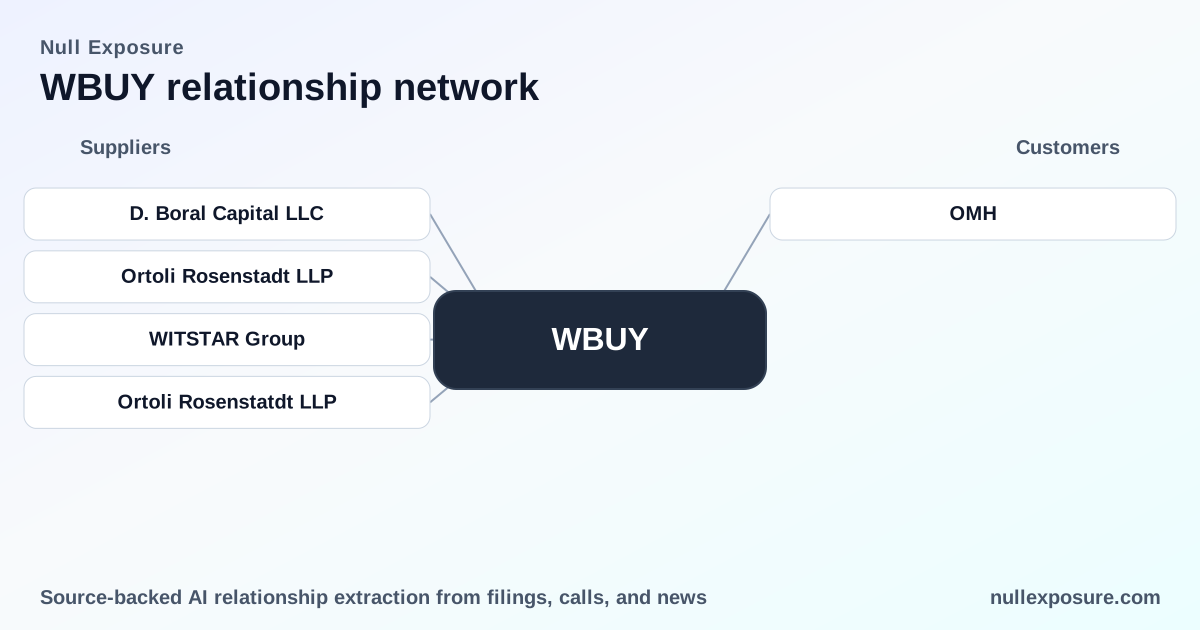
WBUY Customer Relationships: Ohmyhome Partnership and the Distribution Playbook
WeBuy Global Ltd. operates a social commerce platform that connects consumers with curated products and services and monetizes primarily through transactional revenue and partner-driven cross-selling. The company drives growth by integrating third-party services into its consumer funnel, capturing commission and service fees while leveraging community engagement to boost repeat purchase rates. For investors, the core question is whether these partnership-led distribution channels scale fast enough to offset persistent negative margins and concentrated ownership.
For a closer read on relationship-level signals and how they map to WeBuy’s commercial runway, see the firm’s relationship tracking on Null Exposure: nullexposure.com.
Quick financial and structural snapshot investors need to know
WeBuy is a small-cap e-commerce concern listed on NASDAQ (WBUY) with revenue TTM of $18.8 million and a market capitalization roughly $7.3 million, yet it remains unprofitable with EBITDA negative $4.96 million and EPS of -13.43. The stock shows elevated volatility (beta 2.62) and a wide trading range (52-week high $28.85, low $0.873). Insider ownership is modest at ~8.7% while institutional ownership is negligible at ~0.6%, signaling limited institutional support and thin professional liquidity.
These metrics establish the backdrop against which customer relationships—especially strategic cross-sell partnerships—must perform: small asset base, elevated execution risk, and a pressing path to margin improvement.
All customer relationships surfaced in our review
Below are the customer/partner mentions surfaced in public reporting and captured in Null Exposure’s relationship feed. Each entry is represented exactly as found in the results.
Ohmyhome — strategic cross-sell collaboration in Singapore
On Jan. 8, Ohmyhome and WeBuy Global announced a strategic collaboration to cross-sell their distinct services in Singapore, positioning WeBuy to access Ohmyhome’s local consumer base and complementary service set. This partnership was reported in a SahmCapital news piece originally dated Jan. 10, 2024 and recorded in our feed on Mar. 10, 2026.
Source: SahmCapital news item (Top 3 Risk-Off Stocks... Jan. 10, 2024), captured Mar. 10, 2026.
OMH — duplicate tracking entry (same partnership)
An additional entry labels the partner as “OMH” and reproduces the same cross-sell announcement between Ohmyhome and WeBuy Global; this is a duplicate mention in the monitoring feed reflecting identical content capture. The underlying commercial arrangement described is the same Jan. 8 cross-sell collaboration.
Source: SahmCapital news item (Top 3 Risk-Off Stocks... Jan. 10, 2024), captured Mar. 10, 2026.
For a consolidated view of relationships and to monitor future mentions and confirmations, visit Null Exposure: nullexposure.com.
What the Ohmyhome tie concretely signals about go-to-market execution
The Ohmyhome collaboration is a distribution-first move: rather than attempting to vertically integrate complementary services, WeBuy is acquiring reach through strategic commercial alignments. Cross-selling with a Singaporean home-services platform provides a localized channel for customer acquisition and a route to increase average order value for each consumer interaction.
- Commercial upside: cross-sell arrangements create low-capex growth pathways and can accelerate GMV (gross merchandise value) without heavy incremental marketing spend.
- Execution dependency: success depends on seamless product-to-service integration, joint customer journeys, and effective revenue-sharing mechanics—areas where execution slippage would quickly erode thin margins.
This partnership demonstrates the company’s current operating posture: strategic alliances over proprietary scale, which is consistent with the broader profile of a small, growth-focused internet retailer.
Company-level operating constraints and business-model signals
With no explicit constraints listed in the public relationship feed, the following are company-level signals derived from reported fundamentals and the nature of the disclosed partnerships:
-
Contracting posture: WeBuy’s publicized activity shows a collaborative contracting posture—the firm leans on alliances to expand reach rather than building expensive, proprietary distribution assets. Partnerships like the Ohmyhome cross-sell are examples of this outward-facing commercial model.
-
Concentration risk: Low institutional ownership and a market cap below $10 million create concentration risk in both capital and liquidity. Small share float and limited institutional backing amplify vulnerability to single-event volatility.
-
Criticality of relationships: For a platform that monetizes via transactions and cross-sells, partner relationships are critical to top-line growth; the Ohmyhome tie functions as a distribution lever rather than an experimental pilot, making success or failure material to near-term revenue momentum.
-
Maturity and margin profile: Negative EBITDA, a steep negative EPS, and subpar return metrics indicate an early-stage business still working toward a durable profit model. The current financials reflect a prioritization of growth and customer acquisition over near-term profitability.
These signals collectively imply that WeBuy’s commercial viability hinges on scaling partner-driven distribution while controlling operating leverage.
Investment implications and risk checklist
-
Upside path: If cross-sell partnerships convert at scale, WeBuy can grow revenue without proportionate capital intensity, improving gross leverage and providing a route to positive margins.
-
Downside risks: The company’s small market cap, volatile trading, and minimal institutional ownership present liquidity and governance risks that amplify operational misses. Execution failures in partner integrations will directly pressure an already negative EBITDA profile.
-
Catalysts to watch: expansion of the Ohmyhome relationship beyond Singapore, new announced partnerships, and any evidence of margin improvement in quarterly results should be treated as primary catalysts.
Bottom line: measured opportunity, execution-dependent outcome
WeBuy’s partnership with Ohmyhome is a clear tactical effort to expand distribution through partner ecosystems, aligning with a low-capex growth strategy. The commercial logic of cross-selling is sound; however, the stock’s small capitalization, poor profitability, and scant institutional support make the investment thesis highly execution-dependent. Investors should prioritize monitoring subsequent partnership rollouts, measured revenue conversion from existing alliances, and signs of operating leverage before assigning meaningful capital.
For ongoing tracking of customer relationships and real-time mentions, visit Null Exposure: [https://nullexposure.com/].