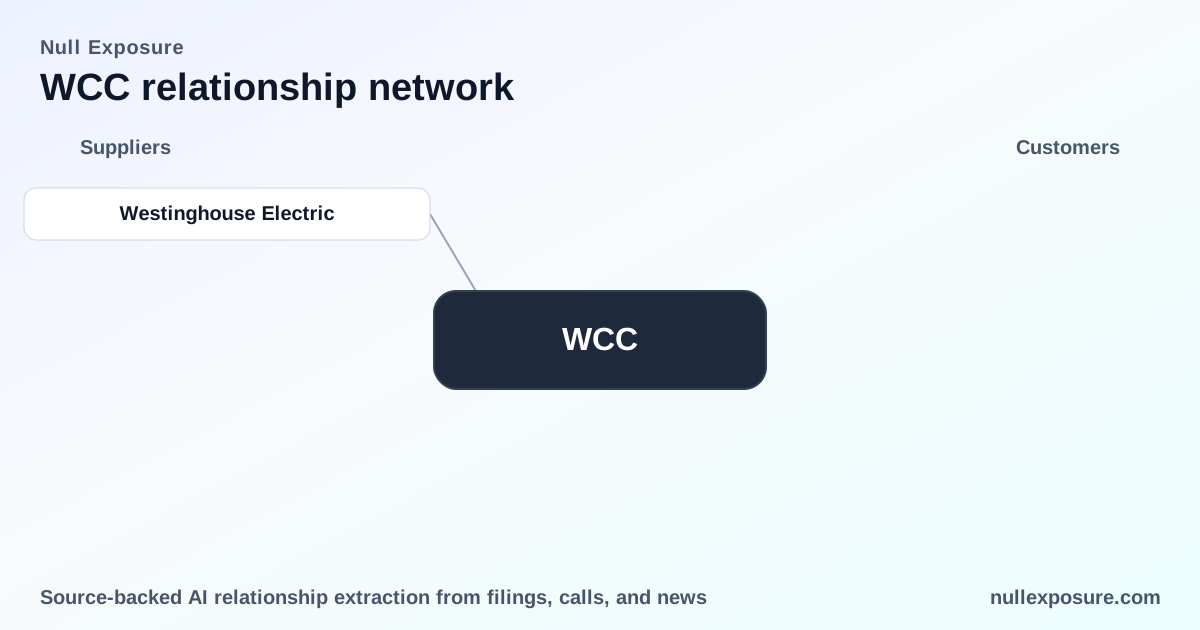
WESCO International (WCC): Customer relationships that shape distribution scale and credit profile
Thesis: WESCO International operates as a global business-to-business distributor and logistics services provider, monetizing through volume-driven product sales, supply-chain solutions, and installed services across industrial, utility, telecommunications and technology end markets. Its commercial model emphasizes short-term fulfillment, broad geographic reach, and diversified large-enterprise and public-sector customers—characteristics that underpin steady gross margins but limit long-duration revenue visibility. For a deeper look at customer-level exposure and implications for underwriting, visit https://nullexposure.com/.
How WESCO’s commercial engine works — the operating model in plain English
WESCO is a distributor and services operator that converts an extensive supplier network into timely deliveries and value-added services for commercial and institutional buyers. The company captures margins as a principal seller on the majority of transactions, runs logistic and fulfillment centers to compress delivery cycles, and layers services and systems integration through specialized segments.
Key company-level signals that determine customer risk and revenue dynamics:
- Short-term contracting posture. WESCO generally satisfies performance obligations within a year or less, which concentrates revenue on ongoing order flow rather than long-term contracted receipts. This reduces receivable duration but limits forward revenue visibility.
- Customer mix includes government and large enterprises. The UBS segment sells to investor-owned utilities and public power entities (including municipalities), while WIS historically served large industrial and commercial end-users—indicating exposure to both public-sector procurement cycles and sizeable enterprise buyers.
- Global footprint with regional depth. WESCO operates across North America, EMEA, LATAM and APAC via hundreds of locations; this geographic breadth spreads demand risk but introduces operational complexity.
- Moderate customer concentration. Top ten customers represented roughly 12% of sales in 2024, with no single customer exceeding 4%—a profile that signals diversified account risk but meaningful aggregate exposure to a small set of large buyers.
- Multiple commercial roles. WESCO functions as a seller, distributor, manufacturer partner and service provider, depending on the business line, which affects margin mix and contractual terms.
- Business lines centered on distribution and services. These segments reflect a mature, transactional revenue base with incremental upside from systems and integration sales.
These characteristics create a business that scales with industrial activity and capex cycles, while leaving collections and short-term credit trends as the primary near-term risks for lenders and suppliers.
Customer relationships disclosed: what the signals say
Below are the customer-relationship items surfaced for WESCO in the provided results. Each entry includes a concise, plain-English summary and an attribution to the original reporting.
Rexel Canada — buyer of WESCO’s legacy Canadian utility business (FY2026)
WESCO sold its legacy Canadian utility business to Rexel Canada, a subsidiary of France’s Rexel Group, in a transaction disclosed in early May 2026; the move represents a strategic divestiture of a heritage utility-focused operation in Canada. According to MDM’s coverage of the deal (May 4, 2026), the sale transfers that customer-facing utility footprint to Rexel Canada and simplifies WESCO’s regional portfolio.
Source: MDM news report on the Rexel Canada transaction, published May 4, 2026.
LILA (Liberty Latin America / Liberty Caribbean Foundation) — partner/contributor referenced in humanitarian aid (FY2025)
WESCO (referenced as “Wesco-Anixter”) is listed among organizations credited for delivering humanitarian assistance following Hurricane Melissa, indicating role as an operational relief contributor and partner to regional telecom and infrastructure efforts in LATAM/Caribbean contexts. The mention underscores WESCO’s channel presence and partner engagements in regionally critical infrastructure work. The recognition appeared in a Liberty Latin America / Liberty Caribbean Foundation release covering hurricane relief activities in late 2025.
Source: Liberty Latin America / Liberty Caribbean Foundation report cited via FinancialContent (October 31, 2025).
What these relationships imply for investors and operators
The Rexel Canada divestiture is strategically meaningful: selling a legacy utility business reduces WESCO’s utility-specific operating complexity in Canada and refocuses capital and management on core distribution and services segments. For investors, divestitures that reduce low-growth, asset-intensive lines can improve returns on invested capital and clarify the revenue base.
The humanitarian contribution reference with Liberty Latin America signals that WESCO’s brand and logistics capabilities are actively used in regional infrastructure and emergency-response contexts, which supports the company’s claim to be a partner for critical infrastructure customers in LATAM/Caribbean markets. That operational presence underpins the company’s service-value proposition to large enterprise and public-sector buyers.
Combine these relationship items with the company-level constraints and the picture is straightforward: WESCO runs a high-volume, geographically diversified distribution platform that sells predominantly under short-term terms to a mix of public and large enterprise customers. That profile is attractive for steady cash generation but requires active working-capital management and regional operational discipline.
Risk and opportunity checklist for credit and equity holders
- Working capital sensitivity: Short-term contracts and principal sales status concentrate exposure in inventory turns and receivables; monitor days sales outstanding and inventory turns for signs of pressure.
- Concentration dynamics: Top-ten customers drove ~12% of sales in 2024—diversified by single-account limits but still susceptible to multi-customer sector downturns.
- Geographic execution risk: A global footprint (NA, EMEA, LATAM, APAC) reduces single-country exposure but increases execution and supply-chain complexity; the Rexel Canada sale reduces one locus of utility exposure in Canada.
- Service and systems upside: The CSS and EES segments provide higher-margin services and integration opportunities; continued growth there will increase revenue stickiness compared with commoditized product sales.
- Public-sector contracting: Sales to municipalities and utilities create predictability around some account streams but introduce procurement-timing risk tied to budget cycles.
Bottom line and next steps
WESCO’s customer signals portray a mature distributor with broad, short-cycle revenue, moderate account concentration, and operational leverage across global regions. The sale to Rexel Canada simplifies the Canadian utility footprint, while public acknowledgements in humanitarian response work highlight WESCO’s role as a partner for infrastructure and network operators in LATAM/Caribbean markets.
For subscribers evaluating counterparty risk or looking to benchmark WESCO’s customer exposure, a targeted review of working-capital metrics and segment-level margin trends is recommended. Learn more about customer-level exposures and how they affect credit and valuation at https://nullexposure.com/.