Western Digital’s Hyperscaler Customers: How the Titan Relationships Drive Revenue and Risk
Western Digital designs, manufactures and sells magnetic storage devices and data-center systems, monetizing through high-volume sales to cloud and hyperscale operators, OEMs and channel partners. The company’s commercial model is driven by large, recurring volume contracts for enterprise helium drives and a global reseller/distributor network that amplifies reach — high unit economics for scale customers and transactional pricing programs for channels. For deeper intelligence on counterparty exposure and contract posture, visit https://nullexposure.com/.
The short investment thesis
Western Digital’s revenue profile is anchored by a small set of very large customers in the cloud/hyperscale segment and a broad, global channel footprint; margin expansion depends on scale sales to hyperscalers and disciplined price/protection terms with resellers, while downside is concentrated in hyperscaler demand cycles and global distribution volatility.
Who the research flagged as customers (as reported)
Below are each of the relationships captured in the sourced market write-up; every result from the dataset is covered with a short, plain-English summary and the article citation.
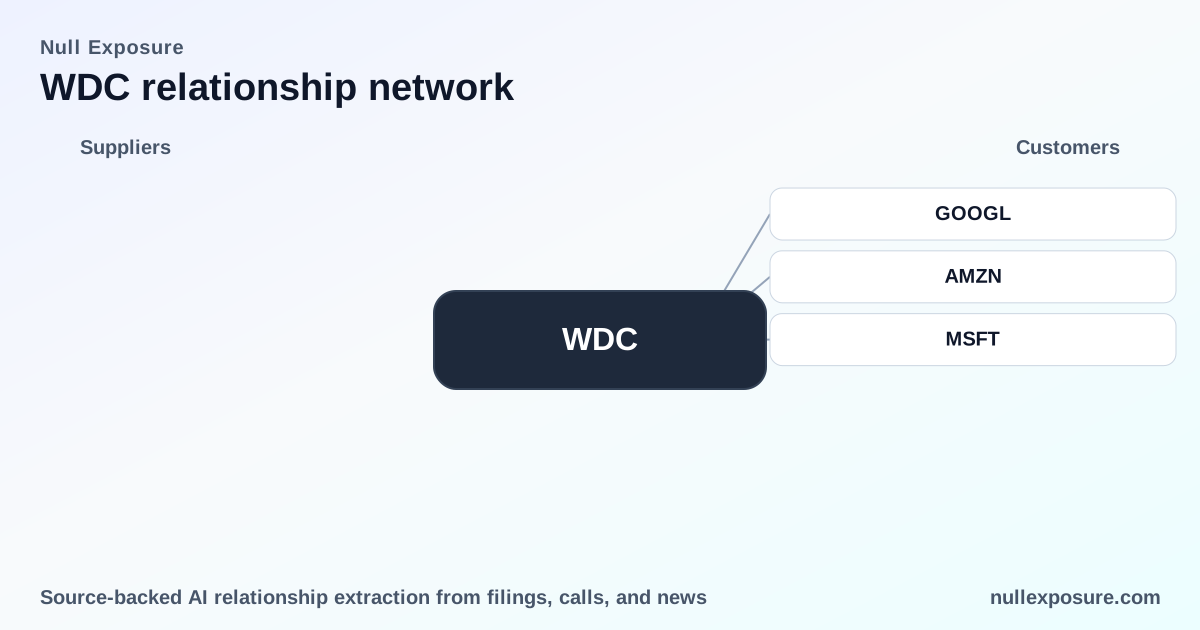
- GOOGL — The Markets.FinancialContent piece (Finterra, March 9, 2026) names Alphabet’s Google as one of Western Digital’s “Titan” cloud customers that purchases massive quantities of high-capacity Enterprise Helium drives for data centers. (Markets.FinancialContent / Finterra, March 9–10, 2026)
- Alphabet — The same March 2026 analysis reiterates Alphabet as a hyperscale buyer of Western Digital’s enterprise helium drives, emphasizing the cloud segment as WDC’s largest, fastest-growing revenue stream. (Markets.FinancialContent / Finterra, March 9–10, 2026)
- Amazon — The article lists Amazon as a principal hyperscaler customer procuring large volumes of enterprise-grade helium drives for its AWS data centers. (Markets.FinancialContent / Finterra, March 9–10, 2026)
- AMZN — The duplicate entry for AMZN in the March 2026 Markets.FinancialContent report reinforces Amazon’s role as a top cloud buyer of high-capacity drives. (Markets.FinancialContent / Finterra, March 9–10, 2026)
- Microsoft — Microsoft is identified among the “Titan” cloud customers purchasing large quantities of enterprise helium drives for its global data-center fleets. (Markets.FinancialContent / Finterra, March 9–10, 2026)
- MSFT — The MSFT entry repeats Microsoft’s classification as a hyperscaler buyer in the March 2026 analysis, underscoring the same point about volume-driven enterprise sales. (Markets.FinancialContent / Finterra, March 9–10, 2026)
- GOOGL (alternate entry) — A second GOOGL-tagged result from the same March 2026 article again lists Alphabet among the hyperscalers that constitute Western Digital’s largest cloud segment customers. (Markets.FinancialContent / Finterra, March 9–10, 2026)
What the customer mix implies about WDC’s operating model
The relationship map and company disclosures collectively describe a hybrid commercial posture: large, direct volume contracts with hyperscalers and transactional, programmatic arrangements through resellers and distributors.
- Contracting posture: Western Digital runs a dual model — long-volume purchasing relationships with hyperscalers for enterprise helium drives while maintaining price-protected inventory and sales incentive programs for resellers and OEMs. According to company filings across 2023–2025, WDC provides limited price protection and sales incentives to resellers and OEMs as part of its channel arrangements.
- Concentration: The firm’s largest and fastest-growing revenue bucket is Cloud and Hyperscale, driven by a handful of “Titan” clients. That concentration creates asymmetric upside during capacity cycles and symmetric downside if hyperscaler demand decelerates.
- Criticality: For hyperscalers, high-density helium drives are a critical input to capacity expansion; therefore, strategic supplier status for WDC with these customers is high, supporting pricing leverage when demand outstrips supply.
- Maturity and global reach: Western Digital sells worldwide and reports that international sales represented 55%–58% of net revenue across recent fiscal years (2023–2025), signaling mature, geographically diversified revenue streams but also exposure to cross-border logistics and trade dynamics.
How channel roles change the economics
Company disclosures describe sales to cloud service providers, OEMs, resellers, distributors and retailers worldwide — this matters because the margin and revenue recognition profile differs materially across counterparty types.
- Resellers and distributors receive price protection and incentive programs, which compress gross margin on channel inventory during price declines but expand volume and market coverage.
- Direct hyperscaler contracts drive high-volume, high-margin outcomes when utilization remains strong and capacity needs scale predictably.
(For tactical counterparty exposure analysis, see https://nullexposure.com/.)
Investment implications — risks and levers
- Upside drivers: Continued hyperscaler capacity growth and supply discipline support revenue and margin expansion; WDC’s product focus on magnetic storage and helium drives positions it to capture large-scale purchases from Amazon, Microsoft and Alphabet.
- Primary risks: Customer concentration and cyclical hyperscaler capex create high demand sensitivity; channel price-protection programs introduce margin volatility in market downturns.
- Operational risks: Global sales mix (majority non-U.S.) raises exposure to logistics, tariffs and geopolitical shifts that could affect delivery timelines or cost structure.
- Balance: The commercial model mixes sticky, strategic large-customer relationships with a broad, incentivized channel — this reduces single-channel failure risk but amplifies margin cyclicality.
Final takeaway for investors
Western Digital’s customer map is dominated by hyperscalers that buy enterprise helium drives at scale, complemented by a global reseller/distribution network that expands reach but introduces price-protection and incentive-driven margin pressure. Investors should treat hyperscaler demand cycles and channel inventory protections as the principal drivers of WDC’s revenue and margin volatility; monitoring contract renewal cadence and hyperscaler capex plans is essential for forward guidance. For an in-depth view of counterparty relationships and commercial posture, visit https://nullexposure.com/.
Bold claims and key signals in this note are drawn from Western Digital’s public filings (FY2023–FY2025 disclosure language on global sales and reseller programs) and a March 2026 market analysis listing Amazon, Microsoft and Alphabet as Western Digital’s hyperscaler customers (Markets.FinancialContent / Finterra, March 9–10, 2026).