Western Digital (WDCVV) — Hyperscaler Contracts Define the Commercial Edge
Western Digital builds and sells data storage hardware and systems — principally hard disk drives (HDDs) and enterprise storage solutions — and monetizes through high-volume product sales and long-term supply contracts with cloud operators and enterprise customers. The company’s commercial model is driven by scale, production leverage, and contract-backed pricing with hyperscale cloud customers, which creates outsized revenue durability when capacity demand is rising and pricing power when supply tightens. For investors and operators evaluating WDCVV customer risk and opportunity, the essential investment thesis is simple: Western Digital’s cash flows and margin profile are increasingly tied to a small set of very large cloud customers that buy in multi-year, high-volume commitments.
If you need a concise supplier-risk or customer-concentration briefing for investment committees or vendor-management teams, see more at https://nullexposure.com/ for structured intelligence and follow-ups.
Why customer relationships matter for capital allocation
Western Digital’s product economics are commodity-like at the component level but highly differentiated at contract scale. Large bulk HDD orders are lower margin per unit than premium SSDs, yet the volumes and long-term nature of hyperscaler commitments convert manufacturing capacity into predictable revenue. That contracting posture gives Western Digital the ability to plan capex, smooth utilization, and extract better pricing when demand outstrips industry supply.
- Concentration: The commercial model concentrates revenue risk among a few hyperscale cloud buyers. That concentration converts single-buyer dynamics into macro-sensitive earnings volatility.
- Contracting posture: Long-term, high-volume contracts favor suppliers who can guarantee supply and manage inventory cycles; Western Digital’s position in the supply chain supports this posture.
- Criticality: For hyperscale customers, cost per terabyte for bulk storage directly affects operating economics; HDD supply is therefore strategically important to buyers.
- Maturity: These relationships are operationally mature — they are governed by volume commitments, supply schedules, and price renegotiation mechanisms rather than spot-market transactions.
Hyperscaler relationships that define revenue exposure
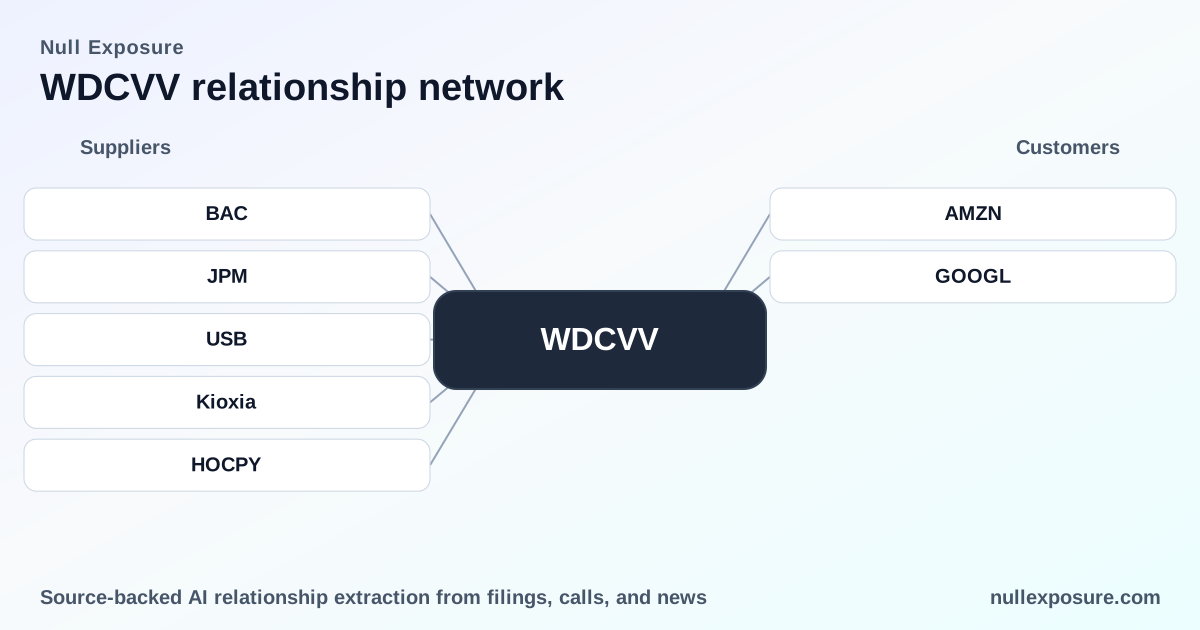
The evidence in recent coverage repeatedly highlights Western Digital’s dependence on the cloud giants. Below I cover every relationship flagged in the available results.
Amazon (AMZN)
Western Digital supplies large-volume bulk storage to Amazon Web Services under long-term commercial arrangements that support AWS’s expanding data lakes; industry coverage frames Amazon as one of the hyperscaler buyers whose demand underpins WD’s scale economics. According to a Finterra research report published on FinancialContent (April 2026), Western Digital maintains “long-term, high-volume contracts with ‘hyperscalers’—the cloud giants like Amazon” (https://markets.financialcontent.com/stocks/article/finterra-2026-4-9-the-ai-storage-supercycle-a-deep-dive-research-report-on-western-digital-wdc). MarketMinute also discussed the pricing leverage Western Digital has over the hyperscalers in January 2026, noting hyperscalers are effectively paying premiums to secure HDD capacity (https://markets.financialcontent.com/stocks/article/marketminute-2026-1-12-the-great-storage-pivot-how-western-digital-outpaced-the-field-in-the-ai-data-supercycle).
Google (GOOG / GOOGL)
Google Cloud is cited alongside Amazon as a strategic buyer of Western Digital’s bulk storage products, participating in the same long-term, high-volume contracting dynamics that drive WD’s manufacturing utilization and pricing power. Finterra’s April 2026 note explicitly lists Google among the hyperscalers engaged in those contracts (https://markets.financialcontent.com/stocks/article/finterra-2026-4-9-the-ai-storage-supercycle-a-deep-dive-research-report-on-western-digital-wdc), and the January MarketMinute coverage reiterates Google’s standing as a hyperscaler that faces elevated costs to expand data lakes when HDD supply and pricing favor Western Digital (https://markets.financialcontent.com/stocks/article/marketminute-2026-1-12-the-great-storage-pivot-how-western-digital-outpaced-the-field-in-the-ai-data-supercycle).
Microsoft (MSFT)
Microsoft, as another hyperscaler buyer, participates in the same commercial pattern: large, multi-year purchases of storage capacity that anchor Western Digital’s production schedules and revenue outlook. Finterra’s April 2026 report names Microsoft alongside Amazon and Google as hyperscalers with long-term, high-volume contracts (https://markets.financialcontent.com/stocks/article/finterra-2026-4-9-the-ai-storage-supercycle-a-deep-dive-research-report-on-western-digital-wdc).
What to watch: risks and strategic levers
Western Digital’s commercial strength is also its principal risk factor. Concentration to a small set of hyperscalers amplifies both upside during a storage supercycle and downside if cloud capex or architectural choices shift. Key operational and market signals investors and vendor managers should monitor:
- Supply/demand balance for HDDs and large-format storage components — tight supply increases WD’s pricing power; oversupply compresses margins.
- Hyperscaler capex cycles and architectural shifts toward higher SSD penetration or alternative storage architectures.
- Contract renewal cadence and pricing mechanisms in multi-year supply agreements.
- Geopolitical or manufacturing disruptions that affect production capacity or logistics.
A short, practical checklist:
- Track public disclosures and third-party research on hyperscaler capex pacing.
- Monitor industry pricing indices for HDDs per terabyte as a leading margin signal.
- Evaluate contractual provisions in customer agreements where available (lead times, penalty clauses, volume floors).
Investor takeaway: Western Digital’s model generates durable cash if hyperscaler demand remains elevated, but the firm's fortunes are tightly coupled to a handful of cloud incumbents and to macro capex cycles.
If you want a tailored quick-brief or a vendor concentration scorecard for your investment memos, visit https://nullexposure.com/ for structured reports and customer-relationship monitoring.
Constraints and company-level signals
No formal constraint excerpts were provided in the source material, but the relationship coverage implies several company-level signals that are meaningful for underwriting and operations:
- High commercial concentration: Revenue is materially affected by a small number of very large customers.
- Long-term contracting posture: Contracts are structured around volume commitments and supply guarantees rather than spot sales.
- High criticality for buyers: HDD economics remain material to hyperscaler storage cost structures, preserving WD’s negotiating leverage when supply is tight.
- Mature supplier-buyer relationships: Contracts and operations are established and recurring, reducing short-term counterparty credit noise but increasing dependency risk.
Bottom line
Western Digital’s commercial value proposition is scale and contract-backed manufacturing advantage. For investors and operators, the critical question is whether hyperscaler demand and HDD supply dynamics will sustain Western Digital’s pricing power through the next capex cycle. Concentration drives both upside and systemic risk — monitor hyperscaler capex behavior and HDD pricing closely.
For deeper customer-mapping and scenario analysis of WDCVV counterparty exposure, Null Exposure provides bespoke summaries and monitoring: https://nullexposure.com/.