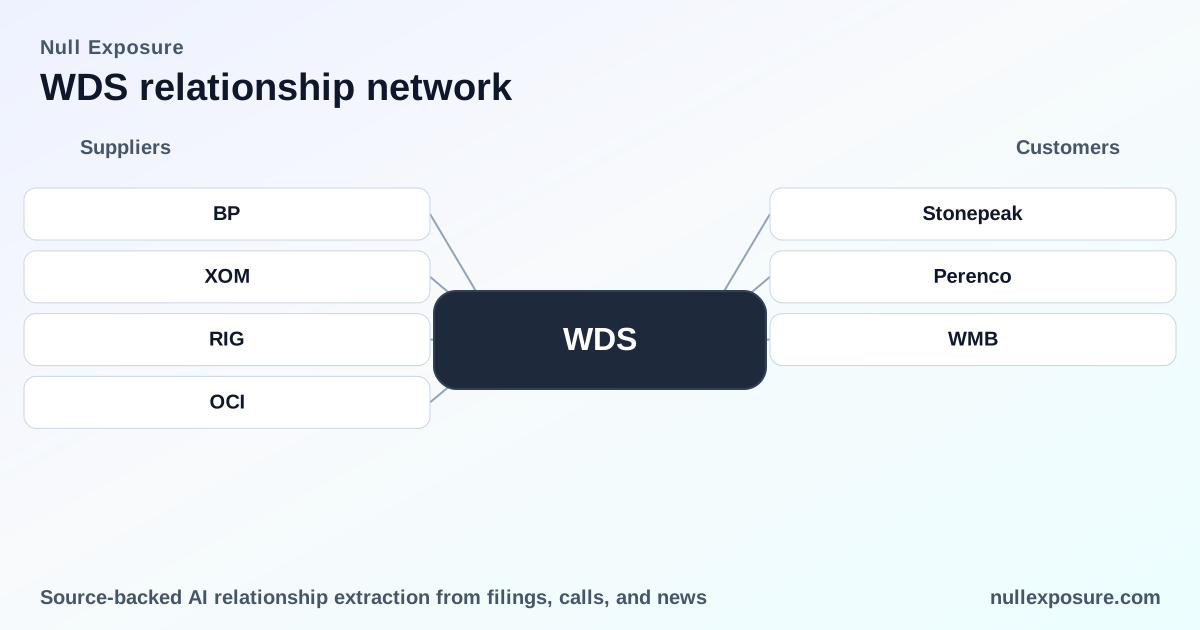
Woodside’s customer and partner map: who’s buying stakes, who’s buying product, and what it means for investors
Woodside Energy monetizes through three clear levers: developing upstream hydrocarbons and LNG projects, selling equity stakes or assets to partners to fund capital and de‑risk projects, and locking in long‑term sales contracts for finished product. Recent activity shows Woodside converting project value into upfront proceeds and long‑dated revenue certainty—while shifting portions of operating and capital exposure to financial sponsors and infrastructure partners.
For a focused investor read on counterparty exposure and strategic opt‑outs, see more at https://nullexposure.com/.
Strategic headline: cash now, exposure later
Woodside’s 2025–2026 activity trades future production and operator roles for immediate capital and contracted demand. Sell‑downs to Stonepeak and Williams injected cash and reduced Woodside’s capex burden, while offtake deals like the one with Uniper lock a meaningful portion of Louisiana LNG output into long‑term revenue. At the same time, asset sales to Perenco and a Scarborough minority sale reposition the portfolio toward larger, more capital‑efficient projects.
Relationship roll call — who’s on the other side of Woodside’s deals
Below are every counterpart referenced in the recent disclosures and news coverage, summarized in plain English with source context.
-
Stonepeak / Stonepeak Partners LP
Woodside sold a 40% stake in its Louisiana LNG infrastructure to Stonepeak for about $1.9 billion and has Stonepeak funding the majority of near‑term project capex (75% of 2025–26 project spend). This is both a liquidity and risk‑transfer transaction. According to SimplyWallSt coverage (May–June 2026) and Woodside’s Q4 2025 earnings call (March 2026), Stonepeak took the meaningful minority stake and is a principal capital backer for the project. -
Williams Companies Inc (Williams, WMB)
Woodside sold a 10% interest in Louisiana LNG HoldCo and transferred an 80% interest and operatorship of Driftwood Pipeline LLC to Williams for an effective purchase price aligned with the 1 January 2025 effective date; the deal also carries modest immediate proceeds. Rigzone reported Woodside’s October 2025 statement summarizing the strategic partnership, and Woodside reiterated the structure in its Q4 2025 earnings call. -
Uniper
Woodside signed a long‑term sales agreement with Germany’s Uniper for up to 2 million metric tons per year—about 25% of Louisiana LNG’s planned production—providing a stable demand foundation for the project starting in 2030. This offtake arrangement was reported in market press coverage in 2026 and affirms contracted future cash flow for a material tranche of output. -
PERENCO S.A. (Perenco)
Woodside completed the sale of producing assets in Greater Angostura, Trinidad and Tobago, to Perenco for approximately AUD 210 million, which reduced Woodside’s 1P and 2P developed reserves and lowered near‑term production. Rigzone and other coverage in early 2026 reference the asset removal from Woodside’s portfolio and the completed transaction timeline (finalized Q3 2025). -
LJ Scarborough Pty Ltd
Woodside agreed to sell a 10% stake in the Scarborough Gas Project to LJ Scarborough for roughly $880 million, crystallizing value from the Scarborough development while retaining the majority interest. SimplyWallSt reported the transaction terms and timing in 2026. -
Denison Mines Corp. (DNN)
Through its Wood Canada unit, Woodside was selected as construction manager for Denison’s Phoenix uranium mine via a competitive tender, marking a non‑traditional service contract that monetizes Woodside’s engineering and construction capability in Canada. CruxInvestor covered the award in FY2026. -
Saudi Aramco
Market commentary referenced potential future LNG agreements with Saudi Aramco as supportive to Woodside’s earnings quality, signaling geopolitical and customer diversification optionality in LNG contracting. This view was noted in SimplyWallSt coverage of Woodside’s FY2026 outlook. -
NEXT (NextDecade Corporation)
Engineering firm Wood (not Woodside) secured a multi‑year assignment with NextDecade for an LNG export project in Texas, a development referenced in industry reporting; investors should treat this as sector context rather than a direct Woodside customer relationship. Offshore‑Energy reported the engineering award in early 2026.
How these commercial moves change Woodside’s operating posture
Woodside’s commercial pattern over 2025–2026 is capital recycling and risk reallocation. The company is monetizing large projects through minority sell‑downs and asset disposals, and replacing some greenfield volume risk with contracted offtake.
-
Contracting posture: Woodside is willing to cede minority equity and operatorship to strategic partners to reduce capital intensity and near‑term balance‑sheet strain. The Williams operatorship of the Driftwood pipeline and Stonepeak’s large equity stake in Louisiana LNG are the clearest examples.
-
Concentration and counterparty mix: Partners include private infrastructure capital (Stonepeak), a U.S. midstream specialist (Williams), European utility offtakers (Uniper), and regional buyers (Perenco, LJ Scarborough). This mix reduces single‑point of failure but increases exposure to sponsor and midstream execution risk.
-
Criticality of relationships: Long‑dated offtake agreements and pipeline operatorship directly affect the economics and timing of project cash flows; counterparty performance and project delivery are therefore materially critical to Woodside’s earnings trajectory.
-
Maturity and de‑risking: Sell‑downs of developed assets and minority stakes are consistent with a de‑risking program—Woodside crystallizes value today at the expense of future ounce‑for‑ounce production retention. That tradeoff improves near‑term free cash flow and lowers capex needs.
Investor implications — what to watch next
-
Upfront proceeds vs. long‑run volume: Asset sales and sell‑downs improve liquidity and lower capex, but they also reduce future production and lift the company’s dependency on partner execution and long‑term offtake pricing. Monitor realized proceeds and the residual net‑asset exposure Woodside retains in each project.
-
Execution and counterparty credit: Projects like Louisiana LNG now depend on Stonepeak and Williams for funding and operations; watch partner credit metrics, project schedule adherence, and any contingent cash calls.
-
Revenue quality: Long‑term offtake (Uniper) materially improves revenue visibility, but global LNG price cycles still determine upside. Contract terms and pricing mechanisms in those offtake agreements will be decisive.
Key takeaways for investors:
- Woodside is deliberately monetizing pipeline and LNG buildouts to reduce capex and secure demand.
- Strategic partners (Stonepeak, Williams, Uniper) supply capital, operational capacity, and contracted demand—shifting execution risk off Woodside’s balance sheet.
- Asset sales to regional buyers reduce near‑term production but generate immediate cash and simplify the portfolio.
For a deeper counterparty risk map and ongoing monitoring of Woodside’s partner exposures, visit our platform at https://nullexposure.com/.
Closing verdict
Woodside’s recent customer and partner activity is a coherent strategy to convert project risk into liquidity and contracted revenues, but it also substitutes counterparty and execution risk for outright operator exposure. Investors should value the improved near‑term cash profile while actively monitoring partner delivery, contractual price mechanisms, and the company’s retained economic interest in sold‑down projects.
Sources cited in coverage above include Woodside’s Q4 2025 earnings call (March 2026), Rigzone reporting (Feb–Apr 2026), SimplyWallSt summaries (May–June 2026), CruxInvestor (FY2026), Offshore‑Energy (2026), and sector press aggregators reporting on Uniper and partner arrangements in 2026.