Weave Communications (WEAV): Customer Relationships That Drive Payments and Recurrent Revenue
Weave operates an integrated customer communication and payment platform targeted at small and mid-market healthcare businesses in North America, monetizing primarily through recurring subscription fees, recurring hardware fees, and transaction-based payment processing revenue. The company’s go-to-market combines direct subscriptions with partner-driven endorsements and payment integrations that expand addressable reach and accelerate adoption. Learn more about our coverage at https://nullexposure.com/.
Why customers matter more than headlines
Weave’s economics hinge on scale in recurring revenue and depth of payment flows inside its installed base. The firm reports $248.7M in trailing revenue and $179.9M gross profit, yet remains unprofitable on the bottom line (negative EBITDA and diluted EPS of -$0.32). For investors, the relevant customer signals are therefore not single large wins but the quality of partner relationships that expand sales channels, deepen payments usage, and shorten customer payback periods.
How Weave contracts, who it sells to, and what that implies
Weave’s customer architecture is driven by a subscription-first model: a majority of customers pay monthly, with a meaningful portion on annual terms; most subscription contracts are month-to-month, while a minority run 1–3 years. The company targets SMB and mid-market healthcare providers across the United States and Canada, with roughly 35,000 locations under subscription as of December 31, 2024. Revenue is generated exclusively in North America, and no single customer accounts for more than 5% of revenue, which supports revenue diversification.
Operationally, that produces four investment-relevant characteristics:
- Contracting posture: Predominantly short-tenor, subscription-based arrangements that reduce lock-in but enable rapid churn-and-convert dynamics.
- Concentration: Customer-level concentration is low — immaterial single-customer exposure — but revenue stability depends on a high aggregated renewal rate across many SMB contracts.
- Criticality: Payments (Weave Payments) and integrated workflows are core features, increasing customer stickiness when payment processing is adopted.
- Maturity: The product stack spans software, hardware, and services (phone hardware and support), indicating a hybrid revenue base where hardware is a small recurring or one-time add-on and services support adoption.
These are company-level signals derived from Weave’s disclosures and investor communications rather than single-relationship attributes.
Customer and partner relationships that matter (each relationship in the record)
-
ACI — Weave has an ongoing commercial rollout with ACI where ACI selected Weave for its payment workflows and integrated solutions, contributing to strong growth in that vertical partnership. This was disclosed in Weave’s Q3 2025 earnings call transcript and reported by The Globe and Mail (May 2026).
Source: The Globe and Mail coverage of Weave’s Q3 2025 earnings commentary (reported May 4, 2026). -
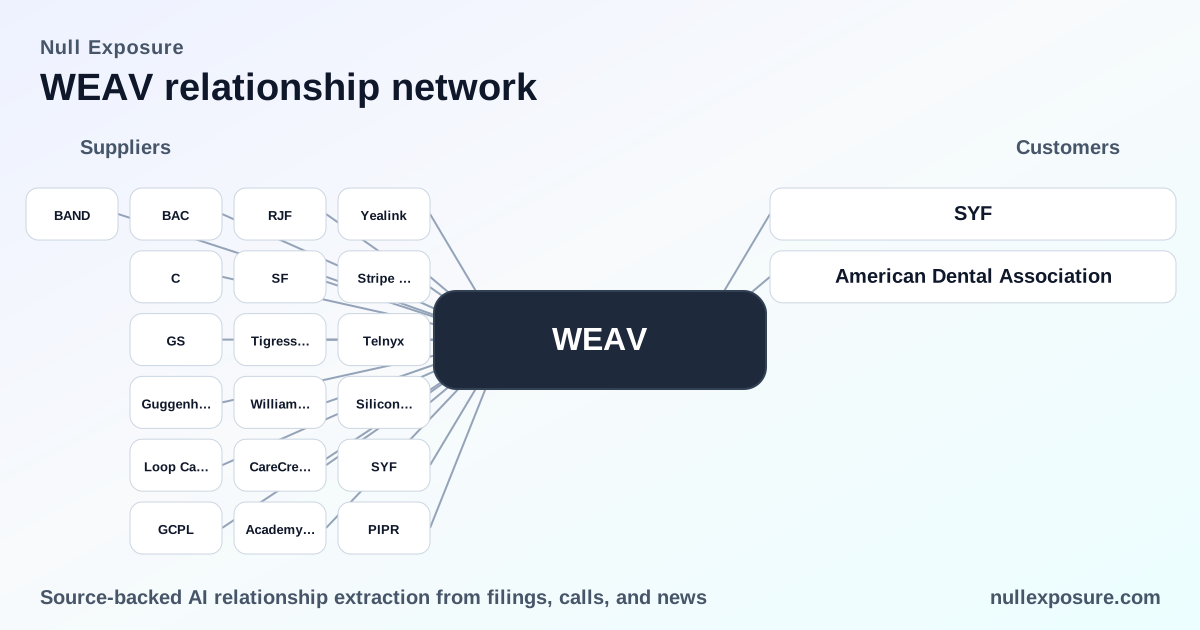
American Dental Association (ADA) — The ADA selected Weave as its exclusive patient engagement platform, providing co-marketing access to the ADA’s roughly 160,000 members and bolstering Weave’s position in dental verticals. Multiple press summaries and earnings-related write-ups referenced the endorsement and its member reach.
Source: MarketBeat earnings coverage (Feb 19, 2026) and corroborating news summaries reported in March–May 2026 (InsiderMonkey; Intellectia.ai). -
CareCredit / SYF (Synchrony Financial) — Weave announced a partnership with CareCredit, the patient financing product used across health and wellness locations, formalized in the company’s Q4 2025 earnings call; Synchrony Financial (SYF) is the corporate sponsor behind CareCredit. The alliance expands Weave’s payments and financing stack inside customer clinics.
Source: Weave’s Q4 2025 earnings call transcript (March 7, 2026).
Each relationship is consequential in a different way: ACI strengthens integrated payment workflows, the ADA endorsement opens a high-value channel into dental practices, and CareCredit integrates point-of-sale patient financing.
What these relationships mean for growth and risk
-
Distribution acceleration through endorsements: The ADA relationship is a channel play — co-marketing access to 160,000 members materially improves lead velocity and lowers customer acquisition cost for dental verticals, accelerating subscription growth if conversion executes as advertised. Source: MarketBeat (Feb 2026) and supporting press coverage.
-
Payments as a revenue multiplier: Partnerships that emphasize payment workflows (ACI) and patient financing (CareCredit/Synchrony) increase per-customer revenue potential through transaction fees and financing origination flows, moving Weave’s monetization beyond flat subscription dollars. This is central to improving lifetime value. Source: Earnings commentary (Q3 and Q4 2025 transcripts).
-
Low single-customer concentration but high portfolio dependency: No single customer contributes more than 5% of revenue, reducing counterparty risk; however, the business depends on broad SMB renewal behavior and cross-selling of payments and hardware to sustain margin improvement. Source: company disclosures (FY2024 metrics).
-
Contract tenors and churn exposure: Month-to-month subscription prevalence tightens the link between product engagement (payments, support, integrated workflows) and churn. Retention will therefore be the primary operational lever to convert partner-driven demand into durable revenue. Source: company subscription disclosures.
Operational risks investors should monitor
- Execution against co-marketing and channel activation with the ADA will determine whether endorsements translate into net-new paid locations rather than free trials or awareness only.
- Payments adoption rates inside new accounts determine the depth of revenue capture; partnerships with payment processors and financing firms are necessary but not sufficient to guarantee high take rates.
- MACRO & SMB sensitivity: Given concentration in small businesses and mid-market healthcare, an economic downturn that pressures healthcare elective spend or small-practice investment could compress renewal and new-sales trajectories.
Bottom line — where this positions Weave for investors
Weave’s customer relationships are strategically chosen to bolster payment monetization and channel reach: endorsements and integrations directly target higher lifetime value per customer while preserving a diversified customer base. However, the subscription contracting posture (predominantly month-to-month), existing negative profitability, and reliance on execution to convert channel access into paid subscriptions are the primary variables that will drive stock performance over the next 12–24 months. For deeper signal coverage and ongoing relationship tracking, visit https://nullexposure.com/.
Bold wins are visible in the partnerships, and the path to durable profitability runs through consistent payments adoption, channel conversion, and improved operating leverage. Investors should watch conversion metrics from ADA referrals, payments take-rates from ACI integrations, and financing traction via CareCredit as the leading operational KPIs.