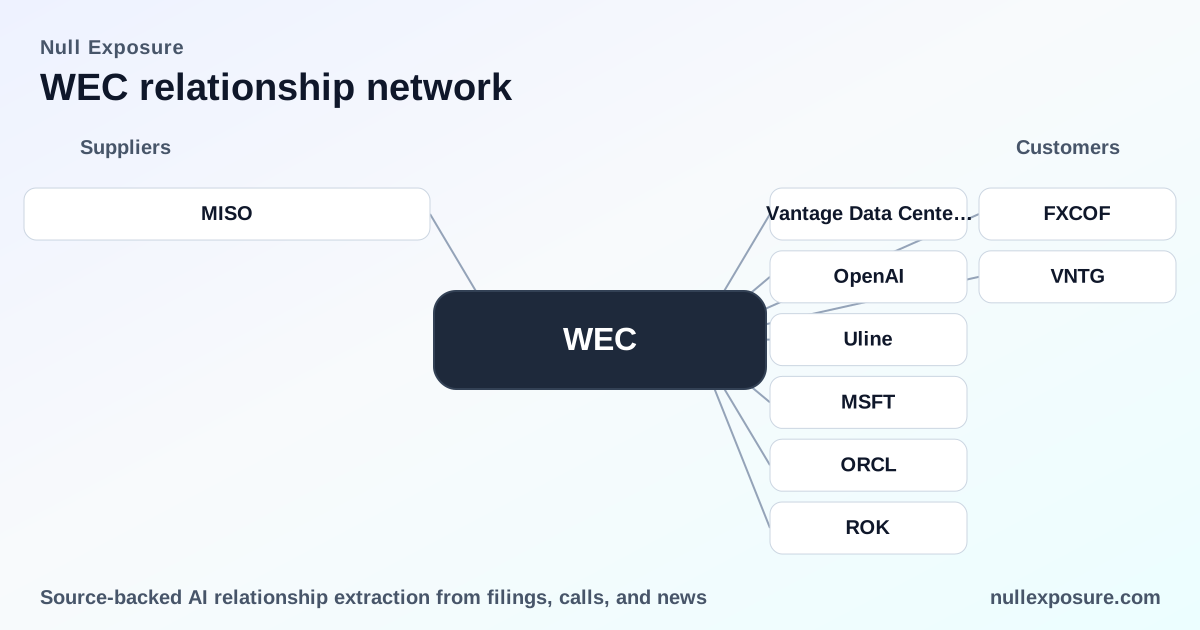
WEC Energy Group: Customer Relationships Driving Rate-Base Growth and Predictable Cash Flow
WEC Energy Group operates as a regulated electricity and natural gas provider to roughly 4.4 million customers across four U.S. states and monetizes through a mix of rate‑base regulated distribution, long‑term offtake and lease arrangements in its non‑utility infrastructure segment, and incremental earnings from infrastructure investments that feed the utility system. Recent contracts and large data‑center commitments from corporate tenants have pushed management to raise demand forecasts and add meaningful capital spending, creating a valuation lever for investors focused on stable cash flows and steady rate‑base expansion. For a concise view of how these customer ties affect credit and growth profiles, visit our research hub at Null Exposure.
How WEC gets paid: regulated revenues plus long-term contracts
WEC’s core cash flows come from regulated distribution businesses that collect customer charges under state rate structures; the company supplements that with infrastructure investments and non‑utility generation that are sold under long‑dated offtake contracts. The firm reports multiple signals that matter to investors:
- Long-term contracting posture: WEC’s non‑utility assets carry offtake contracts spanning 10–22 years and projects that qualify for production tax credits, locking in revenue streams and improving earnings visibility.
- Mixed counterparty base: The customer mix includes residential, small commercial and large enterprise classes, which spreads credit exposure but creates pockets of concentration risk where a few large industrial or data‑center customers drive incremental demand.
- U.S. regional focus: All operations are located in the United States, concentrated across Wisconsin, Illinois, Minnesota and Michigan, which reduces geopolitical risk but increases regulatory and regional demand concentration.
- Dual role: seller and service provider: WEC is primarily an electricity and gas seller, while also performing distribution and customer‑service functions when customers procure commodity supply elsewhere.
- Business segments: Core distribution businesses sit alongside an infrastructure segment (We Power, Bluewater, WECI) that owns generation and storage assets leased under multi‑year contracts.
These characteristics create a predictable cash profile for WEC, while the presence of large enterprise customers and data‑center buildouts introduces a growth catalyst tied to capital spending and regional transmission needs. Explore our methodology and sector coverage at Null Exposure.
Key customer relationships and what they mean for investors
Microsoft — expanding data‑center demand, immediate load
Microsoft has acquired more than 2,000 acres for a large Wisconsin data‑center complex; WEC reports energy is already flowing to the site and the first phase is expected online this year, and management added 500 megawatts of demand to its forecast and $1 billion to its five‑year capital plan in response to Microsoft’s expansion. According to WEC’s 2025 Q4 earnings call (March 7, 2026) and subsequent media coverage (Tikr, Jan–Mar 2026), Microsoft is a material near‑term load driver for WEC and a direct catalyst for rate‑base growth.
Vantage Data Centers — a significant campus commitment north of Milwaukee
Vantage has signed on to develop large data‑center facilities (anchored alongside major hyperscalers) totaling significant acreage in the region; WEC management cites Vantage as a key commercial developer increasing local capacity needs. The 2025 Q4 earnings call and market reports (Tikr, FY2026) identify Vantage as a central partner in multi‑GW data‑center expansion that underpins incremental distribution demand.
Oracle — tenant in the Vantage complex
Oracle is named as a developer tenant in a Vantage‑led complex spanning approximately 1,900 acres, placing it among the enterprise offtakers that will draw new electrical load. This relationship was noted in WEC’s 2025 Q4 earnings call (March 7, 2026) and supports the broader thesis that hyperscaler and enterprise campuses will expand WEC’s commercial load base.
OpenAI — another hyperscaler in the new campus mix
OpenAI is listed alongside Oracle as a planned occupant of Vantage’s development, representing additional high‑density compute demand in the region. WEC referenced these tenant commitments on the 2025 Q4 earnings call (March 7, 2026), reinforcing the concentration of data‑center load growth.
Uline — continued industrial expansion in Southeast Wisconsin
Uline completed a large land purchase to expand operations in Southeast Wisconsin, a development WEC cited on the 2025 Q4 earnings call (March 7, 2026). This expansion translates into traditional industrial load and local economic development that supports utility revenues.
Rockwell Automation — new manufacturing site adds local demand
Rockwell Automation announced plans to build a manufacturing site in southeastern Wisconsin, a move WEC flagged in its 2025 Q4 earnings commentary (March 7, 2026). Manufacturing investments like this add stable industrial load and potential transmission or distribution upgrades.
Foxconn — factory expansion focused on data‑center components
Foxconn disclosed plans to renovate and expand its Racine County campus with a focus on manufacturing data‑center components, including a >$500 million investment and more than 1,300 jobs, per WEC’s 2025 Q4 earnings call (March 7, 2026). This development is both a local demand source and an economic multipler for regional electricity consumption.
Spruce Finance — residential solar portfolio transaction
Spruce Finance acquired a portfolio of 1,047 residential solar systems from WEC (transaction noted in 2020), a deal that shifted behind‑the‑meter assets and operational management to a third party, according to Solar Power World (Nov 2020). This indicates WEC’s selective monetization of small distributed assets through third‑party sales.
AT&T — long‑term PPA beneficiary of Samson I solar
WEC’s infrastructure activity includes the Samson I Solar Energy Center; WEC announced acquisition of an 80% interest in the 250 MW project and noted AT&T as the major PPA counterparty for Samson I, tying telecom corporate demand to the project’s output (Daily Energy Insider, May 2026). This transaction illustrates WEC’s strategy of pairing generation investments with creditworthy, long‑dated buyers.
American Transmission Company LLC — transmission reimbursement linkage
WEC’s reporting cites reimbursements associated with American Transmission Company LLC for transmission infrastructure upgrades, a reflection of regional transmission cost allocation and capital recovery mechanisms discussed in recent company filings and reporting (Quantisnow, FY2026). Transmission partners and cost‑sharing arrangements materially affect the pace and recoverability of distribution upgrades tied to new load.
What investors should watch next: risks and upside drivers
- Upside driver — data‑center demand as a rate‑base accelerator. Large hyperscaler and developer commitments (Microsoft, Vantage, Oracle, OpenAI) are already prompting WEC to increase capex and demand forecasts, which can drive above‑average rate‑base growth and support earnings.
- Risk — regional concentration and transmission constraints. WEC’s U.S. regional footprint concentrates regulatory and operational risk; new high‑density loads require transmission upgrades and cost recovery mechanisms that influence near‑term returns.
- Revenue durability — long‑term offtakes and service contracts. WEC’s infrastructure portfolio carries multi‑year offtake agreements (10–22 years) and long‑term storage service agreements that provide a predictable earnings base and mitigate commodity exposure.
- Counterparty mix — diversified but with large single projects. The company serves both millions of residential customers and a smaller set of large enterprises; investors should monitor counterparties’ credit and contract terms where enterprise load represents meaningful incremental demand.
Bottom line: WEC combines a regulated distribution franchise with a disciplined infrastructure investment program backed by long‑dated contracts, and recent hyperscaler and developer activity in Wisconsin is a clear growth vector for rate‑base expansion. The balance between predictable contracted cash flows and project‑driven capital intensity will determine credit and equity upside over the next several rate cases.