Wendy’s (WEN): Franchise relationships that drive recurring revenue and capital-light growth
Wendy’s operates and monetizes a global quick-service restaurant franchise platform: the company collects royalties, franchise fees, rent and advertising fund contributions from long-term franchise agreements while selectively operating company-owned restaurants. This franchising model produces high-margin, recurring franchise-related revenues and scales international expansion via local development partners rather than heavy capex. Visit https://nullexposure.com/ for further relationship intelligence and investor signals.
How Wendy’s commercial model translates into cash flow
Wendy’s is a licensor and franchisor at scale. Company filings and investor materials show the standard contract posture: 20-year franchise terms with 10-year renewal options, license grants to use trademarks and operational know‑how, and royalties tied to sales plus mandatory advertising fund contributions. These contractual features create predictable income streams and align incentives for both franchisor and franchisee: franchisees invest in local growth while Wendy’s captures a share of top-line expansion without equivalent capital outlay.
- Contracting posture: Long-dated licenses and renewal rights provide durability to revenue streams and reduce churn risk.
- Revenue mix and criticality: Franchise-related revenues (royalties, rent, fees, advertising) are a growing, high-margin component of total revenues; operating restaurants provide product-level testing and direct sales but are secondary to the franchising engine.
- Geographic footprint and scale: Wendy’s operates in the U.S. and 31 foreign countries with roughly 7,240 restaurants as of December 29, 2024, supporting diversification of sales exposure across regions (company filing, FY2024).
- Maturity and activity: The company actively manages franchise portfolio transactions (“franchise flips”) and continues to sell company-operated units to franchisees, indicating a mature, conversion-oriented franchising strategy.
These are company-level signals drawn from regulatory excerpts and investor communications; they reflect the structural constraints shaping Wendy’s customer relationships and monetization.
Franchise partners named in recent disclosures — what each relationship means for investors
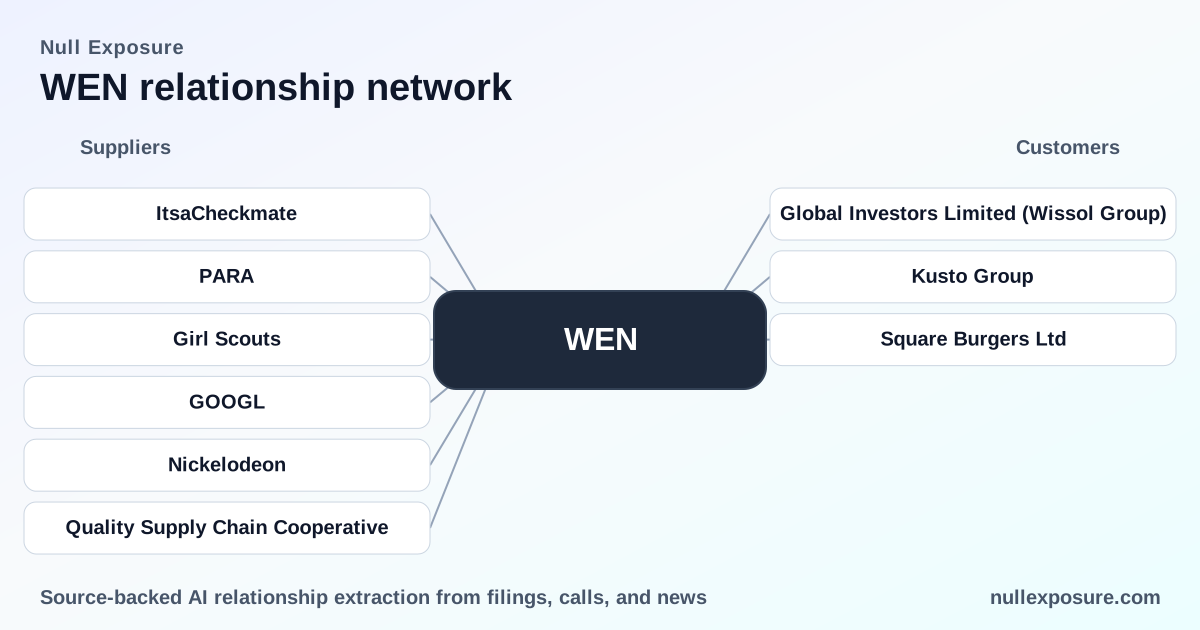
Wendy’s public disclosures and news releases identify specific development partners and franchisees that underpin international expansion. Below are the relationships found in the provided results, each summarized in plain language with source citation.
Global Investors Limited (Wissol Group)
Wissol Group has been a Wendy’s franchisee in Georgia since opening the first local Wendy’s in 2014, representing a long-standing regional operator that supports the brand’s Caucasus/Central Asia footprint. Source: Wendy’s corporate press release (FY2021) — https://www.irwendys.com/news/news-details/2021/The-Wendys-Company-Announces-New-Development-Agreements-in-the-Central-Asia-Region/default.aspx
Kusto Group
Kusto Group is identified as a strategic development partner for Wendy’s expansion in Central Asia, providing local development expertise and operational capability to scale the brand in that region. Source: Wendy’s corporate press release (FY2021) — https://www.irwendys.com/news/news-details/2021/The-Wendys-Company-Announces-New-Development-Agreements-in-the-Central-Asia-Region/default.aspx
Wen Restaurant LLC
Wen Restaurant LLC signed an exclusive franchise agreement to develop 20 Wendy’s restaurants in Armenia through 2030, representing a targeted national development deal that advances EMEA expansion. Source: Wendy’s press release (FY2025) — https://www.irwendys.com/news/news-details/2025/Wendys-Announces-New-Development-Agreements-for-190-New-Restaurants-Across-Italy-and-Armenia/default.aspx
Your Food S.R.L
Your Food S.R.L entered an exclusive agreement to develop 170 Wendy’s restaurants across Italy through 2035, marking a material acceleration of Wendy’s footprint in a major European market and demonstrating the company’s reliance on large-scale local master developers for rapid growth. Source: Wendy’s press release (FY2025) — https://www.irwendys.com/news/news-details/2025/Wendys-Announces-New-Development-Agreements-for-190-New-Restaurants-Across-Italy-and-Armenia/default.aspx
Yellow Cab Holdings
Yellow Cab Holdings is described in media reporting as a multi-state Wendy’s franchisee (New York, New Jersey, Pennsylvania); executives tied to the company have appeared in leadership coverage and sector commentary, reflecting the U.S. franchisee base’s role in core market operations. Source: industry news report (FY2025) — https://www.provisioneronline.com/articles/119082-wendys-ceo-leaves-company
Square Burgers Ltd
Square Burgers Ltd is represented by George Papadamou as a Wendy’s franchisee operating in the UK, illustrating the brand’s use of local operators for market entry and regional management in Europe. Source: Wendy’s corporate blog post (FY2024) — https://www.wendys.com/blog/recruiting-poland-franchisees
What these relationships signal about risk and opportunity
The disclosed partners underline three strategic facts for investors:
- Capital-light expansion: Large development agreements in Italy and Armenia (170 and 20 restaurants respectively) show Wendy’s leverages local capital and expertise to scale rapidly without equivalent corporate capex, improving free cash flow conversion.
- Concentration of operational risk in franchisees: Dependence on a small set of master developers (e.g., Your Food S.R.L) concentrates execution risk regionally; a single partner’s failure to execute would materially slow local rollouts.
- Contract durability and locked-in economics: Long-term licencing and royalty mechanics provide predictable, recurring cash flows while advertising fund contributions lock in marketing support and scale benefits.
Financial and operational takeaways for allocators
Wendy’s balance of company-operated and franchised locations creates an operating profile that is less capex-intensive than company-owned restaurant expansion, with franchise fees and royalties supporting margin expansion. The company’s financials show this: franchise-related revenues are a primary contributor to overall revenue and high operating margins (company financials, FY2024/2025). Concentration of new development in multi-year international deals creates near-term growth optionality but increases country-level execution risk.
Key investor considerations:
- Franchise agreements are long-term and licensed, increasing revenue visibility.
- Large master development deals accelerate growth but concentrate counterparty and execution risk.
- The model supports scalable margin improvement as franchised revenues grow relative to company-operated sales.
For a deeper look at how these partner contracts translate into revenue cadence and counterparty exposure, visit https://nullexposure.com/ for curated relationship analytics.
Bottom line: predictable cash flow, execution-dependent growth
Wendy’s core strength is a franchising model that delivers recurring, royalty-driven cash flows and rapid international expansion via local partners. The recent development agreements in Italy and Armenia and the roster of experienced regional franchisees demonstrate an intentional push to grow internationally while preserving corporate capital. Investors should weight the company’s durable licensing economics against concentration and execution risk embedded in large multi-year development relationships.
For practical next steps, institutional investors and operators should monitor rollout milestones from master developers, changes in royalty/ad fund terms in updated filings, and any indications of franchisee performance variation across new markets. For curated, relationship-level monitoring and alerting, see https://nullexposure.com/.