Werner Enterprises (WERN): customer concentration, contract posture, and what Dollar General exposure means for investors
Werner Enterprises operates as a North American truckload transportation and logistics provider, monetizing through line-haul freight revenue, dedicated fleet contracts and logistics services. Revenue is generated by transporting freight for third-party customers, supplemented by longer-term dedicated arrangements that convert customers’ private fleets and by logistics solutions; this mix creates both recurring revenue (dedicated) and transactional exposure (one-way truckload). For equity investors, the key investment question is how Werner balances predictability from multi-year dedicated contracts against revenue concentration and short-term churn in the truckload spot market. Read more company-level context at https://nullexposure.com/.
How Werner’s contracts and segments shape cash flow
Werner runs a two-pronged operating model: a truckload transportation core that generates nearly all revenues from hauling freight, and a logistics arm that manages supply chain services. Dedicated contracts provide predictable, recurring cash flows — the company discloses longer-term Dedicated customer contracts generally run two to five years and include some annual evergreen clauses — while the one-way truckload book is conventionally short-term and flexible, often terminable on 30 days’ notice. According to Werner’s 2024 Form 10‑K, the company elected the practical expedient under ASC 606 for contracts with original expected length of one year or less and acknowledges that many one-way truckload contracts can be terminated on 30 days’ notice.
This hybrid contracting posture produces a blended revenue stream: dedicated relationships raise revenue visibility and capitalize on asset utilization (Dedicated had 4,840 trucks as of December 31, 2024), while short-term truckload contracts allow pricing responsiveness to market cycles but reduce stickiness. Geographically, Werner generates substantially all revenues within the United States or from North American shipments with U.S. origins/destinations, concentrating operational risk in the North American freight cycle.
Concentration and criticality: a focused customer base
Werner operates with meaningful customer concentration; the filing states the largest 5, 10, 25 and 50 customers made up 36%, 48%, 65% and 77% of revenues in 2024, respectively. Concentration elevates counterparty risk: losing or renegotiating terms with a top customer can move margins and utilization materially. At the same time, the company’s diversified freight base across many customer relationships mitigates single-counterparty dependency beyond the top few accounts.
From an investor perspective, the operational maturity is mixed: long-term dedicated contracts and logistics services are mature, contractual relationships that support stability, while the sizeable one-way truckload book is inherently tactical and sensitive to pricing, fuel, and capacity dynamics. The company’s stated performance obligation model — revenue recognized when shipments are delivered — reinforces that revenue realization is tied to executed freight activity rather than upfront contract billing.
Key company-level signals from the 2024 filing:
- Contracting posture: A deliberate mix of multi-year dedicated contracts and short-term truckload agreements, providing both predictability and flexibility. (Werner 2024 Form 10‑K)
- Concentration: Top customers meaningfully influence revenues; the largest customer contributed 11% of total revenues in 2024. (Werner 2024 Form 10‑K)
- Geography: Predominantly North American revenues and operations. (Werner 2024 Form 10‑K)
- Service role: Predominantly a service provider transporting truckload freight; also acts as a buyer when converting private fleets under dedicated arrangements. (Werner 2024 Form 10‑K)
If you want a concise feed on customer exposures and contract signals for listed companies, see the firm’s research hub at https://nullexposure.com/.
Customer relationships disclosed in public filings
Below are every customer relationship disclosed in the provided results, summarized in plain English with source context.
-
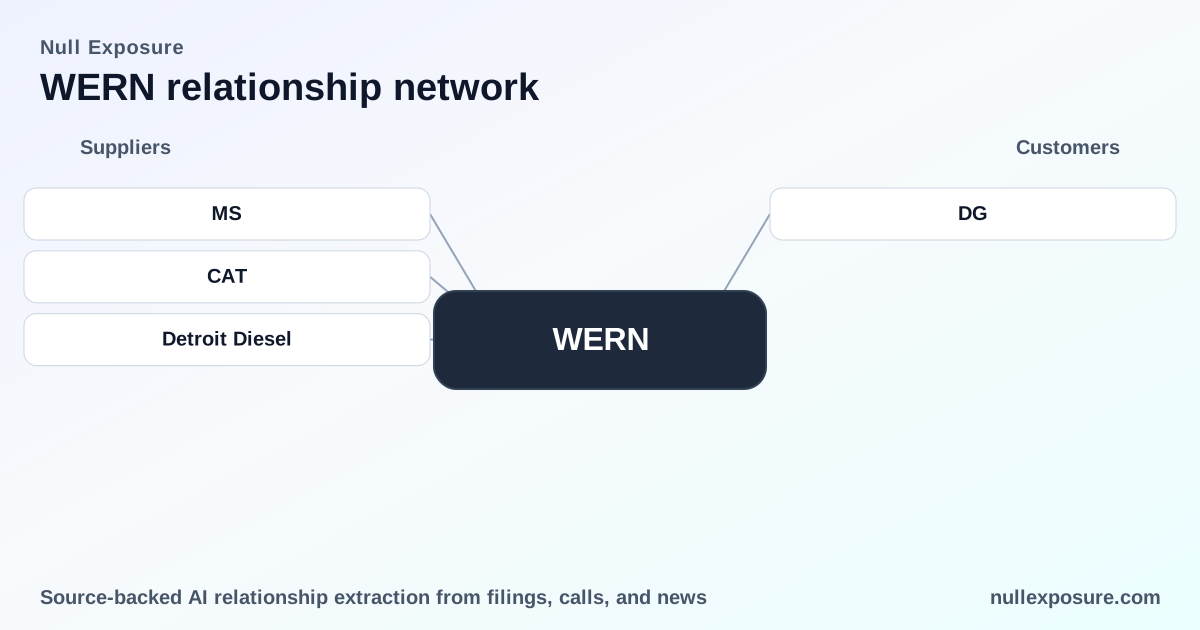
DG (inferred ticker DG): Werner identifies DG as its largest customer, with Dollar General accounting for 11% of total revenues in 2024, underscoring a material dependency on a single retail logistics partner. This fact is reported in Werner’s 2024 Form 10‑K (FY2024).
Source: Werner Enterprises 2024 Form 10‑K, FY2024 filing. -
Dollar General: The filing explicitly names Dollar General and restates that Dollar General represented 11% of Werner’s revenue in 2024, confirming that the retailer is a top-tier account by revenue contribution and strategic importance. This appears in Werner’s 2024 Form 10‑K (FY2024).
Source: Werner Enterprises 2024 Form 10‑K, FY2024 filing.
(Each entry above is drawn from Werner’s FY2024 annual filing, which lists customer concentration metrics and the company’s largest customers.)
What investors should watch next
- Contract renewals and expiration profiles for Dedicated accounts are critical. Multi-year dedicated contracts provide stability, but any loss or material renegotiation of large contracts produces dislocation because customer concentration is high. Monitor disclosures around renewals and any changes to evergreen terms.
- One-way truckload volumes and pricing: short-notice contracts create margin cyclicality. When capacity tightens, Werner benefits from higher spot rates; when markets soften, revenue and utilization can compress quickly.
- Freight mix and utilization of the dedicated fleet (4,840 trucks at year-end 2024) determine fixed-cost absorption. Improved dedicated fleet utilization translates directly to margin expansion.
- Customer-level disclosure cadence: given concentration, investors should expect ongoing discussion of top customer exposures in periodic filings and conference calls.
Bottom line
Werner’s business model blends contracted, recurring revenue from dedicated services with transactional, market-sensitive truckload operations. The presence of a single customer contributing 11% of revenue in 2024 creates a material counterparty risk that is offset to some degree by a broader diversified freight base across the top 50 customers. For investors, the critical monitoring items are contract renewal terms for large accounts, utilization of the dedicated fleet, and short-term truckload pricing trends — all of which determine near-term cash flow stability versus cyclicality.
For a follow-up read on customer exposures across transportation names and contract risk indicators, visit https://nullexposure.com/.