Western Midstream (WES): customer map and what it means for cash flow stability
Western Midstream Partners operates and monetizes a classic midstream services model: the partnership gathers, processes, treats, transports and disposes of natural gas, NGLs, crude oil and produced water and collects fees under a mix of long‑term and volume‑based contracts. Revenue is driven by fee contracts — both fixed-fee and usage-based — supported by minimum‑volume commitments, while the business remains highly concentrated in a handful of major producers, which creates both predictable cash yield and a material single‑counterparty risk. Learn more about customer exposure and contract structure at https://nullexposure.com/.
How WES actually makes money and why investors should care
Western Midstream’s operating model is straightforward and investor-friendly: it sells midstream services to producers and refiners and realizes cash through contractually backed fees. The partnership has been actively converting legacy cost‑of‑service arrangements into fixed‑fee, acreage‑dedicated structures to reduce commodity sensitivity and smooth distributions. Its balance of long‑duration commitments and usage‑sensitive fees gives investors a mix of downside protection and upside capture when volumes hold.
- Contracting posture: the company runs a hybrid model — long‑term contracts (5–10 year initial terms) coexist with usage‑based fee arrangements that pay on volumes or thermal content. This combination is central to WES’s low‑volatility cash‑flow claim.
- Concentration and criticality: Occidental is a dominant counterparty for WES, supporting a substantial share of revenues and throughput, which increases stability when Occidental is active but represents a single‑counterparty concentration risk.
- Geographic profile: operations are concentrated in West Texas and the Rocky Mountain basins (Texas, New Mexico, Colorado, Utah, Wyoming), so basin‑specific drilling and activity trends directly impact throughput.
- Role and maturity: WES is a service provider with predominantly active, fee‑backed contracts across its midstream services segment.
Customer relationships: who matters and what they do
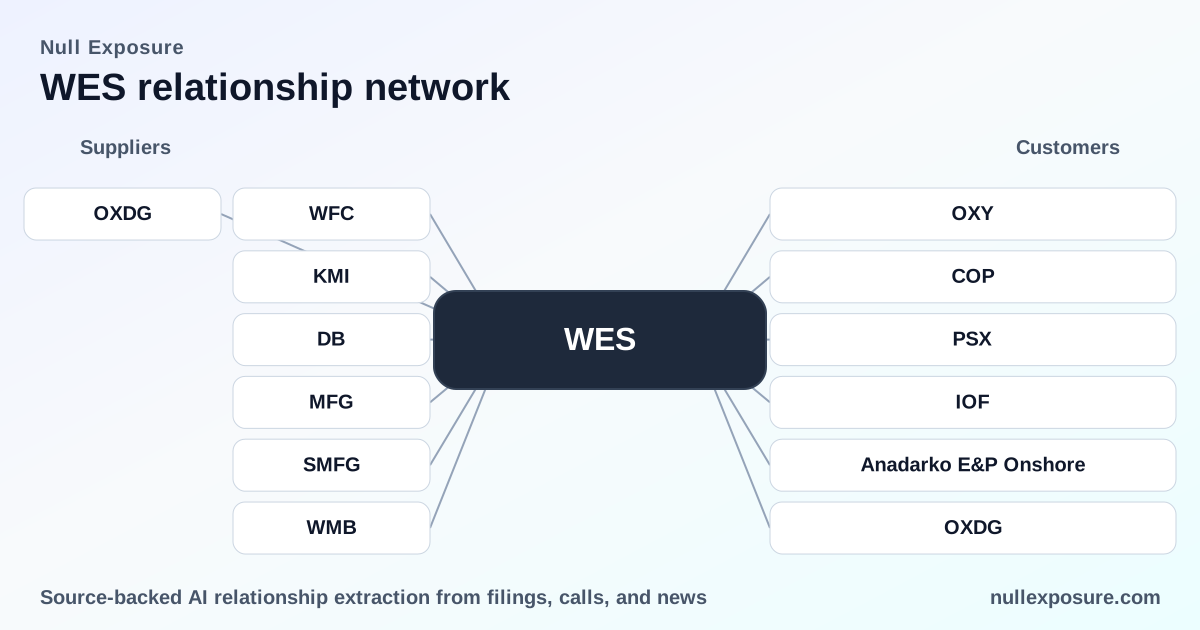
Below are the principal counterparties referenced in public reporting and market coverage; each entry includes a concise, sourced summary.
-
Occidental Petroleum (OXY / Oxy / Occidental Petroleum Corporation) — Occidental is WES’s largest and most strategically important customer, accounting for roughly 60% of total revenues and a majority of throughput across natural gas, crude/NGLs and produced‑water assets per Western Midstream’s Form 10‑K for the year ended December 31, 2024; WES renegotiated Delaware Basin gas contracts with Occidental to a simplified fixed‑fee structure supported by acreage dedication, and Occidental transferred 15.3 million WES common units back to the partnership as part of the arrangement (reported March 2026). (WES 2024 10‑K; PR Newswire, March 10, 2026; Finviz/Investing coverage March 2026)
-
ConocoPhillips (COP) — WES completed a new dedication and fixed‑fee style agreement with ConocoPhillips to gather and process natural gas volumes already on WES’s Delaware Basin system, adding a material fee‑based counterparty to that basin. (PR Newswire/TradingView, March 2026)
-
Oxy (development activity / Bronco CAP) — Occidental’s capital allocation also matters operationally: WES flagged that Oxy’s Bronco CAP development will contribute incremental volumes into WES’s system starting in 1H 2026, partially offsetting basin‑wide throughput declines. (WES Q4 2025 earnings call, March 2026; InsiderMonkey coverage)
-
Iofina plc (IOF / IOF7.FRK) — WES signed an agreement to provide produced water feedstock for a new IOsorb iodine extraction plant in the Permian Basin, reflecting how water‑handling capabilities (accentuated by the Aris acquisition) are creating adjacent revenue streams beyond traditional gathering and processing. (SimplyWall.St and SahmCapital reporting, May / Jan 2026)
-
Enterprise Products Partners L.P. (EPD) — Enterprise agreed to buy an additional 15% member interest in Panola Pipeline Company, LLC from WES for $25 million, a small asset sale that trims WES’s noncore interest while monetizing a minority pipeline stake. (SimplyWall.St reporting, May 2026)
-
Phillips 66 (PSX) — WES identified Phillips 66 as a steady onload customer supporting natural gas throughput, providing a counterbalance to areas where other producers are reducing activity. (WES Q4 2025 earnings call transcript, March 2026)
-
Anadarko E&P Onshore — WES amended a gas gathering agreement with Anadarko E&P Onshore to a fixed‑fee structure, adding a minimum‑volume commitment through 2027 and updating dedication and transfer provisions, which strengthens minimum cash coverage on that acreage. (TradingView summary, March 2026)
Each of the points above is distilled from WES public disclosures and contemporaneous market reports (WES 2024 10‑K and the company’s Q4 2025 earnings call; PR Newswire and multiple market outlets in March–May 2026).
Operational constraints and what they signal for investors
Several company‑level constraints extracted from filings and disclosures materially shape WES’s cash‑flow profile:
- Long‑term orientation with embedded protections: WES’s contracts typically carry multi‑year initial terms (5–10 years) and many include minimum‑volume commitments or cost‑of‑service language; this is an explicit operating lever to preserve low‑volatility cash flows.
- Usage‑based fees remain core: a large share of throughput is still billed on a fee‑per‑volume or thermal‑content basis, meaning throughput declines directly depress revenue absent fixed minimums.
- Regional concentration: operations and revenue exposure are concentrated in the Permian/Delaware and Rocky Mountain basins, so basin specific activity cycles materially affect earnings.
- Service‑provider role and active relationships: WES acts primarily as a midstream services operator with active, fee‑based contractual relationships across natural gas, NGLs, crude oil and produced water.
- Single‑counterparty criticality: per the 2024 10‑K, Occidental represents a critical revenue source, accounting for the majority of throughput and a large share of total revenue, which is a double‑edged sword: it underpins near‑term cash stability but concentrates credit and operational exposure.
Investment implications: balanced yield but concentrated risk
Western Midstream delivers a high‑income profile underpinned by fee contracts and recent structural fixes to legacy agreements. Fixed‑fee conversions and minimum‑volume commitments materially reduce commodity exposure, which supports distribution coverage and predictable cash flows. However, the partnership’s concentration with Occidental and basin‑specific exposure are non‑trivial risks: deterioration in a single major producer’s activity or a basin downturn would transmit quickly to volumes and yield security.
For investors and operators evaluating counterparty risk, the key questions are:
- How durable are the fixed‑fee and minimum‑volume commitments with newly restructured counterparties?
- Will produced‑water growth (and deals like the Iofina IOsorb plant) provide a structural offset to declines in crude/NGL volumes?
- How will asset sales and minority interest monetizations (for example, Panola to Enterprise Products) change capital allocation and balance‑sheet flexibility?
If you want a structured customer exposure report or scenario analysis for WES counterparties, visit https://nullexposure.com/ to request tailored mapping and risk modeling.
Bottom line
Western Midstream’s commercial pivot toward more fixed‑fee, acreage‑dedicated contracts and its expansion into water services increase the predictability of distributions and diversify revenue sources. That improvement in cash‑flow quality is real, but high counterparty concentration — chiefly Occidental — and basin concentration remain primary valuation risks that should be priced into any income‑oriented position.