Webus International (WETO): Partnerships as the Growth Engine
Webus International operates Wetour, a travel-services platform that sells premium chauffeur-driven transfers, charter lines and affiliated mobility services to consumers through B2B distribution partners. The company monetizes through direct service fees on rides and tours, franchise/partner revenue-sharing agreements with large travel platforms and airlines, and ancillary monetization tied to cross-border settlement innovations such as using the XRP Ledger for driver and partner payouts. Revenue today is transaction-driven and partner-distributed; the upside is scaled distribution, and the risk is partner concentration and early-stage operating leverage. For an investor-ready map of customer relationships, see https://nullexposure.com/.
How the business makes money is straightforward: Wetour supplies travel services and car fleets (including AI-driven vehicles in some press reports), integrates with partners’ loyalty and booking channels, and receives a slice of customer-paid fare and settlement-service fees. The company reported $35.6M in trailing revenue with negative operating margins, reflecting an early commercial footprint that depends on partner rollouts to reach profitable scale.
H2: Why the partner list matters for valuation and risk
- Contracting posture: Webus runs a partner-heavy B2B2C go-to-market model — the company’s growth is conditional on winning and operationalizing agreements with incumbents rather than on direct-to-consumer marketing alone.
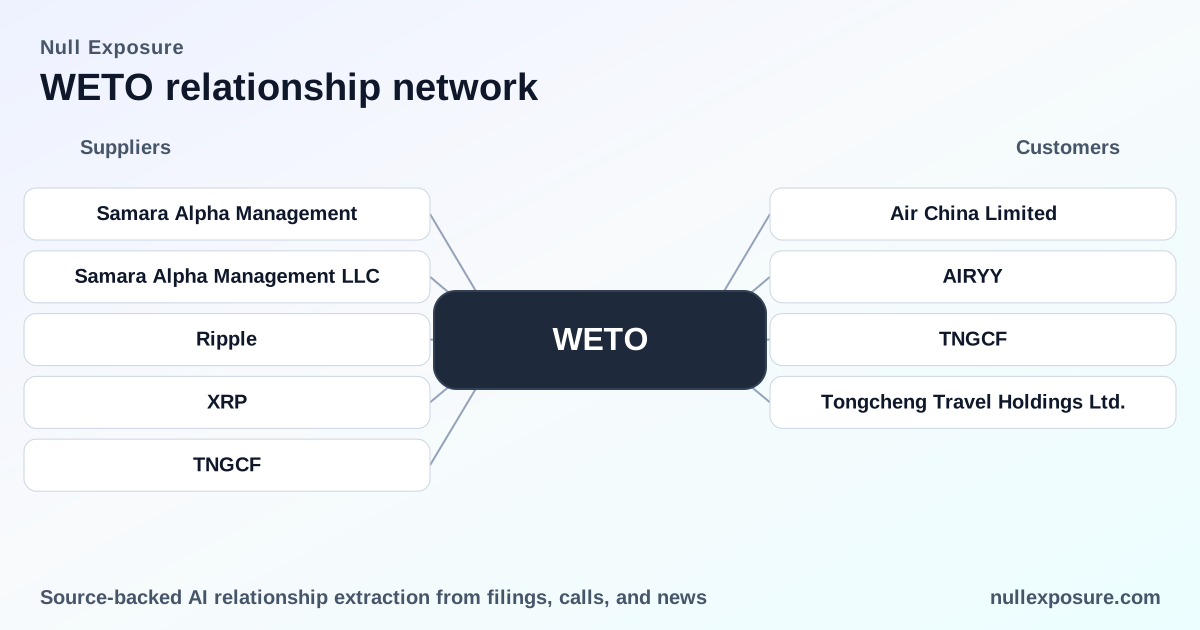
- Concentration: Multiple press items reference Air China and Tongcheng Travel as anchor partners; that creates meaningful distribution but raises single-partner dependency risk if these relationships do not scale proportionately.
- Criticality: Partnerships tied to loyalty programs (e.g., PhoenixMiles) increase the commercial importance of Wetour offerings to partner ecosystems, which can anchor recurring volume if executed properly.
- Maturity: Announcements and “renewal” language indicate Webus is transitioning from proof-of-concept to commercial rollouts, but financials (negative EBITDA) show the company remains in the investment phase.
For more systematic customer due diligence and relationship sourcing, NullExposure offers structured reporting at https://nullexposure.com/.
Relationship roll call: what each source reported (FY2025)
Below are concise, source-linked summaries for every relationship entry captured in the results.
1) Futunn — AIRYY (March 10, 2026)
Futunn reported that through the partnership Webus’s Wetour brand will provide Air China passengers and loyalty members with airport transfers and premium chauffeur services worldwide. The article frames the deal as strategic distribution for Wetour’s travel services. (Futunn news post, March 10, 2026: https://news.futunn.com/en/post/61615002/webus-international-signs-strategic-partnership-agreement-with-air-china-unlocking)
2) Futunn — Air China Limited (March 10, 2026)
The same Futunn piece explicitly names Air China Limited, reiterating that Air China customers and members will have access to Wetour’s airport pickup/drop-off and chauffeur services, positioning the airline as a global distribution channel. (Futunn news post, March 10, 2026)
3) Yahoo Finance — Air China Limited (March 10, 2026)
Yahoo Finance summarized the partnership, noting Wetour’s role in delivering airport transfers and premium chauffeur services to Air China passengers and its loyalty base. The piece emphasizes distribution to PhoenixMiles members. (Yahoo Finance, March 10, 2026: https://finance.yahoo.com/news/webus-international-signs-strategic-partnership-130000095.html)
4) Bitcoin.com — Air China Ltd. (May 4, 2026)
Bitcoin.com reported the Air China agreement with focus on service scope, stating Wetour’s platform will provide premium chauffeur-driven transfers and airport services to Air China passengers worldwide. The write-up links the program to broader payments initiatives. (Bitcoin.com, May 4, 2026: https://news.bitcoin.com/xrp-cracks-into-global-aviation-as-webus-and-air-china-target-60m-loyalty-members/)
5) CoinCentral — TNGCF (March 10, 2026)
CoinCentral covered Webus’s collaboration with Tongcheng, noting that Webus will supply AI-driven vehicles to support Tongcheng’s high-demand routes and expand fleet utility in those corridors. The story frames this as a fleet-supply and service integration agreement. (CoinCentral, March 10, 2026: https://coincentral.com/xrp-news-webus-unveils-plan-for-300m-xrp-reserve-to-drive-global-travel-payments/)
6) CoinCentral — Tongcheng Travel Holdings (March 10, 2026)
The same CoinCentral coverage names Tongcheng Travel Holdings and describes a renewal/extension of the “Wetour x Tongcheng” charter lines, indicating operational cooperation on charter routes and fleet deployment. (CoinCentral, March 10, 2026)
7) Yahoo Finance — TNGCF (March 10, 2026)
Yahoo reported that Webus renewed a partnership with Tongcheng Travel Holdings to extend Wetour x Tongcheng charter lines and stated an intention to use the XRP Ledger for settling cross-border rides and driver payouts. The article links route expansion to payment/settlement experimentation. (Yahoo Finance, March 10, 2026)
8) Yahoo Finance — Tongcheng Travel Holdings (March 10, 2026)
A duplicate Yahoo item names Tongcheng Travel Holdings by full name and reiterates the renewal and the plan to pilot XRP Ledger settlement for cross-border payments to drivers and partners. (Yahoo Finance, March 10, 2026)
9) FinancialContent/Pennwell — AIRYY (clarification) (Sept 10, 2025)
FinancialContent ran a clarification indicating on August 19, 2025 Webus’s PRC subsidiary entered a Preferential Cooperation Agreement with Air China’s Hangzhou Branch for airport pick-up/drop-off services; this is framed as a local operational contract underpinning the broader partnership. (Markets.FinancialContent/Pennwell filing clarification, Sept 10, 2025: https://markets.financialcontent.com/pennwell.dental/article/gnwcq-2025-9-10-webus-international-issues-clarification-on-prior-announcement-regarding-cooperation-with-air-china)
10) FinancialContent/Pennwell — Air China (Sept 10, 2025)
The same clarification names Air China directly and documents the subsidiary-level Preferential Cooperation Agreement, signaling a contractual step that supports Wetour’s airport-service execution in a key Chinese market. (Markets.FinancialContent/Pennwell, Sept 10, 2025)
11) CryptoNews Australia — AIRYY (March 10, 2026)
CryptoNews Australia reported Webus’s strategic partnership with Air China to provide transfers and chauffeur services to PhoenixMiles members (over 60M users), explicitly linking the partnership to large-scale loyalty distribution. (CryptoNews Australia, March 10, 2026: https://cryptonews.com.au/news/webus-partners-with-air-china-to-bring-xrp-powered-travel-solutions-to-60m-phoenixmiles-members-130704/)
12) CryptoNews Australia — Air China (March 10, 2026)
A duplicate CryptoNews entry again highlights PhoenixMiles membership access and frames the Air China link as a meaningful channel for Wetour’s service distribution and payments pilots. (CryptoNews Australia, March 10, 2026)
13) TradingView/FinanceMagnates — Tongcheng Travel Holdings Ltd. (March 10, 2026)
TradingView’s newswire summarized industry reporting that Webus is renewing partnership ties with Tongcheng Travel Holdings, calling Tongcheng a leading Chinese tourism firm and noting the strategic importance of renewed charter and service lines. (TradingView/FinanceMagnates summary, March 10, 2026: https://www.tradingview.com/news/financemagnates:88e5828d5094b:0-webus-bets-300m-on-xrp-to-fuel-payments-xrp-s-price-barely-budges/)
H2: Investment implications and the short checklist
- Growth driver: These partnerships give Webus immediate access to airline loyalty ecosystems and large OTA (online travel agency) distribution, which are necessary to scale rides/tours without proportional marketing spend.
- Execution risk: Announcements differ by outlet and include subsidiary-level agreements and renewals, indicating the relationship pipeline is a mix of proof points and incremental deals rather than a single consolidated contract.
- Payment innovation optionality: Multiple reports link partner rollouts to XRP Ledger settlement pilots — this is a potential cost and speed advantage for cross-border payouts but is ancillary to the core rides business.
- Financial posture: With negative operating margins and modest market cap, Webus needs partner-driven volume to achieve leverage; investors should prioritize verification of booked volumes, revenue share terms, and integration timelines when modeling upside.
For a structured diligence package or to commission a relationship audit, visit https://nullexposure.com/ — the service maps these partner announcements to contractual and revenue signals in investor-ready form.
Conclusion: The partnership set — anchored by Air China and Tongcheng — is the most salient customer-facing development in FY2025 press coverage. Success will depend on converting announcements into recurring, sizeable transaction flows and proving that payment settlement initiatives lower operating friction rather than create execution distraction. Investors should focus on partner rollout evidence, realized volumes, and marginal economics as the company moves from announcement-driven headlines to repeatable cash generation.