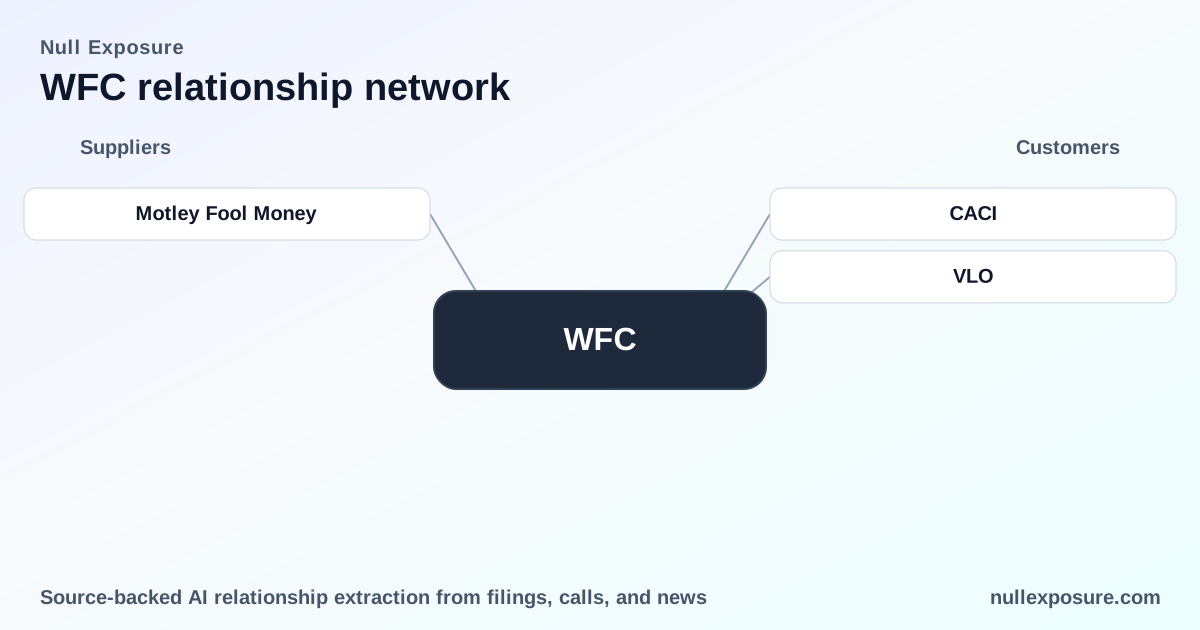
Wells Fargo (WFC): The Customer Map That Drives Wholesale and Markets Revenue
Wells Fargo operates as a diversified financial services platform that monetizes through four core channels: interest income from lending and deposit spread, corporate lending and syndication fees, capital markets underwriting and advisory fees, and transaction banking/merchant services. Its customer relationships—spanning CMBS, corporate credit, structured finance, and equity and debt underwriting—are the operational engine for fee revenue and balance sheet utilization that underpins WFC’s commercial banking and securities franchises. For a quick overview of how we surface counterparty exposure and transaction flow, visit https://nullexposure.com/.
What the relationship roster reveals about Wells Fargo’s operating posture
Wells Fargo’s public deal flow in recent reporting cycles shows a contracting posture that favors balance-sheet-led, agency and administrative roles (administrative agent, bookrunner, sole-placement) and recurrent participation in large commercial real-estate and corporate financings. The catalog of counterparties signals broad industry coverage—real estate, energy, industrials, healthcare, and consumer—consistent with a global wholesale footprint but with a strong North American concentration. The relationships are predominantly service-provider roles (credit agent, arranger, underwriter, financial adviser) and are generally active and mature credit or capital-markets arrangements rather than one-off retail interactions.
- Concentration: WFC is repeatedly lead arranger or administrative agent on multi-hundred-million to multi-billion facilities (e.g., MPLX revolver, SL Green SASB CMBS), indicating material balance-sheet commitments and fee capture.
- Criticality: Many clients use Wells Fargo as administrative agent or exclusive advisor—roles that are operationally critical to deal execution and syndication.
- Maturity and stability: Frequent credit-agreement amendments and facility upsizes point to ongoing, multi-year relationships rather than ad hoc engagements.
- Client mix: Evidence supports coverage across individuals, small business, and institutional clients with a predominant focus on corporate/real-estate institutional relationships (company-level signal drawn from filings and customer-relationship classifications).
Constraints and business-model signals (company level)
Wells Fargo’s public disclosures and customer-role tags present a clear picture: the bank services individuals, small business and institutional clients, operates globally with North America concentration, and predominantly engages as a service provider (agent, arranger, underwriter). These are company-level signals drawn from the relationship inventory and filing excerpts, not attributable to any single client unless explicitly named in the source documents.
For deeper maps of counterparties and to track ongoing changes in WFC’s syndication footprint, browse https://nullexposure.com/.
The full relationship catalog — one-line takeaways and sources
Below is a compact, investor-ready list covering the relationships surfaced in the results. Each entry is a plain-English summary with a concise source link.
- SLG — Wells Fargo executed a $480m CMBS mortgage for SL Green’s Park Avenue Tower acquisition. Source: https://wrenews.com/sl-green-completes-730-million-acquisition-of-nycs-park-avenue-tower/
- AXGN — Wells Fargo Securities served as representative underwriter for Axogen’s public offering and upsized deal activity in January 2026. Source: https://www.stocktitan.net/sec-filings/AXGN/8-k-axogen-inc-reports-material-event-ba0b2ecad837.html
- INOD — Innodata amended its credit agreement with Wells Fargo (fourth amendment) to expand secured revolving capacity and extend maturity. Source: https://www.tradingview.com/news/reuters.com,2026:newsml_FWN40C10T:0-innodata-inc-enters-fourth-amendment-to-credit-agreement-with-wells-fargo-on-march-19-2026-sec-filing/
- TREX — Trex entered a $100m accelerated share repurchase with Wells Fargo Bank as the executing counterparty. Source: http://markets.chroniclejournal.com/chroniclejournal/article/marketminute-2026-3-3-trex-fortifies-market-position-with-100-million-share-buyback-amid-looming-leadership-transition
- TMHC — Taylor Morrison signed an amended credit agreement with Wells Fargo as administrative agent and lender group participant. Source: https://www.tradingview.com/news/tradingview:065182ee7e1ef:0-taylor-morrison-signs-amended-credit-agreement-with-wells-fargo/
- NHPBP — National Healthcare Properties used Wells Fargo Securities as lead book-runner and Wells Fargo Bank as administrative agent on a $400m revolver/$150m term loan package. Source: https://wtvbam.com/2026/04/06/national-healthcare-properties-moves-closer-to-public-markets-with-us-ipo-filing/
- RHP — Ryman Hospitality refinanced and expanded its revolver under a Wells Fargo-led syndicate, extending maturity to 2030. Source: https://www.tradingview.com/news/tradingview:08b088c5de35b:0-ryman-hospitality-properties-signs-credit-agreement-amendment-with-wells-fargo-bank-and-lenders/
- NHPAP — Wells Fargo Securities acted as representative for National Healthcare Properties’ equity offering and follow-on transactions. Source: https://www.tradingview.com/news/tradingview:fc2daeecf325f:0-national-healthcare-properties-closes-38-5m-share-offering-underwriters-exercise-5-8m-option/
- GTN-A — Wells Fargo Securities served as financial adviser to Gray (Quincy Media stations divestiture). Source: https://www.globenewswire.com/news-release/2021/04/29/2220067/0/en/Gray-Sells-Divestiture-Stations-From-Quincy-Media-Transaction-to-Allen-Media-for-380-Million.html
- WEST — Wells Fargo Securities acted as capital markets advisor and sustainability structuring agent on Westrock Coffee credit arrangements. Source: https://www.comunicaffe.com/westrock-coffee-company-reports-third-quarter-2025-results-and-updates-2025-and-2026-outlook/
- CCLDO — CareCloud replaced a Wells Fargo acquisition-related note with a new facility from another bank, noting prior obligation to Wells Fargo. Source: https://www.globenewswire.com/news-release/2025/09/09/3146859/16541/en/CareCloud-Secures-Credit-Facility-on-Favorable-Terms-with-Provident-Bank-to-Support-Medsphere-Acquisition.html
- SLG-P-I — Wells Fargo led a $1.65bn SASB CMBS refinancing of One Madison Avenue with major bank participants. Source: https://www.globenewswire.com/news-release/2026/03/25/3262159/0/en/sl-green-refinances-one-madison-avenue-for-1-65-billion.html
- NTST — NETSTREIT launched an ATM equity program with Wells Fargo Securities among the sales agents/principals. Source: https://m.investing.com/news/sec-filings/netstreit-launches-new-400-million-atthemarket-equity-program-93CH-4627864?ampMode=1
- MPLX — MPLX secured a five-year revolver led by Wells Fargo as administrative agent for general partnership liquidity. Source: https://www.theglobeandmail.com/investing/markets/stocks/MPLX/pressreleases/1306595/mplx-expands-credit-facility-to-enhance-liquidity-flexibility/
- NE — Noble received advisory from Wells Fargo and SB1 Markets in its Diamond Offshore acquisition process. Source: https://www.citybiz.co/article/565321/noble-corporation-to-acquire-diamond-offshore-drilling/
- LNSR — LENSAR entered a $50m priority credit line with Wells Fargo secured by a brokerage account lien. Source: https://www.tipranks.com/news/company-announcements/lensar-secures-50-million-priority-credit-line-facility
- AWR — American States Water added Wells Fargo Securities as a counterparty and agent on its $200m ATM program. Source: https://www.tradingview.com/news/tradingview:75fc9d0a1618e:0-american-states-water-updates-200-million-atm-program-adds-huntington-as-sales-agent/
- BIP-P-A / GATX / BIP — Brookfield/GATX acquired Wells Fargo’s rail portfolio in a joint-venture transaction (~101k cars, ~$4.2bn), reflecting WFC’s rail asset exit. Sources: https://finance.yahoo.com/news/gatx-brookfield-complete-buy-wells-151501304.html and https://www.fasken.com/en/news/2025/06/gatx-corporation-and-brookfield-infrastructure-partners-lp
- RWTQ — Wells Fargo was sole-structuring agent and sole bookrunner on Redwood Trust issuance. Source: https://ca.finance.yahoo.com/news/redwood-trust-announces-closing-sequoia-201500197.html
- ILPT — Industrial Logistics priced a $1.62bn fixed-rate mortgage financing led by Wells Fargo Bank and other real-estate lenders. Source: https://www.connectcre.com/stories/industrial-logistics-properties-trust-prices-1-62b-mortgage-financing/
- ACRE — Ares Commercial Real Estate upsized its Wells Fargo facility to $600m, indicating deeper repo and repurchase facility capacity. Source: https://www.theglobeandmail.com/investing/markets/markets-news/Motley%20Fool/137435/ares-commercial-acre-q4-2025-earnings-transcript/
- MBUU — Malibu Boats retained Wells Fargo as exclusive financial advisor for an acquisition of Saxdor Yachts. Source: https://www.sahmcapital.com/news/content/malibu-boats-inc-accelerates-its-global-expansion-with-the-acquisition-of-category-disruptor-saxdor-yachts-one-of-the-worlds-fastest-growing-boat-brands-2026-03-02
- LXP-P-C — Wells Fargo Securities served as dealer manager for LXP Industrial’s tender offer. Source: https://www.globenewswire.com/de/news-release/2025/10/16/3168118/19004/en/LXP-Industrial-Trust-Announces-Pricing-of-Cash-Tender-Offer-for-Up-to-150-000-000-of-Outstanding-6-750-Notes-due-2028.html
- PECO — Wells Fargo was joint book-running manager on Phillips Edison’s $350m senior unsecured notes offering. Source: https://www.globenewswire.com/de/news-release/2026/02/24/3244092/0/en/phillips-edison-company-announces-pricing-of-offering-of-350-million-aggregate-principal-amount-of-4-750-senior-unsecured-notes-due-2033.html
- ATH-P-E — Wells Fargo appeared among joint book-runners on Athene’s bond placement rounds. Source: https://www.royalgazette.com/reinsurance/business/article/20231208/athene-aims-to-raise-600m/
- AES — Wells Fargo Securities acted as financial advisor in AES-related M&A advisory roles. Source: https://www.stocktitan.net/sec-filings/AES/8-k-aes-corp-reports-material-event-678a3791822f.html
- ORC — Wells Fargo Securities shows up in holdings and RMBS placement activity for Orchid Island. Source: https://www.quiverquant.com/news/Orchid+Island+Capital%2C+Inc.+Declares+December+2025+Monthly+Dividend+of+%240.12+Per+Share
- BCSF / BCSF (Bain Capital Specialty Finance) — Wells Fargo Securities participated as a joint book-runner on the $350m notes offering. Source: https://intellectia.ai/news/stock/bain-capital-specialty-finance-prices-350-million-senior-notes-offering
- PSBD — Palmer Square refinanced its private credit facility with Wells Fargo and reduced spreads. Source: https://www.theglobeandmail.com/investing/markets/stocks/WFC/pressreleases/450128/palmer-square-bdc-psbd-earnings-call-transcript/
- ALMS — Alumis’ final prospectus was available via Wells Fargo Securities distribution channels for its upsized public offering. Source: https://finance.yahoo.com/news/alumis-announces-closing-upsized-public-210500721.html
- OIS — Oil States entered a credit agreement with Wells Fargo as administrative agent for secured cash-flow financing. Source: https://markets.financialcontent.com/stocks/article/bizwire-2026-1-28-oil-states-enters-into-new-credit-agreement
- UMH-P-D / UMH — UMH added manufactured-home communities into its Fannie Mae credit facility arranged through Wells Fargo. Source: https://www.globenewswire.com/news-release/2026/02/25/3245074/0/en/UMH-PROPERTIES-INC-REPORTS-RESULTS-FOR-THE-FOURTH-QUARTER-AND-YEAR-ENDED-DECEMBER-31-2025.html
- UE — Urban Edge up-sized its revolver with Wells Fargo Securities as joint lead arranger and Wells Fargo Bank as administrative agent. Source: https://finance.yahoo.com/news/urban-edge-properties-upsizes-aggregate-211500290.html
- SHO — Sunstone’s unsecured credit facilities are led jointly with Wells Fargo as administrative agent. Source: https://finance.yahoo.com/news/sunstone-hotel-investors-completes-1-120000696.html
- RGA — Wells Fargo served as exclusive financial advisor to RGA on reinsurance advisory work. Source: https://www.insurancebusinessmag.com/reinsurance/news/breaking-news/rga-partners-with-american-national-for-3-5-billion-coinsurance-deal-503224.aspx
- CACI — Wells Fargo served as exclusive financial adviser and provided committed financing on CACI’s ARKA acquisition. Source: https://investor.caci.com/news/news-details/2026/CACI-Completes-Acquisition-of-ARKA-Group/default.aspx
- SHC — Wells Fargo Securities acted as underwriter on Sotera Health’s secondary offering. Source: https://www.globenewswire.com/news-release/2026/03/04/3249766/0/en/sotera-health-announces-secondary-offering-of-common-stock.html
- SGMO — Cantor and Wells Fargo Securities acted as joint book-running managers for Sangamo’s underwritten offering. Source: https://www.globenewswire.com/de/news-release/2026/02/03/3231197/0/en/Sangamo-Therapeutics-Announces-Pricing-of-25-0-Million-Underwritten-Offering.html
- SITM — SiTime intends to fund an acquisition with $900m of fully committed debt financing from Wells Fargo. Source: https://www.eetasia.com/sitime-to-acquire-renesas-timing-business/
- TYGO — Tigo Energy signed a revolving credit agreement with Wells Fargo (asset-based facility reported in SEC filings). Source: https://www.bitget.com/asia/news/detail/12560605332778
- NAII — Natural Alternatives entered into a Waiver and Release Agreement with Wells Fargo on its credit agreement defaults. Source: https://in.investing.com/news/sec-filings/natural-alternatives-international-receives-waiver-for-credit-agreement-defaults-93CH-5158286
- CNX — CNX retained Wells Fargo Securities as dealer manager for a tender offer and as underwriter for private notes. Source: https://www.prnewswire.com/news-releases/cnx-resources-corporation-announces-final-results-and-expiration-of-tender-offer-for-its-6-000-senior-notes-due-2029--302695145.html and https://www.tradingview.com/news/tradingview:906e96db545d2:0-cnx-resources-lines-up-500-million-5-875-senior-notes-due-2034-closing-expected-feb-26/
- PEB / PEB-P-E — Pebblebrook’s refinancing and unsecured facility syndication lists Wells Fargo as syndication agent. Source: https://pulse2.com/pebblebrook-hotel-trust-closes-450-120000087.html
- CPART / CPRT — Copart replaced its credit facility with a Wells Fargo-led syndicate as administrative agent. Source: https://m.investing.com/news/insider-trading-news/copart-inc-ceo-liaw-sells-869k-in-shares-93CH-4621975?ampMode=1
- CLPR — Clipper Realty executed a $100m mortgage loan modification with Wells Fargo. Source: https://www.tradingview.com/news/tradingview:ec7540a7acbc4:0-clipper-realty-signs-loan-modification-agreement-with-wells-fargo/
- MLKN — MillerKnoll signed a credit agreement amendment with Wells Fargo and participating lenders. Source: https://www.tradingview.com/news/tradingview:e9a1d68d4a83f:0-millerknoll-signs-amendment-to-credit-agreement-with-wells-fargo-bank/
- BRSP — BrightSpire placed notes with Wells Fargo Securities among placement agents for multi-class CRE transactions. Source: https://www.stocktitan.net/sec-filings/BRSP/8-k-bright-spire-capital-inc-reports-material-event-db7f1216edfd.html
- Several additional clients across real estate, industrials, and corporate finance (PDFS, AAT, PDM, TRTN, GLPI, AMH-P-H, WES, WHR, TPGXL, NMFCZ, MLKN, EHAB, UHT, ONL, and many others) show recurring Wells Fargo roles as administrative agent, lead arranger, joint bookrunner, underwriter or exclusive financial adviser in 2025–2026 filings and press releases. Representative sources include TradingView, GlobeNewswire, Investing.com, and company press releases captured between 2025–2026 (examples above).
Investment implications and risk highlights
- Fee capture and balance-sheet utilization are material: repeated lead-agent roles on large corporate and real-estate financings support WFC’s fee-income runway and loan pipeline.
- Exposure to real-estate and structured finance cycles: concentration in SASB CMBS and large CRE loans increases sensitivity to credit spreads and commercial property performance.
- Client-stickiness reduces execution risk but raises concentration risk: administrative-agent positions strengthen recurring revenue but lock capital into multi-year facilities.
- Operational criticality: many clients rely on Wells Fargo as exclusive adviser or administrative agent, which preserves revenue but elevates reputational and operational risk if counterparties weaken.
For active monitoring of WFC’s client-flow and to convert these relationship signals into exposure dashboards for investment or operational due diligence, see https://nullexposure.com/.
Bold takeaway: Wells Fargo’s 2025–2026 deal flow confirms a wholesale playbook centered on lead-agency roles and capital-markets origination—driving fee revenue and balance-sheet deployment, while concentrating exposure in CRE and corporate credit corridors.