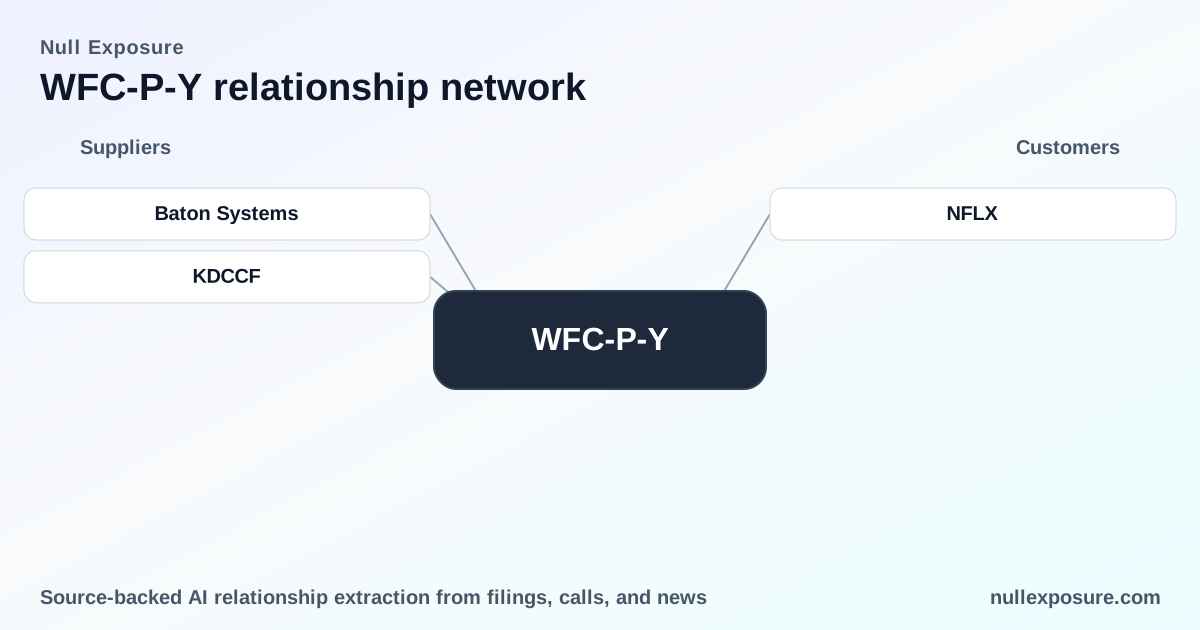
Wells Fargo (WFC-P-Y) — customer relationships that matter for credit and franchise risk
Wells Fargo operates as a diversified financial services franchise that monetizes through lending spreads, deposit and payment services, fee-based wealth and fiduciary businesses, and capital markets activity. For holders of WFC-P-Y depositary preferreds, the bank’s customer relationships drive loan performance, fee flows, and reputational capital that underpin long-term credit strength. This note dissects recent customer links disclosed in public reporting and media, assesses how each relationship maps to Wells Fargo’s operating posture, and highlights the commercial implications investors should track. For a broader view of relationship intelligence and monitoring, visit https://nullexposure.com/.
Why customer relationships matter for preferred holders
Wells Fargo’s balance sheet and franchise value are shaped by three relationship types: early-stage innovation investments that feed future product pipelines, corporate lending that affects asset quality and capital usage, and large corporate service deals that generate fee and deposit flows. Each relationship category carries distinct concentration, criticality, and maturity characteristics that translate directly into credit and operational risk for preferred securities.
Recent relationship snapshot — every item found in the record
Below I cover each relationship surfaced in public sources. Each entry is a concise, plain-English description with the origin of the information.
Blip Energy — incubator participant
Wells Fargo added Chicago-based Blip Energy to its Innovation Incubator (IN2) cohort, signaling direct funding and technical support to an early-stage energy decarbonization firm as part of the bank’s climate and innovation agenda. According to ESG Dive (May 4, 2026), Blip Energy joined a group expanding Wells Fargo’s incubator portfolio to 75 companies, demonstrating strategic investment in technology that could generate future fee or lending opportunities.
Evercloak — incubator participant
Evercloak, an Ontario-based materials/technology company, was included in the same IN2 cohort and received Wells Fargo’s incubator funding and access to NREL expertise, aligning the bank with emerging climate-tech supply chains that could become clients or collateral partners. This participation was reported by ESG Dive (May 4, 2026).
Transaera — incubator participant
Transaera of Somerville, Massachusetts, enters Wells Fargo’s IN2 cohort, reflecting the bank’s emphasis on building proprietary relationships with early-stage decarbonization companies that could feed future structured finance, equipment leasing, or project lending pipelines. The addition of Transaera was noted in ESG Dive (May 4, 2026).
UK’s MFS — opportunistic lender in market disruption
Wells Fargo provided lending to the UK’s MFS after Barclays exited a deal and froze accounts, stepping into a disrupted financing situation; this action reflects Wells Fargo’s capacity to underwrite or bridge corporate exposures when market counterparties retreat. MarketScreener cited Bloomberg coverage that reported the bank’s lending role during the April 22 (2026) episode, illustrating Wells Fargo’s willingness to deploy credit in event-driven situations.
Netflix (NFLX) — commercial relationship referenced in media
Media commentary indicates Wells Fargo is “on the Netflix deal,” implying the bank participates in some form of financing or service engagement with Netflix; the reference was made in InsiderMonkey’s March 10, 2026 write-up. This suggests involvement in corporates’ financing or treasury activities where Wells Fargo can generate fees and deposit or payments volume.
What these relationships collectively reveal about Wells Fargo’s operating model
- Contracting posture: Wells Fargo operates a hybrid posture: it acts as a strategic partner in longer-term innovation initiatives (IN2 incubator funding) while also behaving as a reactive market lender to step into dislocated credit situations (UK’s MFS). This mix shows the bank executes both patient, partnership-style contracts and transaction-driven credit plays.
- Concentration: Relationship types are diversified across stages and sectors — early-stage climate-tech, large media/tech corporates, and opportunistic corporate lending — which reduces single-client concentration risk but concentrates exposure in sectors where platform and reputation matter.
- Criticality: Early-stage incubator ties are low immediate criticality but high optionality for future fee and lending flows; corporate lending and large-deal participation (e.g., Netflix, MFS) are directly critical to near-term balance sheet utilization, provisioning, and fee income.
- Maturity: The portfolio contains a range of maturities: incubator relationships are embryonic and long-dated in payoff, while corporate lending and deal underwriting are short- to medium-term and have immediate balance sheet implications.
Investment implications — what investors should watch
- Credit and capital signals: Opportunistic lending episodes (like the MFS case) increase near-term asset utilization and can shift loss provisioning dynamics if exposures deteriorate; watch reported loan balances and nonperforming asset trends in filings and regulatory updates.
- Revenue optionality: Incubator investments (Blip Energy, Evercloak, Transaera) are revenue optionality plays, not current earnings drivers, but they expand Wells Fargo’s pathway into decarbonization finance and related fee pools.
- Reputational and franchise risk: Public participation in climate-tech incubators supports ESG positioning and can bolster corporate client recruitment; conversely, stepping into deals abandoned by peers increases political and operational scrutiny.
- Operational concentration: While relationships are diversified by type, sector concentration toward climate tech and large corporates increases sensitivity to sector-specific cycles — monitor sector loan performance and deal pipeline composition.
Quick-run takeaways for analysts and operators
- Wells Fargo pairs strategic, long-term incubator investments with opportunistic credit deployment, revealing a dual-mode commercial strategy that supports both franchise-building and balance-sheet utilization.
- Short-term credit exposure and fee generation predominantly come from corporate deal activity, whereas incubator relationships are a longer-term hedged bet on future product and fee streams.
- No specific contractual constraints were identified in the reviewed reporting set, so relationship terms and materiality remain driven by standard commercial and credit negotiations rather than disclosed binding restrictions.
Sources and where to read more
- ESG Dive reported the IN2 incubator additions (Blip Energy, Evercloak, Transaera) on May 4, 2026, describing Wells Fargo’s funding and partnership with NREL for the bank’s 14th cohort.
- MarketScreener relayed Bloomberg coverage (Apr. 22, 2026) that Wells Fargo lent to the UK’s MFS as Barclays exited and froze accounts.
- InsiderMonkey referenced a March 10, 2026 media item noting that Wells Fargo is “on the Netflix deal,” indicating bank involvement with Netflix financing or services.
For continued monitoring of Wells Fargo’s counterparty and customer relationships, consider the continuous relationship-tracking resources available at https://nullexposure.com/.