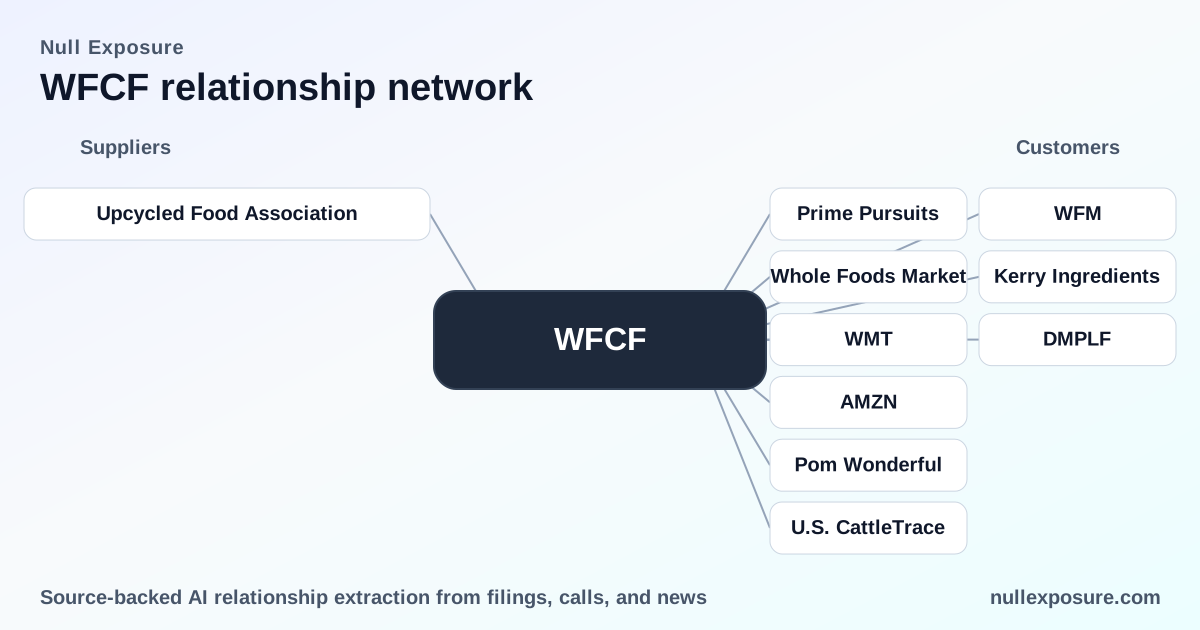
Where Food Comes From (WFCF): Customer Relationships and Commercial Footprint
Where Food Comes From is a North American third‑party verification and certification provider to agricultural, livestock and food companies, monetizing primarily through service fees for on‑site and desk audits, annual certification charges, and ancillary product sales (notably cattle identification ear tags). The company expands revenue by acquiring and operating certification programs (for example, Upcycled Certified and RaiseWell) and then licensing those standards to retailers and CPG customers who pay verification fees and participate in branded premium programs. For a quick look at our coverage and mapping tools, visit https://nullexposure.com/.
How WFCF contracts and where value concentrates
WFCF operates as a service‑oriented verification provider with product support, not as a commodity vendor. Key commercial characteristics that govern investor risk and upside:
- Contracting posture: many audits and certifications are billed on a short‑term or annual fixed‑fee basis, which creates recurring but renew‑risk‑sensitive revenue for specific audit types. (Company disclosures note fixed fees for certain third‑party crop and processed product audits.)
- Customer profile: the client base includes large enterprise food companies and specialty retailers, which drives higher ticket sizes and meaningful reference value when major chains adopt a program.
- Geographic concentration: operations and customers are concentrated in North America, limiting currency and country diversification but aligning the business with large U.S. retail and packer markets.
- Role and criticality: WFCF is a third‑party service provider and standard operator—it is relied upon for independent verification and program administration rather than as an ingredient supplier.
- Business mix: revenue comes from services (verification/certification) as the core and hardware (ear tags) as an ancillary, lower‑margin complement that ties customers into verification workflows.
These characteristics imply recurring but renewal‑dependent revenue, high importance of anchor retail partnerships for program adoption, and moderate operational leverage from program scaling.
Customer relationships that matter — documented counterparties
Prime Pursuits
WFCF disclosed collaboration with Prime Pursuits alongside Walmart to introduce CARE Certified sustainable leather to U.S. automotive brands, indicating WFCF’s role in certifying sustainability claims beyond protein into leather supply chains. Source: WFCF 2025 Q4 earnings call (03/07/2026).
Walmart (WMT)
WFCF cited a joint effort with Walmart to introduce CARE Certified sustainable leather, positioning Walmart as a strategic commercial partner for program rollout into large retail and industrial channels. Source: WFCF 2025 Q4 earnings call (03/07/2026).
Whole Foods Market
Whole Foods Market became the first major retailer to adopt WFCF’s RaiseWell Certified for Beef, a commercial endorsement WFCF highlighted as likely to drive broader adoption of the program and to expand its premium protein portfolio. Source: Globenewswire press release (Feb 19, 2026) and WFCF 2025 Q4 earnings commentary.
WFM (alternate listing for Whole Foods)
In earnings remarks WFCF reiterated that Whole Foods Market is the inaugural major retail adopter of RaiseWell, underscoring the program’s strategic value as a retail reference account. Source: WFCF 2025 Q4 earnings call (03/07/2026).
AMZN (Amazon / Whole Foods parent)
Press coverage and company releases framed Whole Foods’ adoption of RaiseWell within Amazon/AMZN‑linked reporting, reinforcing the potential distribution and marketing reach that accompanies a Whole Foods endorsement. Source: TradingView/Zacks and Globenewswire coverage (FY2026 press cycle, March 2026).
Pom Wonderful
Pom Wonderful is cited among brand participants in certification programs tied to sustainability and waste‑reduction (Upcycled Certified), illustrating WFCF’s penetration into specialty ingredient and beverage suppliers. Source: The Packer reporting on Upcycled Certified growth (FY2025).
U.S. CattleTrace
WFCF agreed to administer technical aspects of U.S. CattleTrace’s mission, acting as the implementation partner while governance remains with CattleTrace leadership and board—demonstrating WFCF’s role as a systems operator for traceability initiatives. Source: Drovers (reporting on partnership, FY2025).
Superior Livestock Auction
WFCF distributed video links and public materials around the first auction sale of RaiseWell‑certified cattle at Superior Livestock Auction in Oklahoma City, indicating channel execution from certification to cash price discovery in live cattle markets. Source: Globenewswire investor notice (Jan 06, 2026).
Kerry Ingredients
Kerry Ingredients is listed among CPG and ingredient customers referenced in WFCF’s acquisition of Upcycled Certified, signaling WFCF access to large food manufacturers and ingredient processors through the upcycled program. Source: Bluebook Services / NewHope coverage of the Upcycled Certified acquisition (FY2023–FY2024 reporting).
Del Monte
Del Monte is specifically cited as one of more than 90 companies with products certified under Upcycled Certified, demonstrating WFCF’s established commercial relationships with leading CPG brands through program ownership. Source: Bluebook Services and NewHope reporting on the Upcycled Certified program (FY2023–FY2024).
DMPLF (Del Monte alternate ticker)
Press and industry articles referencing Upcycled Certified list Del Monte (DMPLF) among certified customers, reinforcing the same commercial linkage under a market ticker notation. Source: The Packer / NewHope reporting (FY2024–FY2025).
What these relationships imply for investors
- Commercial validation: Whole Foods Market’s adoption of RaiseWell is a high‑quality retail endorsement that materially improves the program’s go‑to‑market profile and WFCF’s ability to sell verification services to other retailers and branded suppliers. (Globenewswire, Feb 2026.)
- Revenue characteristics: the mix of annual fixed‑fee audits and program administration contracts generates recurring revenue that is nevertheless dependent on renewals and program adoption cycles; large enterprise customers amplify both upside and client concentration risk.
- Operational leverage: owning program IP (RaiseWell, Upcycled Certified) and providing technical administration for initiatives like U.S. CattleTrace creates scalable margins if adoption broadens, but execution across auctions, retail supply chains, and CPG customers remains the gating factor.
Key takeaways and investor action points
- Positive catalyst: retailer adoption (Whole Foods) is a concrete commercial catalyst that supports premium pricing for certified protein and improves WFCF’s referenceability.
- Concentration and renewal risk: reliance on large enterprise customers and short‑term/annual certification billing suggests revenue is recurring but renewal‑sensitive.
- Operational optionality: program ownership and technical administration work (U.S. CattleTrace, auction partnerships) provide multiple monetization pathways beyond pure audit fees.
For a structured counterparty map and deeper relationship scoring, visit https://nullexposure.com/ — our platform catalogs these linkages and their primary source references.
Bold investment thesis: WFCF is a niche provider converting program ownership and high‑quality retail endorsements into scalable verification revenue — upside depends on program adoption velocity and enterprise renewal rates.