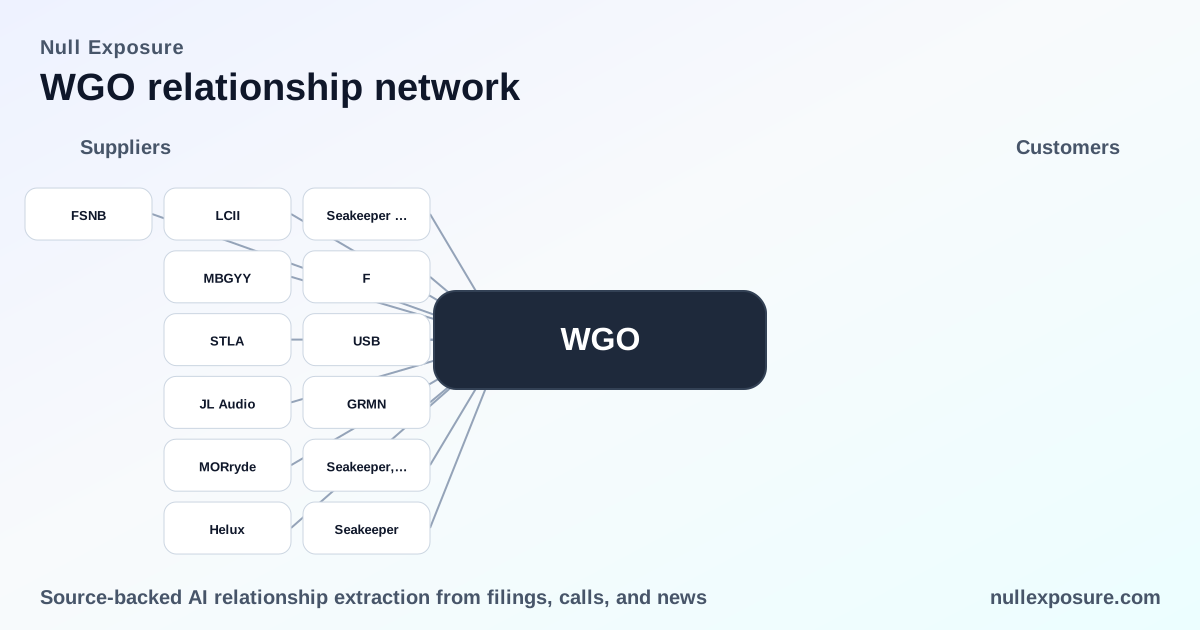
Winnebago (WGO): Customer Relationships and What They Signal for Investors
Winnebago Industries operates as a manufacturer and reseller of recreational vehicles and marine products, monetizing primarily through the manufacture and wholesale sale of motorhomes, towable RVs, marine units, parts and related services to an independent dealer network across the U.S. and Canada. Revenue is driven by unit sales to dealers, supplemented by parts, accessories and direct sales of specialty items (for example, Lithionics batteries), while short-term repurchase obligations and predominantly cash sales to dealers create a distinct working-capital and contingent-liability profile for the business. For a concise view of customer signals and relationship exposures, see NullExposure for additional context and signals: https://nullexposure.com/
Two customer relationships surfaced — what they are and why they matter
Winnebago’s publicly observed customer and partner touches in our set are narrow but telling: a commercial fleet customer (LandJet) and a supply-chain/partner mention from a third-party company (CWH). Both illustrate Winnebago’s positioning as a manufacturing supplier to other businesses and as a collaborative partner within the broader RV ecosystem.
LandJet — a commercial franchise customer for custom Sprinter mobile offices
LandJet has launched a next-generation fleet of custom Mercedes Sprinter mobile office vehicles that are manufactured exclusively by Winnebago Industries, demonstrating Winnebago’s ability to supply bespoke, commercial-use specialty vehicles beyond leisure RVs. This relationship was reported by QuadCities on May 4, 2026. (Source: QuadCities news report, May 4, 2026)
CWH — cited as a partner in demand-visibility collaboration
In a 2025 Q4 earnings call, CWH said it works extensively with partners including Thor, Forest River and Winnebago to ensure those manufacturers have "visibility into our real-time demand" so they can adjust parts and materials ordering—indicating Winnebago participates in information-sharing and coordination with distribution or channel partners. (Source: CWH earnings call, 2025 Q4 — March 8, 2026)
What the observed relationships collectively reveal about Winnebago’s customer posture
The two items above cover the relationships surfaced in the available results. Taken together with company disclosures, they reflect a consistent operating model:
- Dealer- and channel-led distribution: Winnebago sells predominantly to independent dealers across North America who then retail to consumers, and it also supplies specialized commercial customers (e.g., LandJet) who buy customized units.
- Reseller orientation with active dealer agreements: The company describes its dealers as independent resellers and maintains sales and service agreements that are subject to annual review, signaling an established but continually re-evaluated dealer network.
- Short-term, spot-like contracting posture: Company disclosures emphasize that sales to dealers are primarily on cash terms and that repurchase agreements create contingent obligations for only limited periods (up to 18 months for RVs and up to 24 months for marine units). This is a commercial model that favors transactional sales over long-term, fixed-price contracts.
- Low single-customer concentration: Winnebago reports that no single dealer organization accounted for more than 10% of net revenues for FY2023–FY2025, which is a company-level signal that revenue concentration risk at the dealer level is low.
- Modest contingent exposure: The company discloses a repurchase accrual of approximately $1.6 million as of August 30, 2025, which sits against $2.9 billion in trailing revenue—an indicator that repurchase-related contingent liability is measurable yet small relative to the revenue base.
These are company-level signals drawn from disclosures; they are not assigned to any single named customer unless explicitly stated in the source excerpts.
How the constraints shape near-term risk and operational flexibility
Winnebago’s contract mix and obligations create a distinctive risk/return tradeoff for investors:
- Working-capital sensitivity: Cash sales to dealers and short repurchase windows mean revenue is realized quickly, but inventory cycles at dealers and repo exposure create episodic working-capital pressure.
- Limited counterparty concentration reduces the risk of a single dealer failure but increases sensitivity to aggregate dealer demand; declines in leisure spending or dealer inventories would transmit quickly to Winnebago’s top line.
- Operational maturity and active relationships: Annual reviews of dealer agreements and an “active” relationship stage reinforce that the dealer network is long-established and operationally mature, but still subject to periodic re-pricing and re-terms.
- Small but present contingent liabilities: The repurchase accrual and repurchase agreement language indicate short-duration contingent liability, which is manageable in absolute terms but important to monitor during credit cycles or dealer distress.
Investment implications: what to watch and why it matters
- Revenue predictability: The dealer-reseller model and low single-dealer concentration support diversified revenue streams, but because contracts are short-term and often cash-based, visibility into future months depends on dealer inventories and order flow rather than long-term sales contracts.
- Earnings sensitivity to channel activity: Parts, accessories and specialty sales (including direct sales like Lithionics batteries) provide margin diversification; however, the core earnings profile remains linked to unit shipments and dealer order cadence.
- Balance-sheet resilience: The repurchase accruals and short repurchase windows require monitoring, but current disclosures place the measured repurchase exposure at a modest level relative to revenue and market capitalization.
- Value from commercial and custom work: The LandJet relationship underscores Winnebago’s ability to capture higher-value, purpose-built commercial orders—an adjacent revenue stream that can lift average selling prices and improve utilization of manufacturing capacity.
For further signal aggregation and a structured view of customer relationships across peers, consult NullExposure: https://nullexposure.com/
Bottom line: clear supplier to many, limited counterparty risk, watch dealer demand
Winnebago is a manufacturer whose revenue model is reseller-driven, spot-oriented and geographically North American, with low counterparty concentration and short-duration contingent repurchase obligations. The surfaced relationships—LandJet as an exclusive manufacturer customer and CWH’s mention of collaborative demand visibility—underscore Winnebago’s dual role as a supplier of both leisure and commercial specialty vehicles and as a participant in information-sharing across the RV supply chain. Investors should focus on dealer order trends, inventory levels, and the evolution of repurchase obligations as the primary near-term drivers of cash flow and earnings variability.
Bold takeaways:
- Core exposure is to aggregate dealer demand, not a handful of large customers.
- Contracting is short-term and often cash-based, which increases sensitivity to cyclical dealer behavior but limits long-term counterparty risk.
- Repurchase accruals exist but are small relative to revenue; they are a monitoring item rather than an immediate capital threat.