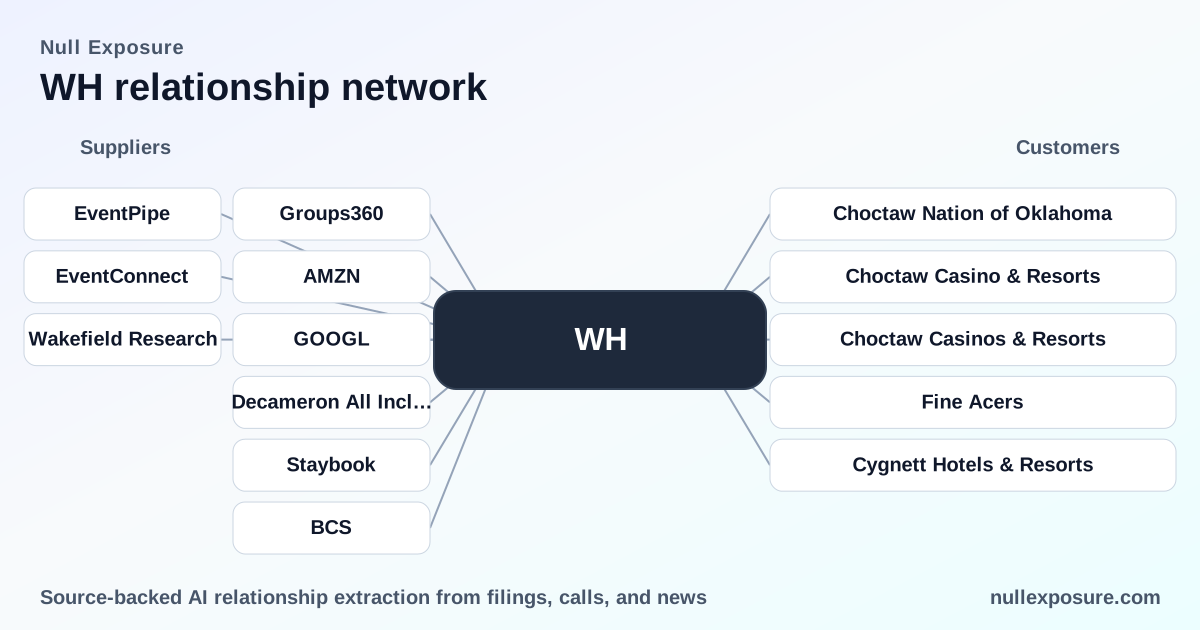
Wyndham Hotels & Resorts — customer map and what it means for investors
Wyndham Hotels & Resorts operates as a pure-play global hotel franchisor and brand licensor, monetizing through long-term franchise agreements, ongoing royalties, reservation and marketing fees, and selective management contracts. The company leverages a highly diversified owner base to scale room growth and ancillary revenue while preserving capital-light economics; investors should value WH as a recurring-fee business with exposure to global travel trends, brand mix upgrades and regional expansion. For a concise intelligence feed on customer relationships and partner concentration, visit https://nullexposure.com/.
How Wyndham’s customer relationships drive cash flow and risk
Wyndham’s operating model is a licensor-first, fee-driven platform. Franchise agreements are typically 10–20 years, providing multi-year visibility into royalties and marketing fees, and the company licenses its brands to thousands of owners globally, which reduces single-counterparty concentration while increasing operational complexity. The constraints in public disclosures provide useful signals:
- Contracting posture: Franchise contracts are long-dated (10–20 years), which supports predictable royalty streams and improves valuation visibility.
- Counterparty mix: The owner base ranges from sole proprietors to institutional REITs and national groups, creating low counterparty concentration but mixed credit profiles.
- Geographic exposure: The business is global, though U.S. royalties remain dominant (roughly 78% of royalties in 2024), which concentrates cash flow sensitivity to North American travel cycles.
- Role diversity: Wyndham acts primarily as licensor and service provider, and selectively as hotel manager under management contracts — this hybrid role creates modest operational exposure where Wyndham takes on more delivery risk.
These characteristics translate into steady cash conversion with episodic upside from brand upgrades and pipeline conversions, and cyclical sensitivity driven by U.S. travel. For ongoing relationship monitoring and customer analytics, see https://nullexposure.com/.
Relationship map: partners, owners and named properties
Below is a concise, investor-focused run through every customer relationship reported in recent coverage, with source context for verification.
-
Decameron All-Inclusive Hotels & Resorts — Decameron signed with Wyndham in 2023 to bring over 2,600 rooms across nine all‑inclusive resorts into Wyndham’s registry, including multiple Mexican properties. According to SahmCapital (Apr 6, 2026).
-
Palladium Hotel Group — Palladium entered a strategic alliance in 2022 that added upper-upscale and luxury resorts in Mexico and the Caribbean to Wyndham’s Registry Collection. Reported by SahmCapital (Apr 6, 2026).
-
Choctaw Nation of Oklahoma — Wyndham announced a multi-hotel agreement with the Choctaw Nation to expand its upscale and lifestyle offerings. Announced via PR Newswire (Mar 10, 2026).
-
ALMAL Real Estate Development — ALMAL selected Wyndham to manage The One by ALMAL Bali Nusa Dua, adding a luxury property to the Registry Collection under a management/branding agreement. Reported by SahmCapital (Mar 24, 2026).
-
Choctaw Casinos & Resorts — The deal with the Choctaw brings four Choctaw Casino & Resorts properties (nearly 2,000 rooms) into Wyndham’s portfolio, expanding resort and casino-adjacent inventory. Covered by BreakingTravelNews and PR Newswire (Mar 10, 2026).
-
Viva Resorts (Viva Resorts by Wyndham) — Viva Resorts is a long‑standing partner; nine all‑inclusive resorts (over 3,700 rooms) in Mexico and the Caribbean operate under Wyndham’s Trademark Collection. Reported by SahmCapital and TravelMarketReport (Apr–May 2026).
-
Grupo MX Hotels — Grupo MX strengthened growth through a long-term partnership with Wyndham, supporting the company’s Mexico expansion. Reported by SahmCapital and TravelMarketReport (Apr–May 2026).
-
Grand Decameron Complex Bucerias — This beachfront resort was included among Decameron properties franchised into Wyndham’s Trademark All‑Inclusive offering. Noted in Finviz coverage on the Trademark Collection milestone (May 2026).
-
Hilo Hawaiian Hotel — The Hilo Hawaiian Hotel is listed under Trademark Collection by Wyndham, supporting brand penetration in Hawai‘i. Cited by Finviz (May 2026).
-
Bilt — Bilt added Wyndham Rewards as a transfer partner, integrating Wyndham’s loyalty currency into Bilt’s membership transfer lineup. Announced by Bilt newsroom (2026).
-
Hotel MX Condesa CDMX — Hotel MX Condesa joined Trademark Collection by Wyndham, expanding urban portfolio presence in Mexico City. Mentioned in Finviz (May 2026).
-
Hotel Traveltine Downtown Singapore — Traveltine Downtown Singapore joined the Trademark Collection, supporting Wyndham’s expansion into Southeast Asian boutique assets. Cited in Finviz (May 2026).
-
MB Hotel (Miami Beach) — MB Hotel, a boutique oceanfront property, is part of Trademark Collection by Wyndham in Miami Beach. Covered by Finviz (May 2026).
-
The Beekman Tower — The historic Beekman Tower in Manhattan joined Trademark Collection, adding distinctive, apartment-style inventory to Wyndham’s urban offering. Finviz (May 2026).
-
The Galt House Hotel — The Galt House, a flagship Trademark Collection property in Louisville with more than 1,300 rooms, reinforces Wyndham’s large independent-hotel strategy. Finviz (May 2026).
-
Fontinha Porto — Fontinha Porto in Portugal joined Trademark Collection, reflecting Wyndham’s selective European boutique additions. Finviz (May 2026).
-
The Orbit Hotel — The Orbit in Cleveland (a converted NASA facility) joined Trademark Collection, reflecting brand focus on properties with local storytelling. Finviz (May 2026).
-
TNL (Travel + Leisure Co.) — TNL executives acknowledged Wyndham as a critical strategic partner for owner upgrades and revenue optimization, per a Q4 2025 earnings call transcript. Cited in InsiderMonkey and TradingView excerpts (Mar 2026).
-
The Proud Karon Beach Phuket — This Phuket resort entered the Trademark Collection, supporting Wyndham’s Asia inventory growth. Finviz (May 2026).
-
Bhanfort Palace Resorts Pvt. Ltd. — Bhanfort signed to develop Wyndham Garden Chittorgarh Sahnawa (138 rooms) in Rajasthan, India, illustrating pipeline growth in South Asia. Reported by HotelsMag and HospitalityNet (May 2026).
-
Revo Hospitality Group — Wyndham disclosed a deferral of fees from Revo and noted Revo’s contribution to revenue dynamics in Q1 2026 reporting. LodgingMagazine (May 2026).
-
FibraHotel — FibraHotel has contributed to Wyndham’s Mexican footprint as part of several group partnerships reinforcing national scale. SahmCapital (Apr 6, 2026).
-
Bel Air — Bel Air (a group with ~700 rooms) is cited as instrumental in scaling Wyndham’s Mexico footprint. SahmCapital (Apr 6, 2026).
-
Alzen — Alzen (more than 1,300 rooms) is a significant Mexican group partner that strengthened Wyndham’s nationwide presence. SahmCapital (Apr 6, 2026).
-
Grupo Hola — Grupo Hola is named among the chain partners that aided Wyndham’s expansion in Mexico. SahmCapital (Apr 6, 2026).
-
Fibra Inn — Fibra Inn is called out as another institutional owner that helped build Wyndham’s scale in Mexico. SahmCapital (Apr 6, 2026).
-
Cygnett Hotels & Resorts — Wyndham entered a strategic alliance with Cygnett for La Quinta and Registry Collection brands, targeting the India market. AsianHospitality (Mar 2026).
-
Optima — Optima is referenced among groups that enhanced Wyndham’s Mexican reach. SahmCapital (Apr 6, 2026).
-
AADESHA Hotel Group — AADESHA is an owner of Dolce by Wyndham Miami Beach, illustrating Wyndham’s owner mix for upper-tier brands. AsianHospitality (2026).
-
Blue Road Hospitality — Blue Road Hospitality co‑owns Dolce by Wyndham Miami Beach with AADESHA, reflecting joint ownership structures. AsianHospitality (2026).
-
PCG‑SP Venture 1, LLC — PCG‑SP Venture 1, LLC owns V Capri Palm Springs, a property operating under Wyndham’s flag. AsianHospitality (2026).
-
Tarrytown Partners LLC — Tarrytown Partners LLC owns Sleepy Hollow Hotel, which is part of Wyndham’s branded portfolio. AsianHospitality (2026).
-
Fine Acers — Fine Acers partnered with Wyndham to launch Dolce by Wyndham in India with properties in Goa and Udaipur, signaling brand rollouts in new markets. AsianHospitality (Mar 2026).
Investment takeaways and consequences for underwriting
- Core investment thesis: Wyndham’s franchise‑and‑licensing model converts global room growth into recurring fees with high operating leverage and capital-light returns. The long-term nature of franchise agreements is the primary stabilizer for revenue forecasts.
- Key risks: Geographic concentration in the U.S. and dependence on large regional owner groups for scale (Mexico partnerships, casino deals) create cyclical exposure and some counterparty economic sensitivity.
- Catalysts: Upscale brand conversions (Registry Collection, Dolce, Trademark) and loyalty partnerships (e.g., Bilt) will accelerate fee growth and ancillary revenue capture.
For deeper client‑level monitoring and structured relationship intelligence on WH customers, visit https://nullexposure.com/ for ongoing coverage and signal tracking.