Wheeler REIT (WHLR) — Tenant Relationships and Commercial Profile for Investors
Wheeler Real Estate Investment Trust (WHLR) owns and manages a portfolio of grocery-anchored and value-oriented retail properties across the United States and primarily monetizes through long-term triple-net leases, property management fees and selective leasing activity that targets national and regional necessity retailers. The company’s cash flow profile is driven by long-duration leases with renewal optionality and a tenant mix weighted to supermarkets and discount chains.
For a deeper dataset-led view of WHLR’s tenant relationships and operating constraints, visit https://nullexposure.com/.
How Wheeler’s business model turns retail storefronts into predictable cash flow
Wheeler pursues a value-oriented, income-first REIT strategy: acquire well-located retail centers, lock in national and regional grocery and discount tenants on long-term leases, and extract stable base rent with occasional ancillary property management revenue. WHLR reports a weighted-average remaining lease term of 36 years, and its operating portfolio (75 properties totaling ~7.66 million sq ft) is 93.1% leased as of December 31, 2024, which underpins income stability and valuation multiple defensibility. According to the 2024 Form 10‑K, most leases include renewal options that can extend terms from five to fifty years, emphasizing Wheeler’s contracting posture toward durable, long-dated cash streams.
Explore the full platform at https://nullexposure.com/ for related signals and source-traced references.
The tenant list you need to know — names, roles, and sources
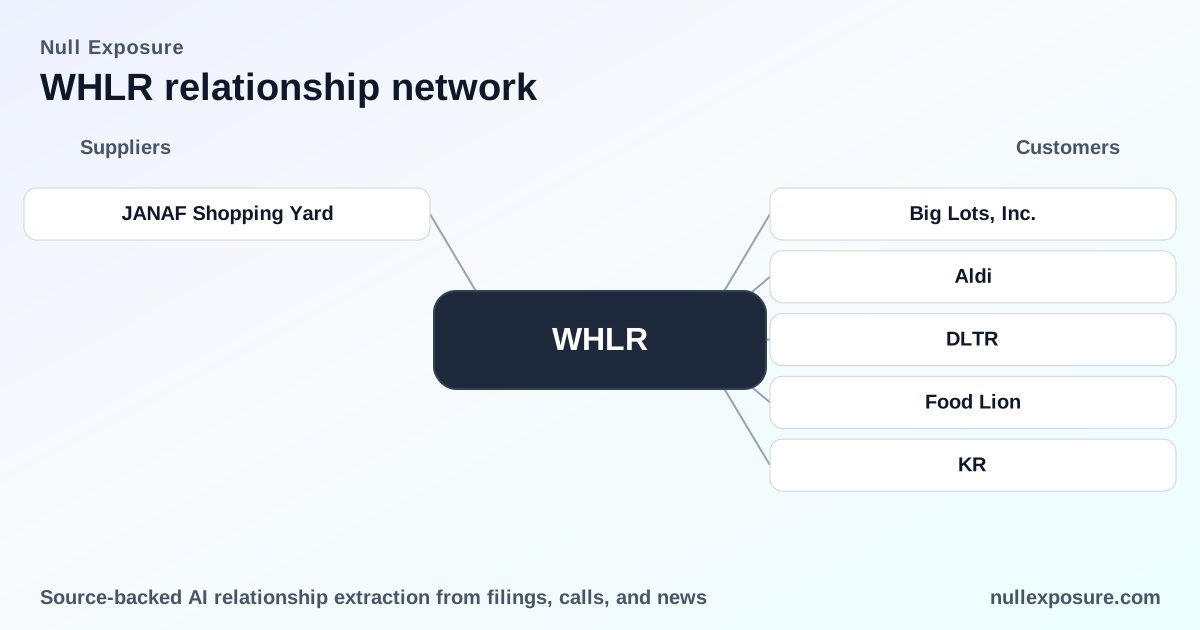
Below are the customer relationships surfaced in the coverage set. Each relationship is summarized in plain English, with source context.
-
Big Lots, Inc.
Big Lots is a direct tenant in WHLR’s portfolio; Wheeler disclosed that Big Lots leased five locations and that Big Lots filed for Chapter 11 protection, which introduces a tenant credit event with direct rent exposure across five stores. This is documented in WHLR’s 2024 Form 10‑K (FY2024). -
Aldi
Aldi is listed as one of WHLR’s blue‑chip tenants with long-term leases supporting portfolio resilience; this tenant mention is cited in a March 2026 press piece that discussed shareholder activism and WHLR’s grocery-anchored profile. (Reporter News, March 2026). -
Dollar Tree (DLTR)
Dollar Tree figures among the national, value-oriented tenants noted as part of WHLR’s grocery/value tenant mix and long-term lease strategy; the mention appears in multiple March 2026 news items discussing Wheeler’s tenant composition. (Reporter News and inkl.com, March 2026). -
Food Lion
Food Lion is identified as a grocery anchor in WHLR’s portfolio and is cited as a contributor to portfolio stability in recent press coverage addressing the REIT’s tenant quality. (Reporter News and inkl.com, March 2026). -
Kroger (KR)
Kroger is referenced as one of the national supermarket anchors in WHLR’s tenant mix; recent investor- and media-focused write-ups cite Kroger alongside Food Lion and discount retailers to explain the portfolio’s necessity-driven rent base. (Reporter News and inkl.com, March 2026). -
TALK (Talkspace)
A FierceHealthcare article (March 2026) references Talkspace’s partnership with a virtual care platform named Wheel; this news item appears in the relationship results but does not establish Talkspace as a retail tenant of WHLR in filings and should be treated as a peripheral media mention rather than a core tenant relationship. (FierceHealthcare, March 2026).
What the contract and portfolio constraints tell investors
WHLR’s public reporting and derived constraints paint a clear operating posture:
-
Contracting posture: long-term, lock-in focused. The 10‑K discloses a weighted-average remaining lease term of 36 years and renewal options that can extend leases up to 50 years, indicating a portfolio designed for predictable, sticky income rather than rapid turnover.
-
Counterparty profile: national and regional necessity retailers. WHLR intentionally targets supermarket chains and value retailers that generate regular consumer traffic; this reduces vacancy risk relative to discretionary retail formats.
-
Geographic concentration: U.S. regional clusters. The company operates exclusively in the U.S., with portfolio exposure concentrated in the Mid‑Atlantic (≈44%), Southeast (≈43%) and Northeast (≈13%), an arrangement that concentrates macro retail risk by region but also creates operational scale in those markets.
-
Service-layer revenue and intra-company relationships. WHLR provides property management and leasing services to Cedar (a subsidiary), receiving $1.4M in 2024 under the Wheeler Real Estate Company Management Agreement; this establishes a secondary revenue stream and intra-group dependency on management contracts (10‑K, FY2024).
-
Maturity and stage: active operator with stabilized occupancy. The portfolio is explicitly described as an “Operating Portfolio” of 75 properties at 93.1% leased as of year‑end 2024, signaling a mature, cash-generating asset base.
Risk profile and concentration considerations
- Tenant credit events can have concentrated impact. The Big Lots Chapter 11 filing affects five leased locations — a material operational credit event given the REIT’s deliberate emphasis on long-term, fixed-rent arrangements. (WHLR 2024 Form 10‑K).
- Regional exposure amplifies local retail cycles. With ~87% of base rent tied to two regions (Mid‑Atlantic and Southeast), economic weakness or competitive retail shifts in those corridors would stress rental re‑let dynamics and valuation multiples.
- Counterparty mix reduces but does not eliminate retail risk. National grocers and discount retailers lower vacancy risk, yet retail secular shifts (omnichannel grocery, format consolidation) remain an underwriting consideration.
Investment takeaways and near-term catalysts
- Income-first profile supported by long leases and high occupancy provides a defensible income base, which investors should value differently than portfolios with shorter lease durations.
- Tenant credit monitoring (e.g., Big Lots) is a near-term focus; rent recoverability, store closures, and lease re‑negotiations will influence 2026 cash flow and valuation.
- Regional macro and retail format trends will disproportionately affect WHLR given its geographic clustering and supermarket/discount tenant concentration.
For point-of-entry research, portfolio heat maps and tenant-level rollups are helpful next steps — visit https://nullexposure.com/ for matched-source analytics and to explore source-backed relationship signals.
Final view
Wheeler REIT operates as a deliberately conservative, lease‑term-heavy retail landlord with a tenant mix concentrated in necessity and value retail. The firm’s long lease durations and high occupancy rate are core strengths, but Big Lots’ bankruptcy filing and regional concentration are actionable risk factors that will determine near-term cash flow stability and valuation rerating. Investors must weigh the durability of long-term contractual income against tenant credit trajectories and regional retail economics.