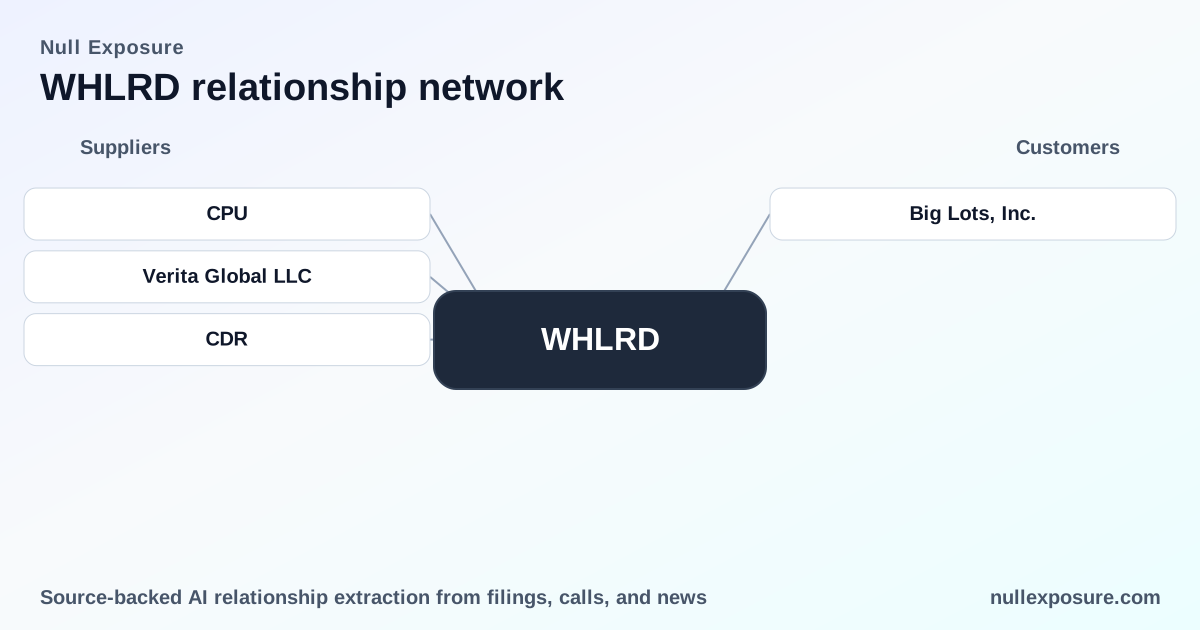
WHLRD customer relationships: what institutional investors need to know
Wheeler Real Estate Investment Trust (Preferred: WHLRD) operates a self-managed, grocery‑anchored retail REIT that monetizes primarily through base rent collections, tenant reimbursements and ancillary property management fees. The company’s income stream is driven by a mix of long‑dated minimum rents and shorter leases that allow market repricing on turnover, while incremental fee income flows from management services it provides to affiliated entities. For investors evaluating counterparty risk and operational durability, the public record highlights a low tenant concentration profile offset by exposure to value‑retail bankruptcies and a regional U.S. footprint that concentrates cash flows in a few states. Learn more coverage at https://nullexposure.com/.
How Wheeler’s economics work in practice
Wheeler owns and operates 75 properties (roughly 7.66 million leasable square feet) that are 93.1% leased as of year‑end 2024. The business model combines three revenue levers:
- Minimum contractual rents under noncancelable leases, which create predictable cash flow over the near term.
- Re‑leasing upside from a significant subset of leases shorter than ten years, which the company uses to drive rent resets at market rates.
- Service and management fees earned through internal arrangements with related entities.
Financial scale is modest: revenue for the trailing twelve months was about $99.4 million, with reported EBITDA of $52.2 million and a market capitalization near $33.6 million. Those figures underline a capital structure and equity base where operating surprises or tenant recoveries have outsized effects on shareholder returns.
Operating constraints that shape revenue stability
The 2024 public filings expose a clear set of company‑level signals that govern how resilient the cash flow is:
- Lease mix is mixed‑term: WHLRD reports both long‑term noncancelable rents that provide multi‑year visibility and a material share of leases under ten years that enable market re‑pricing at turnover. This combination supports near‑term predictability and medium‑term rent upside.
- Low landlord concentration risk: No single tenant accounted for more than approximately 6% of annualized base rent, which reduces single‑counterparty exposure.
- Regional concentration in the U.S.: All operations are domestic; the portfolio is concentrated in the Mid‑Atlantic, Southeast and Northeast, which represented roughly 44% / 43% / 13% of annualized base rent respectively as of December 31, 2024.
- Counterparty profile skews to national and regional chains: The company primarily leases to supermarket and value‑oriented retailers, a tenant mix that drives steady consumer traffic but also ties cash flow to retail sector cycles.
- Self‑managed operating posture: Wheeler is a fully integrated, self‑managed REIT that performs property management and leasing for an affiliate (Cedar) and recognized fee income from that arrangement: $1.4 million in 2024 and $2.1 million in 2023 per the filing.
- Core focus on grocery‑anchored centers: The business is intentionally concentrated on grocery‑anchored shopping centers, which preserves demand during retail dislocation but increases exposure to grocery landlord pricing dynamics.
These constraints collectively imply moderate cash‑flow stability with active operational levers: long minimum rents provide a base, shorter leases provide re‑pricing optionality, and self‑management produces fee income but centralizes execution risk.
Customer relationships disclosed in public filings
Below are the customer relationships that WHLRD has disclosed publicly in the documents reviewed.
Big Lots, Inc.
WHLRD reports that Big Lots filed for Chapter 11 protection on September 9, 2024, and that Big Lots leased five locations from WHLRD. This creates an immediate counterparty recovery and re‑leasing consideration for those five assets. According to WHLRD’s 2024 Form 10‑K, the bankruptcy filing is explicitly referenced and tied to the leases in question (10‑K, FY2024).
Cedar (affiliate management relationship)
WHLRD performs property management and leasing services for Cedar, a subsidiary, under a formal management agreement and received $1.4 million in 2024 (and $2.1 million in 2023) for those services. That relationship generates recurring fee income and concentrates operational execution inside the Wheeler organization, as described in the 2024 Form 10‑K (constraints evidence in the FY2024 filing).
What the Big Lots bankruptcy means for holders and operators
The Big Lots Chapter 11 filing is the most concrete counterparty event disclosed and carries several practical implications:
- Near‑term cash‑flow disruption is likely for the five leased locations, given the stay and rent‑treatment mechanics under Chapter 11; the exact cash impact depends on whether leases are assumed, rejected or assigned.
- Re‑leasing opportunity exists: If leases are rejected, WHLRD can re‑market grocery‑anchored space in markets where demand remains strong; the company’s lease mix (many leases under ten years) supports faster repricing on vacated boxes.
- Economic exposure is limited at scale: WHLRD’s filing states no tenant exceeds ~6% of annualized base rent, so the Big Lots exposure, while material locally, is immaterial at the portfolio level.
The bankruptcy therefore constitutes a localized operational shock rather than a systemic threat to WHLRD’s portfolio cash flows, given the low tenant concentration and diversified national counterparty base.
Investment implications and risk signals
For investors and operators, the public record creates a clear risk/reward profile:
- Strengths: Grocery‑anchored focus and a near‑full occupancy rate support predictable rent rolls; low single‑tenant concentration shields balance‑sheet metrics from single‑counterparty failure.
- Risks: Regional concentration in a handful of U.S. markets concentrates macro retail risk; exposure to value retailers creates vulnerability to retail bankruptcies (as evidenced by Big Lots).
- Operational leverage: Self‑management produces fee income and margin capture but centralizes execution risk—operational failures would directly hit both property-level performance and management fee streams.
Key metrics to watch in subsequent quarters are rent collection trends for the vacated Big Lots locations, re‑leasing velocity and achieved spreads on turnovers, and whether affiliate fee income from Cedar stabilizes or declines.
Explore in‑depth counterparty coverage and modeling templates at https://nullexposure.com/ — the firm maintains structured visibility on tenant events and landlord exposures.
Bottom line
WHLRD runs a cash‑flow driven retail REIT model that benefits from grocery anchors, a blended lease maturity profile and a self‑managed structure that produces both rent and service fee income. The publicly disclosed Big Lots Chapter 11 filing is an immediate operational test but not a portfolio‑level existential threat given low tenant concentration and multi‑market exposure. Investors should focus on rent recovery outcomes at the affected assets, re‑leasing spreads on turnover and the company’s ability to convert shorter‑term lease expirations into positive rental repricing.