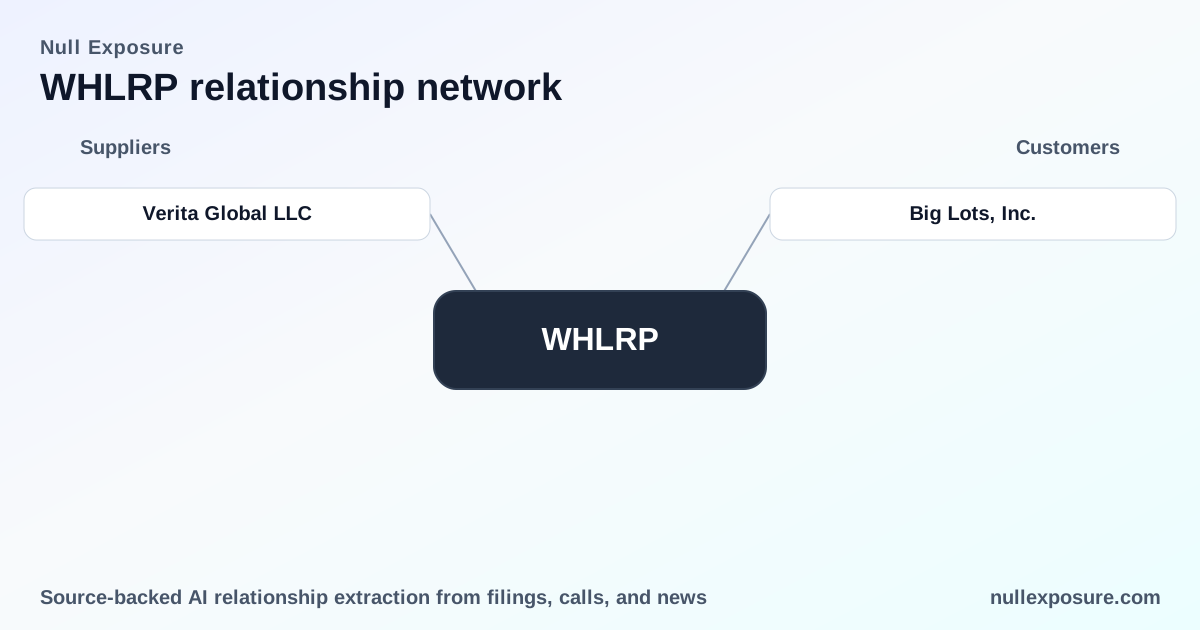
Wheeler REIT (WHLRP) — Customer Relationships and What They Mean for Investors
Wheeler Real Estate Investment Trust operates and monetizes a portfolio of retail and community shopping centers across the U.S., generating principal cash flow from rental revenues and incremental income from property management and leasing services it performs for related entities. The company's business model is concentrated on leasing long-term retail tenants and self‑administering property management, which creates steady rent receipts but exposes investors to retail leasing cycles and geographic concentration in the Mid‑Atlantic, Southeast and Northeast.
For a concise enterprise‑level view and further client relationship intelligence, see Null Exposure’s research hub: https://nullexposure.com/.
One customer relationship on the record — what the filings show
Big Lots, Inc.
- Big Lots leased five locations from Wheeler Real Estate, a tenant relationship disclosed in Wheeler’s FY2024 Form 10‑K. According to the company's FY2024 10‑K filing, the leases are identified collectively as the “Big Lots Leases.” (Source: Wheeler Real Estate FY2024 10‑K, 2024 filing.)
Takeaway: Big Lots is a multi‑site retail tenant in Wheeler’s portfolio; the filing lists the count of leased locations but does not disclose that tenant as a disproportionately material renter.
How Wheeler’s customer relationships shape the operating profile
Wheeler’s public disclosures and extracted constraints sketch a clear operating posture for the landlord business:
-
Contracting posture — long‑term, predictable rent streams. The company discloses future minimum rents under noncancelable operating leases for multiple years forward, reflecting a portfolio structured around long‑dated tenant contracts rather than short, turnover‑prone arrangements. This implies predictable cash flow visibility for investors who underwrite rent roll stability. (Company-level signal derived from FY2024 lease disclosure.)
-
Counterparty profile — national and regional retail tenants. Wheeler states it “generally leases its properties to national and regional retailers” and focuses on necessity and value‑oriented concepts that drive regular consumer traffic. This tenant selection strategy is explicitly designed to stabilize occupancy and reduce retail churn. (Company-level signal from FY2024 disclosures.)
-
Geographic concentration — U.S. regional clusters. The portfolio is concentrated in the Mid‑Atlantic (≈44% of annualized base rent), Southeast (≈43%) and Northeast (≈13%), and the firm has no operations outside the U.S. This regional concentration improves operational focus but increases sensitivity to economic conditions and retail trends within those corridors. (Company-level signal from FY2024 disclosures.)
-
Concentration / materiality — small tenant concentration but rental revenue is the core business. Wheeler discloses that no tenant represents more than ~6% of annualized base rent or 7% of gross leasable square footage, which signals limited single‑tenant concentration risk. At the same time, rental revenues comprised the bulk of reported revenue in FY2024 (rental revenues $102,408 vs. total revenue $104,574), underscoring that lease cashflows are the company’s primary value driver. Both facts are company-level signals from the 2024 filing.
-
Service provisioning and internalized operations. Wheeler self‑administers property management, leasing, and core administrative functions, and it also provides property management and leasing services to a subsidiary (Cedar) under a management agreement; Cedar paid Wheeler $1.4 million in 2024 for those services. That vertical integration reduces third‑party fees and maintains control over leasing execution and tenant relations. (Company-level signal; FY2024 management‑agreement disclosure.)
-
Relationship stage — active leased portfolio accounting. The company recognizes minimum rents on a straight‑line basis over lease terms, resulting in unbilled rent assets or deferred rent liabilities on the balance sheet — a standard treatment that indicates active, in‑force leases rather than merely pipeline or speculative deals. (Company-level signal from FY2024 accounting note.)
What investors should focus on next
-
Lease roll schedule and tenant liquidity. Long‑term leases give predictable cash flow, but investors should stress‑test scenarios where value‑oriented retail tenants compress sales; the 10‑K indicates long leases, but tenant financial health will govern rent collection and renewal economics.
-
Geographic risk concentration. With roughly 87% of annualized base rent in three U.S. regions, macroeconomic weakness or localized retail disruption in those regions would reverberate across the rent roll more quickly than a more diversified national footprint.
-
Service revenue is real but secondary. Management fees from the Cedar arrangement ($1.4M in 2024) provide incremental margin but do not materially offset dependence on rental income, which remains the nexus of enterprise value.
-
Low tenant concentration by percentage is comforting — no single tenant exceeds ~6% of annualized base rent — but aggregate exposure to the retail sector and to particular retail formats is the more significant portfolio risk.
Scenario analysis lens for portfolio valuation
- In a base case where occupancy and same‑store rents hold, Wheeler’s long‑term contracts and self‑managed operations should sustain cash flow sufficient to support preferred security servicing requirements.
- In a stressed retail scenario, regional concentration and sector exposure amplify downside, while self‑management and long leases temper volatility versus a portfolio with short‑term pop‑in tenants.
Bottom line for investors evaluating WHLRP customer exposure
- Wheeler relies predominantly on long‑term rental revenue from national and regional retail tenants, and it operates an internally managed platform that generates modest ancillary service income. The company reports an active, in‑force rent roll and low single‑tenant concentration, but meaningful geographic clustering in the Mid‑Atlantic, Southeast and Northeast concentrates macro and localized retail risk.
- Big Lots is on the tenant roster as a five‑location lessee, documented in the FY2024 10‑K; however, Wheeler’s disclosures treat this relationship as one of many retail leases rather than a dominant counterparty. (Source: Wheeler Real Estate FY2024 10‑K.)
For a tighter view of lease expirations, tenant payment histories, and consolidated counterparty exposure to inform preferred‑security underwriting, visit Null Exposure’s research portal: https://nullexposure.com/.
If you need a tailored investor memo that converts these disclosures into a stress‑tested cash‑flow model and probability‑weighted recovery curves for WHLRP, I can prepare one integrating the FY2024 lease schedule and portfolio metrics.