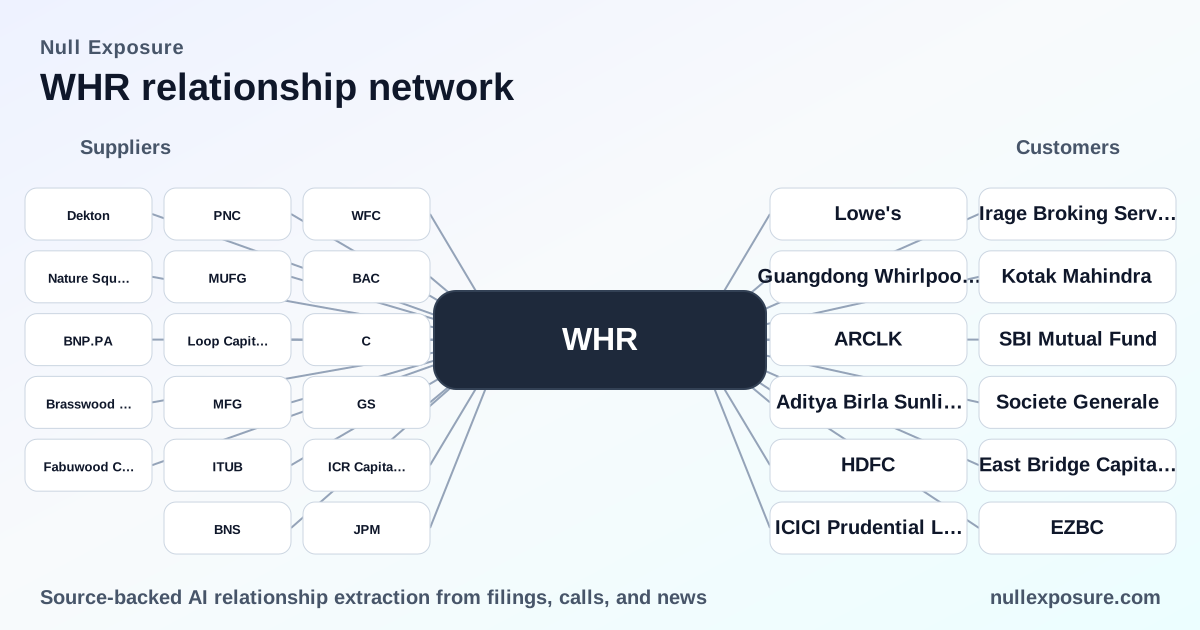
Whirlpool (WHR): Customer relationships that drive margins — and where exposure concentrates
Whirlpool is a global manufacturer and marketer of major home appliances that monetizes primarily by selling hardware to large retail, distribution and builder channels, plus parts and separate extended service arrangements. Revenue is recognized when control transfers—typically at shipment—so the business operates on spot and short-term commercial terms with large trade customers who hold meaningful leverage over pricing and volume. For deeper coverage of how customer concentration and contracting posture affect Whirlpool’s risk profile, visit Null Exposure.
The commercial map that matters to investors
Whirlpool’s operating model is straightforward: build and sell appliances at scale, support through parts and warranty services, and partner with builders and retailers to reach end consumers. Key structural signals from filings and market reports:
- Contracting posture is largely spot and short-term — Whirlpool recognizes product sales on shipment and explicitly discloses that most products are not sold under long-term contracts, which means revenue is sensitive to retailer and builder sourcing decisions.
- Customer mix combines large enterprise buyers and retail/reseller distribution — company disclosures highlight sophisticated, large trade customers that exert buying leverage, while spare parts flows are routed through distributors and retailers and occasionally to end consumers.
- Geographic concentration is material — the United States and Brazil individually contributed north of $2.4–$10.1 billion in recent years, signaling meaningful exposure to North American and Latin American demand cycles.
- Scale of customer spend is large — the company’s top geographies and channel partners imply customer-level spend bands in the $100m+ range, reinforcing counterparty importance.
These characteristics create a revenue profile that is highly scalable when retail demand is healthy, but also exposed to rapid re-sourcing risk from major buyers.
Relationship roll-call: every customer mention in the coverage
-
Lowe’s — Whirlpool is a major supplier of laundry, refrigeration, cooking and dishwasher appliances to Lowe’s in North America, a relationship described in Whirlpool’s 2025 Form 10‑K that highlights the company’s reliance on large home-improvement retailers for shelf presence and volume. (Whirlpool 2025 10‑K)
-
Guangdong Whirlpool Electrical Appliances Co., Ltd. — In February 2026 the company entered a Common Stock Purchase Agreement selling 434,782 shares of Whirlpool common stock to Guangdong Whirlpool for $30 million, reflecting a corporate sale transaction between Whirlpool and its China JV-related entity. (PR Newswire, February 24, 2026)
-
LGI Homes (LGIH) — Multiple LGI Homes press releases in March–May 2026 note that LGI includes energy-efficient Whirlpool® appliances as part of its CompleteHome packages across new communities, signaling repeated builder-level adoption of Whirlpool’s kitchen and laundry appliances in production home builds. (GlobeNewswire / Finviz / SahmCapital press releases, March–May 2026)
-
Arcelik (ARCLK) — Reports and filing commentary in March 2026 describe Whirlpool contributing its European major domestic appliance business into a newly formed company with Arcelik and selling its Middle East & North Africa business to Arcelik, reflecting portfolio reshaping and counterparty-level strategic divestitures. (TradingView summary of filings, March 2026)
-
Lifetime Brands (as referenced via Newsday / LCUT) — Coverage of Lifetime Brands’ asset activity references KitchenAid and other branded kitchenware; historical and competitive relationships in branded kitchenware influence channel dynamics and accessory cross-sell opportunities. (Newsday, retrospective reporting)
-
Aditya Birla Sunlife Mutual Fund — Indian institutional investors, including Aditya Birla Sunlife, participated in block deals completing the partial sale of Whirlpool’s stake in its Indian arm, indicating institutional demand for Whirlpool of India shares after the February 2024 transaction. (Economic Times, March 2026)
-
East Bridge Capital Master Fund — Listed among institutional buyers in November transactions tied to Whirlpool of India share sales, East Bridge Capital is one of the purchasers referenced in coverage of Whirlpool’s India divestment activity. (Economic Times, March 2026)
-
HDFC — HDFC mutual fund participated as a buyer in the Whirlpool of India secondary transactions that raised roughly ₹1,500 crore from an 11.2% stake sale, reflecting local mutual fund appetite for appliance-sector exposure. (Economic Times, March 2026)
-
ICICI Prudential Life Insurance — ICICI Prudential is identified as one of the institutional investors acquiring Whirlpool of India shares in the November block sell-down, indicating participation from insurance asset pools in the Indian holding. (Economic Times, March 2026)
-
Irage Broking Services — Named among secondary buyers in the November transactions for Whirlpool of India, representing regional brokerage-led allocations in the block deals. (Economic Times, March 2026)
-
Kotak Mahindra — Kotak Mahindra mutual funds are named as lead purchasers in the block sales of Whirlpool of India stakes, supporting local distribution of the equity after the parent’s strategic partial divestiture. (Economic Times, March 2026)
-
SBI Mutual Fund — SBI Mutual Fund led institutional purchases in the February 2024 block deal that sold a 24.7% stake in Whirlpool’s Indian unit, a meaningful instance of institutional allocation to Whirlpool’s India exposure. (Economic Times, March 2026)
-
Societe Generale — Societe Generale is cited as a foreign institutional investor participant in the India block transactions, supplying cross-border demand during the stake sale process. (Economic Times, March 2026)
-
EZBC (and Franklin Templeton referenced) — Franklin Templeton and other global managers are listed among buyers of Whirlpool of India shares in November transactions; coverage cross-references asset managers with inferred tickers and demonstrates investor-level interest in the regional unit. (Economic Times, March 2026)
Note: multiple LGI Homes items in the source set describe distinct community openings but all document the same commercial pattern—builder channel adoption of Whirlpool appliances across new-home spec packages. (Various GlobeNewswire/Finviz/SahmCapital press releases, March–May 2026)
How these relationships drive risk and upside
-
Concentration and bargaining power: Large retailers and builders like Lowe’s and LGI Homes generate volume but also wield negotiating leverage; because most sales are not under long-term contracts, Whirlpool’s volumes are responsive to buyer sourcing decisions, creating revenue cyclicality risk when retail inventories or housing starts shift.
-
Geographic exposure: The U.S. and Brazil each represent material shares of consolidated net sales, so macroeconomic swings or localized supply disruptions in these regions have outsized P&L impact.
-
Portfolio reshaping with strategic partners: Joint ventures and divestitures with Arcelik and local share transactions in India change Whirlpool’s cash profile and regional operating footprint, and institutional buyers (Kotak, HDFC, SBI, Franklin Templeton, Societe Generale) show available market appetite for lines of business that Whirlpool spins off or partially sells.
-
Revenue mix: Hardware sales dominate, with parts and extended service arrangements providing lower-margin, recurring flows; the company acts mostly as an agent for many service arrangements, recognizing fees rather than full-service revenues.
Investment implications and next steps
Whirlpool’s customer network delivers scale and predictable shelf placement, but the combination of spot/short-term contracting, concentrated geography, and powerful trade customers amplifies downside in an economic slowdown. Investors should weigh the company’s attractive valuation metrics and dividend yield against execution risks around retailer inventories, builder demand and the effects of ongoing portfolio transactions.
For project-level tracking and updated relationship monitoring, see more at Null Exposure.