Whitehawk Therapeutics (WHWK): What the Kaken divestiture and customer footprint mean for investors
Whitehawk Therapeutics operates as an oncology therapeutics developer that historically monetized through product sales of FYARRO via specialty distributors and specialty pharmacies, licensing arrangements (notably an upfront license payment from EOC), and one-off strategic transactions such as the divestiture of its Aadi subsidiary. The company has crystallized capital through a $100 million PIPE and a reported $102.4 million cash sale of Aadi to Kaken — transactions that shift Whitehawk’s balance of operating cash flow toward licensing and transaction proceeds rather than recurring FYARRO product revenue. For investors evaluating customer relationships and revenue risk, the critical facts are high customer concentration, a distributor-heavy commercialization posture, and an ongoing strategic reset following the FYARRO divestiture. For a concise view of Whitehawk’s public materials, see https://nullexposure.com/.
How the Kaken deals change the company’s cash and customer map
Whitehawk closed the Aadi divestiture and a substantial PIPE financing in early 2025, converting an operating franchise into cash that materially alters near-term liquidity and optionality. According to the company's Q1 2025 press release on PR Newswire, Whitehawk closed a $100 million PIPE and divested Aadi Subsidiary, Inc. to Kaken Pharmaceuticals for $102.4 million, including specified purchase price adjustments. Per the Form 10‑K for the fiscal year ended December 31, 2024, the company executed a Divestiture Agreement with KAKEN on December 19, 2024 that culminated in the FYARRO divestiture closing on March 25, 2025.
- Key takeaway: the combination of PIPE proceeds and the Aadi sale materially strengthens cash reserves and reduces operating exposure tied to the FYARRO product line, while transferring customer and product risk related to Aadi to Kaken.
If you want the corporate filings and press releases that underpin these conclusions, they are assembled for investor analysis at https://nullexposure.com/.
The relationships in the public record — one by one
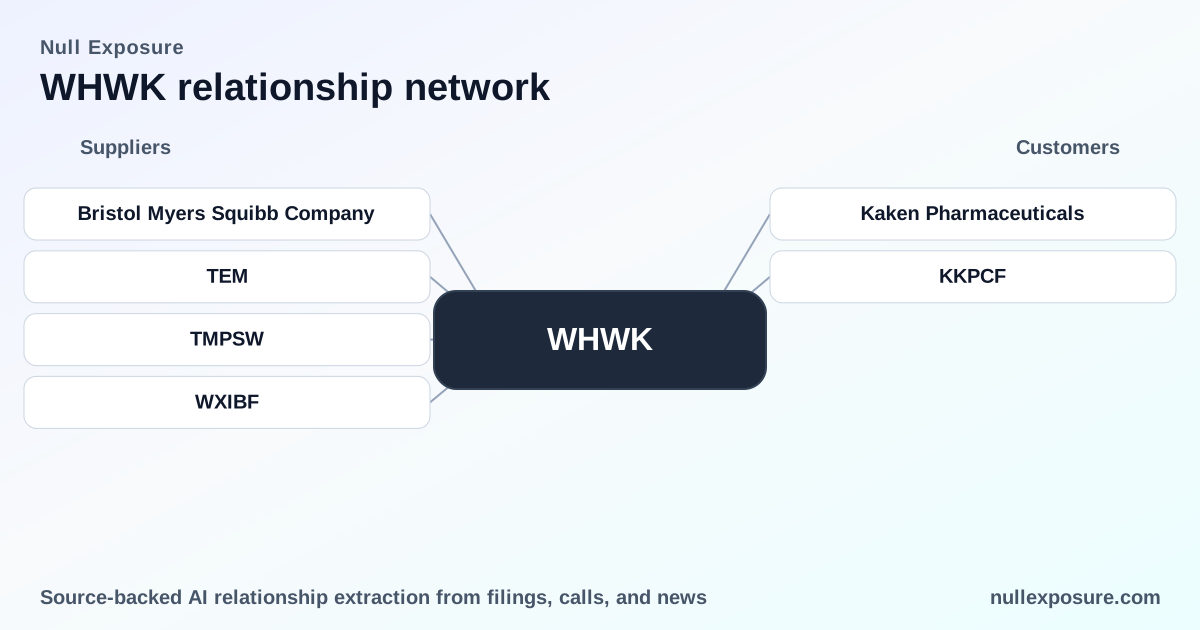
Whitehawk’s public disclosures list a small set of counterparties connected to the Aadi/FYARRO transactions; below are the entries extracted from filings and press coverage.
Kaken Pharmaceuticals
Whitehawk reported in its Q1 2025 press release that it completed the sale of Aadi Subsidiary, Inc. to Kaken Pharmaceuticals for total consideration of $102.4 million, following a concurrent $100 million PIPE financing. This press release is the primary public notice of the cash realization tied to the Aadi sale (PR Newswire, Q1 2025).
KAKEN (as disclosed in the 10‑K)
Whitehawk’s Form 10‑K for the year ended December 31, 2024 states that on December 19, 2024 the company entered into a Divestiture Agreement with KAKEN PHARMACEUTICAL CO., LTD and associated parties concerning the Aadi Subsidiary. The 10‑K documents the contractual framework that led to the subsequent closing of the transaction (Form 10‑K, FY2024).
KKPCF (inferred symbol tied to KAKEN disclosure)
The same 10‑K references the divestiture counterparties under an inferred symbol mapping to KKPCF in the indexing of external references; the entry repeats that the Divestiture Agreement executed December 19, 2024 covered the acquisition of Aadi Subsidiary. Treat this entry as a filing-level alias capturing the KAKEN transaction in SEC disclosures (Form 10‑K, FY2024).
What the customer-relationship constraints reveal about operating posture
Whitehawk’s public disclosures and constraint annotations give a clear view of how the company historically sold product and where the business concentrated risk.
- Distributor-led commercialization: Whitehawk recognizes product sales when specialty distributors (SDs) and a specialty pharmacy (SP) obtain control of product. The company sells primarily through a limited number of SDs and SPs, establishing a commercial model that depends on channel partners rather than direct hospital or clinic sales (Form 10‑K disclosures).
- Acute customer concentration: For the year ended December 31, 2024, two customers represented 43% and 55% of revenue, signaling extreme concentration and consequent revenue vulnerability if one large customer changes purchasing patterns (Form 10‑K, FY2024).
- License economics as a structural source of cash: Whitehawk recorded a $14.0 million non‑refundable, non‑creditable upfront payment from EOC under a license of FYARRO, and treated that license as the sole performance obligation — evidence that the company has used licensing to supplement product sales with fixed, contractually certain cash flows (Form 10‑K).
- Buyer role confirmed for Kaken: The divestiture disclosures explicitly name KAKEN as the buyer that acquired 100% of Aadi’s outstanding stock, and the FYARRO business was transferred out of Whitehawk upon closing on March 25, 2025 (Form 10‑K; PR Newswire).
These constraints combine into a clear operational profile: Whitehawk historically relied on a narrow set of commercial channels and a tiny number of large customers for recurring revenue, while supplementing cash needs through licensing and strategic divestitures. The Aadi sale reduces exposure to the FYARRO product line but concentrates future cash-generation expectations on licensing, partnerships, and one-time transactions.
Implications for investors and operators
- Balance sheet vs. revenue run rate: The $100 million PIPE plus the roughly $102.4 million cash divestiture consideration materially preserve runway and optionality; investors should view this as an explicit de‑risking of liquidity. Per company-reported figures, revenue TTM is small relative to the transaction proceeds, and the valuation dynamics (Price-to-Sales > 20) reflect a market pricing of optionality and pipeline prospects rather than current product cash flow (company filings, TTM metrics).
- Revenue concentration is the principal operating risk: Two customers accounting for 98% of revenue in aggregate is a structural weakness for a product-led company; the divestiture reduces one element of that exposure but does not eliminate the underlying concentration challenge for any remaining product revenues.
- Commercial execution now looks partnership- and license-led: With FYARRO moved out of the company and license payments already material to revenue recognition, Whitehawk’s future upside will depend on deal flow, licensing economics, and successful redeployment of the balance sheet into either R&D or additional business development.
- Governance and follow-through matter: Investors should track post-close integration of Aadi under Kaken, the deployment of PIPE proceeds per corporate guidance, and any new licensing or distributor arrangements disclosed in subsequent filings.
Final read: position, risk, and the signal investors should act on
Whitehawk has transitioned from an operating company dependent on a narrow commercial channel to an entity with a meaningful cash buffer and a business model that leans on licensing and strategic transactions. The company’s pivot reduces near-term liquidity risk but leaves structural revenue concentration and commercial channel dependence as the foremost investment risks. Active investors should prioritize monitoring subsequent partnership announcements, use of PIPE proceeds, and any re‑acceleration of diversified revenue streams. For the primary source documents and press releases used in this analysis, review Whitehawk’s 2024 Form 10‑K and the company’s Q1 2025 press release (PR Newswire).
For direct access to compiled relationship summaries and filings that informed this commentary, visit https://nullexposure.com/.