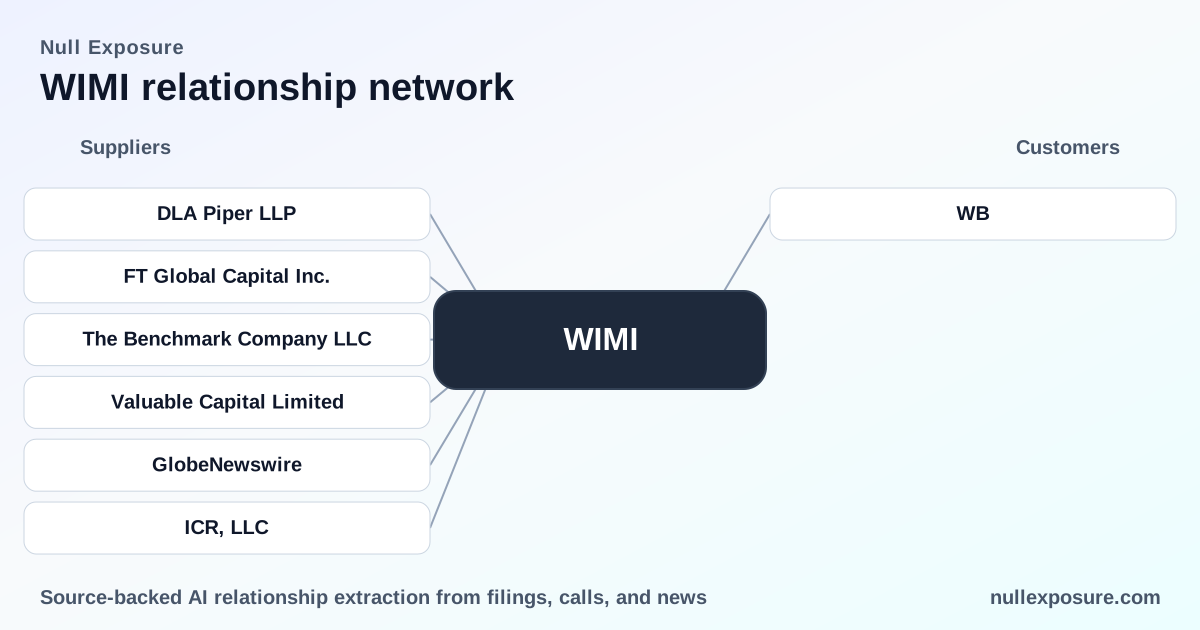
WiMi Hologram Cloud (WIMI): Customer relationships and strategic investor links
WiMi Hologram Cloud builds and monetizes augmented-reality (AR) holographic products and services for advertising, media, and enterprise clients in China. The company generates revenue through licensing of AR content and technology, cloud-based hologram delivery services, advertising integrations, and enterprise solutions, while strategic equity placements have historically reinforced distribution and cross-platform opportunities. This note summarizes every customer/investor relationship disclosed in our records and translates those ties into practical implications for investors evaluating revenue exposure, partner concentration, and strategic optionality.
For broader coverage on partnership intelligence, visit https://nullexposure.com/.
High-level read on what the relationships tell investors
WiMi’s disclosed relationships in public filings and press releases are sparse but meaningful: the firm attracted institutional participation from entities affiliated with large social platforms during capital raises. That pattern signals a go-to-market orientation that blends product sales with strategic investor alignments—investments that can convert into distribution, content channels, or advertising partnerships. For active investors, the primary question is whether these relationships translate into recurring customer revenue or remain one-off financing events that provide optional strategic value.
Company-level operating model signals
There are no constraint excerpts in the relationship records, so the following observations are derived at the company level rather than tied to any single counterpart:
- Contracting posture: WiMi executes a mix of transactional licensing and ongoing cloud/service contracts, implying a hybrid vendor posture where both one-off deals and recurring service agreements coexist.
- Concentration: Limited public disclosure of named customers suggests revenue concentration risk is possible, with material reliance on a small number of strategic partners or large buyers.
- Criticality: Equity participation from platform-affiliated investors increases the strategic criticality of those specific relationships, because investors can also be distribution or content partners.
- Maturity: The disclosed relationships date to FY2020 and reflect the company’s capital-market phase where strategic financing and partnership formation are central to scaling commercial deployments.
All customer/investor relationships found in public records
Below are every relationship documented in our results. Each entry is summarized in plain English and tied to its source.
-
WB — A group of institutional investors that participated in WiMi’s public offering included WB, listed as a participant in the offering. According to a GlobeNewswire press release dated July 29, 2020, WB was named among select institutional participants in the deal. (Source: GlobeNewswire, July 29, 2020 — https://www.globenewswire.com/news-release/2020/07/29/2069633/0/en/WiMi-Hologram-Cloud-Inc-Announces-Closing-of-Public-Offering.html)
-
WB Online Investment Limited (affiliate of Weibo Corporation) — The public offering disclosure explicitly lists WB Online Investment Limited, an affiliate of Weibo Corporation, as a participant in WiMi’s FY2020 offering, indicating a direct capital tie between WiMi and a major Chinese social media platform affiliate. GlobeNewswire’s July 29, 2020 announcement names this affiliate as an institutional participant in the offering. (Source: GlobeNewswire, July 29, 2020 — https://www.globenewswire.com/news-release/2020/07/29/2069633/0/en/WiMi-Hologram-Cloud-Inc-Announces-Closing-of-Public-Offering.html)
How to interpret these partner mentions for revenue and strategic prospects
The documented relationships are investor-participation entries tied to a public offering. Investors should read them as strategic financing events that carry optionality for distribution and monetization, not as explicit evidence of large recurring commercial contracts. The presence of an affiliate of Weibo as an offering participant is a high-quality signal: a social platform affiliate on the cap table typically accelerates content distribution and advertising integrations, which aligns directly with WiMi’s advertising and media monetization model.
Key implications:
- Upside via platform distribution: Equity ties to a social platform affiliate create a clear pathway for scaling AR content distribution and advertising placements—important for revenue expansion in both consumer and advertiser channels.
- Customer revenue uncertainty: The filings document investor participation, not contract-level customer revenue. Investors should demand evidence of signed service agreements or revenue line items tied to platform integrations before attributing recurring revenue to these relationships.
- Concentration risk still material: With few named partners disclosed, investors should anticipate potential concentration and conduct diligence on revenue mix and renewal economics.
For portfolio managers tracking partner-driven growth, WiMi’s strategic investor profile is a signal to probe deeper into contractual pipelines and monetization milestones. For more detailed partner intelligence and revenue mapping, see https://nullexposure.com/.
Operational questions investors should press management on
- Which equity or strategic investors have converted into commercial partners with signed revenue-generating contracts?
- What percentage of YoY revenue growth is attributable to platform-driven advertising or content distribution tied to investor affiliates?
- Are there exclusivity or preferred-deal clauses that could lock WiMi into advantageous or restrictive distribution arrangements?
Bottom line: where this leaves investors
WiMi’s public record shows targeted institutional participation in a FY2020 offering, including a named affiliate of Weibo. That single disclosure is strategically valuable but not sufficient to assume large, recurring customer revenue from the affiliate—instead it signals optionality: the company has access to a major distribution channel if commercial agreements are secured. The absence of a broader roster of named customers in the records reported here raises concentration and transparency questions that should be resolved through direct diligence on contract terms, customer retention, and revenue attribution.
- Positive: Strategic investor affiliation with a major social platform affiliate opens clear monetization pathways for AR advertising and content distribution.
- Risk: Public records, as summarized above, do not yet demonstrate converted, recurring customer revenue tied to those investor relationships—so revenue concentration and execution risk remain active concerns.
For investors and operators who require ongoing partner and customer intelligence on WIMI and similar AR platform plays, our research hub provides continual updates and relationship mapping. Visit https://nullexposure.com/ for ongoing coverage and primary-doc tracking.