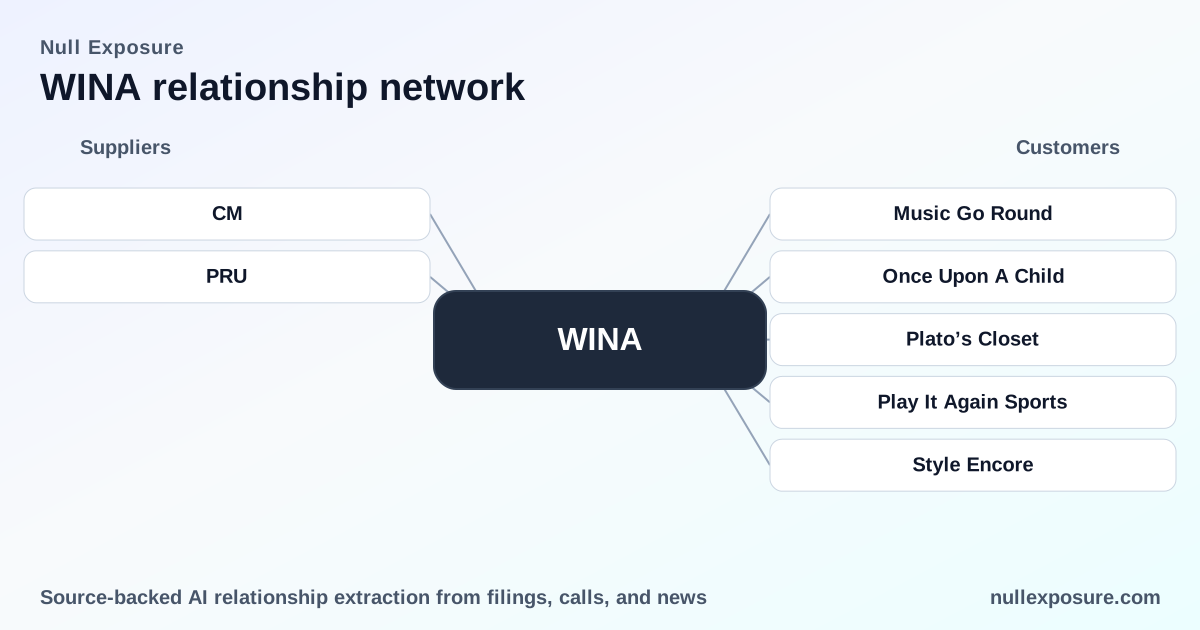
Winmark (WINA) customer map: how five franchise brands underwrite recurring cash flows
Winmark is a pure-play franchisor that licenses five resale retail concepts and collects recurring royalties, advertising contributions and ancillary product sales from franchisees across the United States and Canada. The company monetizes primarily through usage-based royalties and marketing fees from franchise operators, supplemented by hardware and merchandise sales to certain brand franchisees; royalties account for the vast majority of revenue. For investors, Winmark is a cash-generative, high-margin franchising business whose value is driven by franchise count growth, same-store sales at franchise locations, and the consistency of recurring fee streams. Learn more about how we source these customer relationships at https://nullexposure.com/.
The simple economics behind Winmark’s model
Winmark’s operating model is straightforward: it grants franchise licenses and an operating system, collects weekly continuing fees (royalties) equal to a percentage of gross sales, and enforces marketing contributions and other brand standards. Royalties are usage‑based and highly material to consolidated revenue—reported as roughly 88.8% of total revenue in the company tables for 2024—so same-store sales trends at franchise locations translate quickly into corporate cash flow. Franchise agreements are structured for longevity, with initial ten-year terms and subsequent renewals that lock in brand exclusivity at the territory level.
How the contracts shape capital allocation
- Contracting posture: long-term, renewable franchise agreements that transfer local operating risk to franchisees while preserving recurring fee capture for the franchisor.
- Revenue concentration and criticality: royalties are the dominant revenue source, creating a single-thread dependence on franchise performance across the portfolio.
- Geographic footprint and maturity: North America-focused with ~1,350 franchises as of late 2024 and significant expansion capacity across available territories.
These company-level signals define both the stability and the sensitivity of Winmark’s cash flows to retail cycles and local operator execution.
Brand-by-brand: the five customer relationships that matter
Below I cover every relationship cited in recent coverage and filings. Each entry is a plain-English investor summary with the source noted.
Plato’s Closet
Plato’s Closet is Winmark’s youth-focused resale brand that buys and sells gently used clothing for teens and young adults; franchisees operate stores under Winmark’s license and contribute royalties and marketing fees to the franchisor. TradingView reported a franchise-level ad-fund change effective July 1, 2026, increasing the Plato’s Closet contribution to a 2% North American Ad Fund and raising total marketing spend to 6% of sales (from 5%), which directly affects franchise economics and corporate marketing pool size (TradingView, May 4, 2026).
Music Go Round
Music Go Round is Winmark’s franchise brand for used musical instruments and equipment; it is one of the five resale concepts Winmark franchises and supports through licensing and the corporate operating system. Franchise Times lists Music Go Round alongside the other core brands under Winmark’s umbrella, confirming it as an active franchise channel for the company (Franchise Times, cover story).
Once Upon A Child
Once Upon A Child is Winmark’s children’s resale chain and is operated by franchisees under license from Winmark; it was highlighted in local press on the occasion of new store openings, underscoring continued franchise-level expansion. A CityBiz article noted that Once Upon A Child is franchised by Winmark together with the other resale brands, demonstrating ongoing unit-level growth activity in FY2025 coverage (CityBiz, March 2026).
Play It Again Sports
Play It Again Sports is Winmark’s sporting goods resale brand; in addition to licensing the brand to franchisees, Winmark sells point-of-sale system hardware and certain merchandise to Play It Again Sports franchisees, creating a small but valuable source of non-royalty revenue (MarketScreener / Intellectia.ai, FY2026 / FY2025 coverage). This vendor relationship adds modest margin capture beyond royalties and strengthens Winmark’s control of store systems.
Style Encore
Style Encore is Winmark’s resale brand for contemporary women’s apparel and accessories; franchisees operate the stores under Winmark’s licensed service marks and pay continuing fees and marketing contributions to the franchisor. Multiple sources that summarized Winmark’s portfolio list Style Encore as one of the five core brands, confirming its role in the franchised revenue base (Investing.com & Franchise Times, FY2026).
(If you want a consolidated view of these relationships and how they feed into franchise-level economics, visit https://nullexposure.com/ for our customer-mapping platform.)
What the constraints tell an investor about Winmark’s risk profile
The evidence across filings and press provides a consistent picture of the company’s contractual and commercial constraints:
- Long-term contracting: franchise agreements carry initial 10-year terms with subsequent 10-year renewal periods and exclusive geographic territories, which supports predictable royalty flows and long horizon cash conversion.
- Usage-based fees: continuing fees are charged weekly and generally range from 4% to 5% of gross sales, aligning Winmark economically with franchisee revenue performance.
- Geographic concentration: operations are concentrated in the United States and Canada (1,350 franchises on December 28, 2024), which limits international exposure but creates regional sensitivity to North American retail cycles.
- Material reliance on royalties: royalties represent the dominant revenue stream (88.8% of revenue in the company table), making Winmark a play on franchise sales stability rather than product margins.
- Relationship roles: Winmark acts primarily as franchisor and licensor; in a narrower role, some franchisees (for example, Plato’s Closet operators) function as resellers of used goods under the brand.
These constraints collectively indicate a mature franchising business with highly recurring cash flow but concentrated exposure to franchised same-store sales and operator economics.
Investment implications — steady cash flows, franchise execution is the lever
Winmark’s model generates high operating margins and predictable cash return to shareholders via dividends (recent dividend declarations are part of the FY2026 press flow). The core upside is continued unit growth and same-store sales gains across the five brands; the principal risk is a franchise-level sales slowdown or a structural deterioration in discretionary resale demand. The recent Plato’s Closet ad-fund increase is an example of a corporate-level decision that changes franchise unit economics and could influence unit-level investment incentives.
Key takeaway: investors buy Winmark for durable, usage-based royalty economics and low capital intensity, but must monitor franchise-level sales, the cost pass-through of advertising and marketing funds, and unit expansion cadence.
For a practical, investor-oriented breakdown of customer relationships and contract signals for other franchisor models, see our repository at https://nullexposure.com/.
Conclusion: Winmark is a focused franchisor whose franchise agreements, usage-based royalties and North American footprint produce stable, high-margin cash flow. The portfolio of Plato’s Closet, Style Encore, Once Upon A Child, Play It Again Sports and Music Go Round are the customer relationships that underwrite Winmark’s recurring revenue profile—watch franchisee sales trends and marketing-fee changes as the primary drivers of near-term performance.