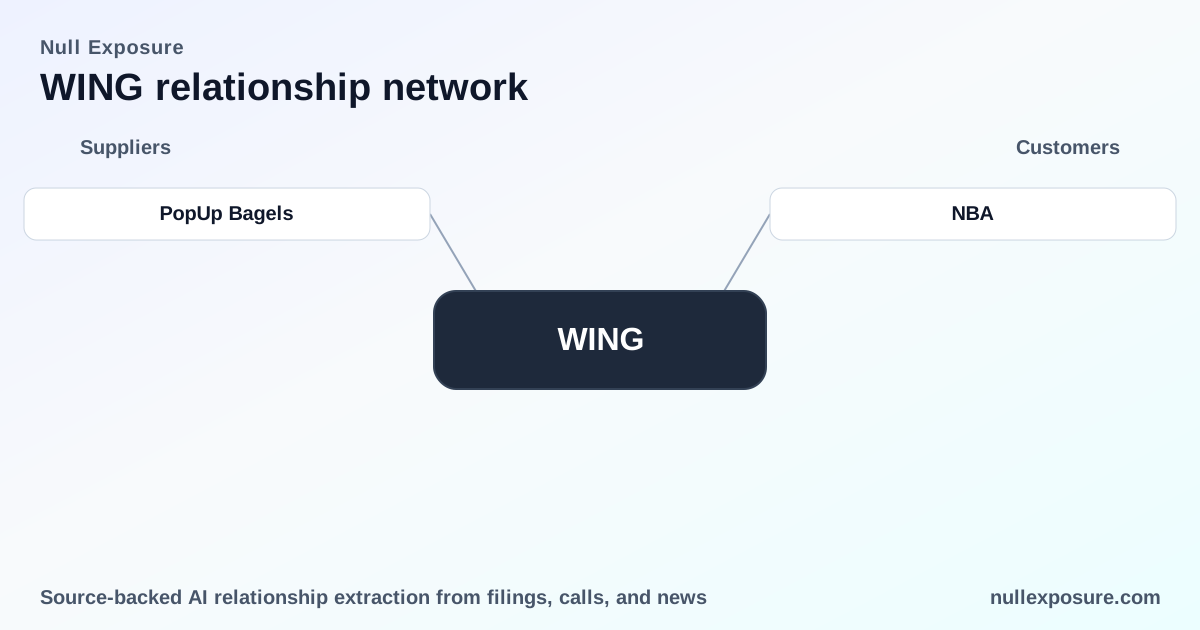
Wingstop’s customer relationships: who pays, who partners, and why it matters to investors
Wingstop Inc. operates a highly franchised restaurant platform that licenses its brand and collects recurring, usage‑based royalties from franchisees while providing training, marketing and operational services; the company also pursues brand partnerships (notably with the NBA) to drive national awareness. Wingstop monetizes primarily through franchise fees, 6% royalties on gross sales, and a 5.3% advertising fund contribution from franchisees — a business model that converts unit-level sales growth into predictable, recurring revenue and advertising leverage. For a deeper look at the company's customer ties and commercial constraints, visit the Null Exposure homepage: https://nullexposure.com/.
Market context and quick investor thesis Wingstop is a franchisor with a global footprint and a capital-light growth path: 98% of the system is franchised, producing a high-margin, asset-light revenue mix that benefits from same-store sales expansion and unit growth. The company’s valuation reflects growth expectations (trailing P/E ~39.7, EV/EBITDA ~25.4) and a premium for a scalable royalty stream; investors should weigh that premium against the chain’s dependency on franchisee economics and brand‑partner activation success.
What Wingstop’s public disclosures tell investors about its partners Below I cover every customer/partner relationship surfaced in the available materials, with concise takeaways and source notes.
Lemon Pepper Holdings, Ltd. (United Kingdom master franchisee)
- Wingstop recognized a non‑controlling interest sale gain tied to Lemon Pepper Holdings that materially affected prior‑period results; the company’s FY2026 Q1 materials reference a $97.2 million gain on the sale of its non‑controlling interest in Lemon Pepper Holdings, its U.K. master franchisee. According to an earnings call transcript, the same transaction was described as a $92.5 million nonrecurring gain in the prior year. (Company FY2026 Q1 financial results press release; Q1 2026 earnings call transcript coverage via InsiderMonkey, May 2026)
NBA (brand partnership / Official Chicken Partner)
- Wingstop maintains a national partnership positioning it as the Official Chicken Partner of the NBA, using co‑branding and limited‑edition product promotions (for example, a limited‑edition 32‑oz ranch cup) to amplify brand awareness and drive traffic to franchisees. This partnership is cited in Wingstop press materials and a company PR announcing financial‑results timing and promotions. (Wingstop promotional release on product/partnership, March 2026; PRNewswire/StreetInsider company announcement, April 2026)
How these relationships translate into revenue and optionality
- The Lemon Pepper disposal was a one‑off financial event that impacted reported earnings and cash flows in the prior period; it does not change Wingstop’s core merchant economics but does illustrate how occasional balance‑sheet transactions with master franchise partners can create meaningful earnings volatility. (FY2026 Q1 press release and earnings call materials)
- The NBA relationship functions as a marketing and brand‑building lever that benefits the entire franchised system rather than a direct revenue‑share customer contract; such partnerships increase demand at the unit level and therefore support royalty and ad‑fund receipts. (Company promotional materials and PR)
Operating model and contract constraints: what the filings reveal about risk and predictability Wingstop’s relationship constraints are company-level signals that shape how to value the franchise cash flow stream:
-
Long‑term contracting posture. Franchise agreements typically provide a 10‑year initial term with renewal opportunities, which creates a durable royalty base and deferred revenue recognition tied to franchise fees; this structure supports multi‑year visibility into recurring revenue from the installed base. (Company franchise agreement descriptions)
-
Usage‑based economics drive revenue growth and volatility. Royalties and advertising fund contributions are calculated as a percentage of gross sales (standard royalty 6%, Ad Fund ~5.3%), making Wingstop’s topline highly correlated with franchisee sales performance and national marketing effectiveness. This magnifies the upside when units grow AUVs and introduces sensitivity to traffic declines. (Franchise agreement terms in filings)
-
Licensing plus services model. Wingstop acts as licensor and service provider—the company licenses marks and also delivers pre‑opening training, ongoing menu development, advertising management and operational monitoring—creating a mix of low‑touch licensing revenue and higher‑value services that support system quality control. (Management description of performance obligations)
-
Global and concentrated scale characteristics. Wingstop reports operations across multiple international markets (franchised restaurants in 11+ countries and territories and >2,550 locations overall), indicating a global footprint but one still concentrated in North America for revenue; international master franchise relationships (e.g., the U.K. partner) can be both growth accelerants and sources of event risk. (Company system counts and international disclosures)
-
Active, mature relationship stage. The company characterizes its restaurant base as active and largely franchised (about 2,513 franchised restaurants as of late‑2024), reflecting a mature franchising play where revenue scales with system sales rather than company‑operated store profitability. (System counts in filings)
Investment implications: where revenue certainty and risk intersect
- Upside driver: Usage‑based royalties and a high‑margin model deliver operating leverage as system AUVs and unit counts rise; national partnerships such as the NBA campaign amplify brand demand that converts into royalties and ad fund income.
- Risk vector: Dependence on franchisee economics creates sensitivity to local labor, commodity inflation, and digital delivery competition; one‑off balance‑sheet transactions with master franchisees can produce earnings volatility.
- Valuation lens: The premium on Wingstop reflects expected unit growth and higher AUVs; investors should focus on system sales momentum, advertising effectiveness, and the cadence of nonrecurring items when modeling earnings.
Key takeaways for investors
- Wingstop is a licensing‑first, service‑enabled franchisor whose core cash flow derives from usage‑based royalties and advertising contributions.
- Long franchise terms (10 years) and an active, global franchise network create recurring revenue durability, while royalty exposure concentrates risk in system sales performance.
- Nonrecurring transactions with master franchise partners (e.g., the Lemon Pepper sale) can swing reported earnings and should be treated as one‑time items in valuation models.
- Brand partnerships like the NBA are strategic marketing assets that translate into top‑line support across the franchised base rather than direct, material revenue contracts.
For a structured deep dive into Wingstop’s partner footprints and to track ongoing relationship signals that matter to investors, see our analysis hub at https://nullexposure.com/.