Wipro (WIT) — Customer Relationships That Frame the Next Phase of Growth
Wipro is an IT services and consulting company that monetizes through multi-year managed services contracts, digital transformation engagements and increasingly AI-led transformation deals; revenue scales with large enterprise programs that drive recurring service fees and platform-led upsells. Wipro’s commercial strategy centers on a small number of large, long-duration clients whose strategic transformations deliver high revenue visibility but concentrate execution risk. For a deeper tracking feed on counterparties and deal flow, visit https://nullexposure.com/.
Why these customer ties matter to investors
Wipro’s financial profile (FY2026 revenue: ~₹926 billion; operating margin ~17.1%) is supported by long-term transformation contracts that both stabilize revenue and compress near-term margin volatility during large implementation phases. Contracts with global conglomerates and insurance firms are revenue-critical and increase both contract concentration and delivery complexity — factors that determine upside from Wipro’s AI push and downside from execution missteps.
A quick signal set for how Wipro operates commercially:
- Contracting posture: Focus on multi-year, transformation-oriented engagements that often include strategic partnership elements and multi-phase delivery.
- Concentration: A handful of large customers (retail, CPG, insurance, agribusiness) carry outsized revenue and program risk.
- Criticality: Many wins are core to client operations (IT transformation, analytics, cloud and AI), making renewals high-value but dependent on service delivery.
- Maturity: Relationships range from legacy platform modernization (multi-year) to newer AI-first programs, indicating an evolution in Wipro’s service mix toward higher-margin advisory and IP-led outcomes.
If you want ongoing, front-line visibility into Wipro’s customer signals and press-cover deal flow, see our research hub at https://nullexposure.com/.
The relationship map — one entry at a time
TruStage (deal announced in FY2026)
Wipro disclosed a deal with U.S.-insurance provider TruStage during FY2026, though the company did not disclose deal value in the earnings announcement; the mention signals Wipro’s continued push into core insurance services. Source: Yahoo Finance recap of Wipro’s FY2026 quarter (May 4, 2026) — https://sg.finance.yahoo.com/news/indias-wipro-misses-fourth-quarter-110251847.html.
Estee Lauder (noted slowdown in FY2026)
Wipro reported that business from key apparel and cosmetics customer Estee Lauder slowed in FY2026, highlighting client-level revenue variability even within large accounts. Source: Yahoo Finance coverage of Wipro’s quarterly results (May 4, 2026) — https://sg.finance.yahoo.com/news/indias-wipro-misses-fourth-quarter-110251847.html.
Harte Hanks / HHS (collaboration from 2017 cited in FY2018 context)
Wipro and Harte Hanks announced a partnership in March 2017 to combine Harte Hanks’ agency capabilities with Wipro’s global technology delivery, aiming to upgrade analytics and marketing-technology platforms — this is an example of Wipro’s long-standing strategy of combining digital agency assets with IT execution. Source: San Antonio Report coverage referencing the March 15, 2017 announcement (article archived; cited FY2018 context) — http://sanantonioreport.org/harte-hanks-stock-falls-amid-family-management-dispute/.
Olam Group — Wipro press release (large multi‑year strategic transformation)
Wipro announced a multi‑year strategic transformation engagement with Singapore-based Olam Group in April 2026, positioning the firm as a marquee agri-business transformation client and a cornerstone example of Wipro’s AI- and data-led offerings. Source: Wipro press release (April 6, 2026) — https://www.wipro.com/newsroom/press-releases/2026/wipro-wins-one-of-its-largest-strategic-transformation-engagements-from-food-and-agri-business-leader-olam-group/.
Olam Group — coverage noting a large deal win (media report)
Multiple outlets flagged Wipro’s Olam deal as a significant, large-scale engagement; media reporting emphasizes the strategic and scale dimensions of the agreement in FY2026. Source: Fortune India coverage on Wipro’s Q4 focus and the Olam win (May 2026) — https://www.fortuneindia.com/business-news/it-earnings-q4fy26-focus-on-deals-acquisitions-and-share-buyback-at-wipros-upcoming-earnings-meet/132417.
Olam Group — reported as an 8-year transformation deal (local business press)
BusinessToday reported the Olam engagement as an 8-year strategic transformation, reinforcing the extended-duration nature of the contract and the long revenue backlog it creates for Wipro. Source: BusinessToday (April 2026) — https://www.businesstoday.in/markets/stocks/story/wipro-share-price-target-ahead-of-buyback-meet-on-apr-16-check-history-estimated-size-525378-2026-04-13.
Olam Group — industry commentary linking the engagement to AI-led transformation
Analysts and local market commentary present the Olam engagement as emblematic of Wipro’s pivot to large AI-led transformation programs, illustrating the company’s route to higher-value services. Source: IndiaInfoline blog post about Wipro’s buyback and strategy (May 2026) — https://www.indiainfoline.com/blog/wipro-share-price-declines-2-company-announces-largest-buyback-worth-15000-crore.
HanesBrands (multi-year AI-first transformation)
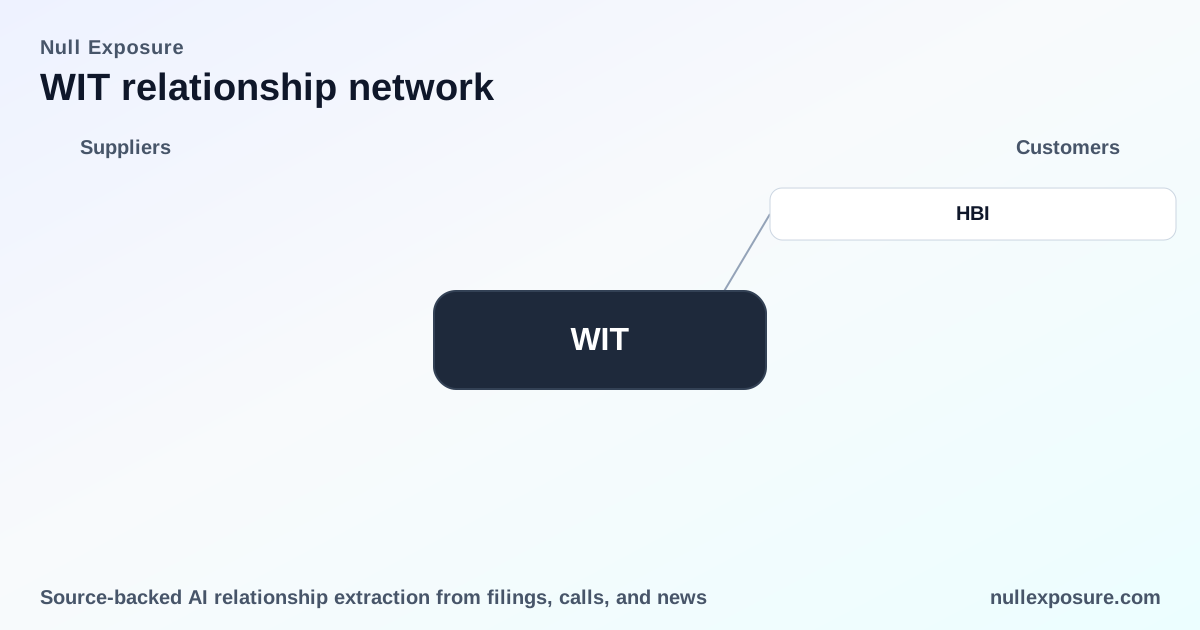
Wipro secured a multi-year deal to transform HanesBrands’ IT with an AI-first approach, signaling continued traction in retail/consumer clients for Wipro’s AI agents and factory-AI initiatives. Source: InsiderMonkey coverage on Wipro’s AI partnerships and the HanesBrands engagement (March 10, 2026) — https://www.insidermonkey.com/blog/wipro-wit-bets-on-ai-agents-with-factory-ai-partnership-after-mixed-earnings-1695198/?amp=1.
HBI (duplicate entry referencing HanesBrands)
The dataset includes a second reference to HBI that restates the same multi-year AI transformation engagement with HanesBrands, underscoring how media coverage clustered around Wipro’s AI narrative in FY2026. Source: InsiderMonkey (March 10, 2026) — https://www.insidermonkey.com/blog/wipro-wit-bets-on-ai-agents-with-factory-ai-partnership-after-mixed-earnings-1695198/?amp=1.
Alight (strategic partnership through 2029)
Alight entered into a strategic partnership with Wipro intended to enhance Alight’s service offerings through 2029, reflecting Wipro’s willingness to structure multi-year alliances that extend beyond pure IT delivery into managed services and joint go-to-market activity. Source: TradingView summary of Alight’s SEC filing/news (March 9, 2026) — https://www.tradingview.com/news/tradingview:919650174331c:0-alight-inc-delaware-sec-10-k-report/.
What these relationships mean for investors
- Revenue durability and concentration: The Olam, Alight and HanesBrands engagements are multi-year, high-visibility contracts that create predictable revenue streams but also concentrate execution risk in a few large programs.
- Strategic shift to AI and transformation: Multiple entries explicitly reference AI-led or transformation-oriented work; Wipro is monetizing a productized advisory and platform angle rather than purely labor arbitrage.
- Operational risk is execution risk: Slower business from Estee Lauder and the undisclosed value for TruStage illustrate client-level revenue volatility that can affect near-term guidance despite long-term contracts.
- Renewals and partnership maturity matter: Historic tie-ups such as Harte Hanks show Wipro’s long-term pattern of integrating agency/analytics capabilities with systems delivery — a model that supports client stickiness when successfully executed.
Bottom line — how to weight Wipro’s customer signals
Wipro’s FY2026 customer map signals a company pivoting into AI-first transformation at scale while relying on a concentrated set of large, multi-year clients for revenue visibility. Investors should value the higher-margin potential from platform and AI offerings against elevated program execution risk and client-specific variability. For ongoing monitoring and a curated feed of Wipro counterparty events, visit our hub at https://nullexposure.com/.
Bold, deal-level wins like Olam and Alight are positive structural signals; slower pockets at major clients underscore the need to watch execution metrics and contract economics in quarterly disclosure.