Wix and Google: Distribution Lift for Bookings, and What It Means for Investors
Wix.com is a cloud-native platform that monetizes primarily through subscription products, marketplace services, and incremental commerce features—notably its Wix Bookings vertical which drives premium upgrades and transaction revenue from SMBs and micro-entrepreneurs. The company combines a high-gross-margin software base with upsell paths (premium plans, professional tools, and add-on services), turning product integrations and distribution partnerships into measurable retention and monetization levers. For investors, the critical question is whether distribution lifts such as the Google integrations translate into scalable revenue per customer and improved lifetime value without materially increasing customer acquisition costs.
For a concise customer-risk and partner-impact view, visit https://nullexposure.com/.
Why an integration with Google matters for Wix’s economics
The announced integration links Wix Bookings directly into Google Search, Google Maps and Google AI Mode, converting discovery into instant bookings. This is not a product tweak — it is a distribution channel expansion that reduces friction in the conversion funnel and directly supports Wix’s monetization strategy by making paid booking features more valuable to small businesses. Given Wix’s subscription-led model and emphasis on paid plan conversions, any reliable pathway that boosts appointment volume or conversion rates will lift average revenue per user (ARPU) and improve churn profiles over time.
- Distribution effect: Exposure in Google Search and Maps places Wix merchants at the point of intent, which historically drives higher conversion value than organic traffic alone.
- Product engagement: Bookings usage is a clear upsell vector; more bookings means more reasons for merchants to shift to premium features or retain paid subscriptions.
Relationship summaries — the coverage in the public record
-
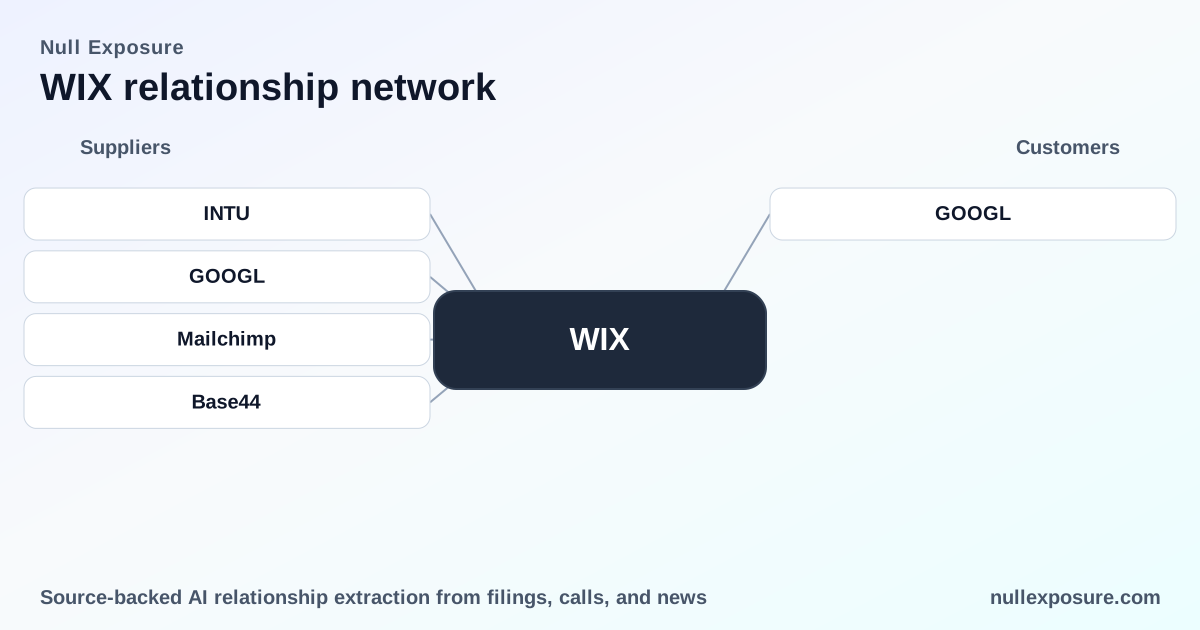
GOOGL — According to a Finviz news report on March 10, 2026, Wix launched an integration between Wix Bookings and Google Search, Google Maps and Google AI Mode, enabling queries to turn into instant bookings and directly connecting Wix merchants with user intent on Google platforms. (Finviz, March 10, 2026)
-
Google — The same March 10, 2026 Finviz item also reported the news under the Google label, describing the integration in identical terms: Wix Bookings now feeds into Google Search, Google Maps and Google AI Mode to facilitate immediate booking actions from search results and map listings. (Finviz, March 10, 2026)
Both entries reflect a single public announcement observed under two company name variants; each confirms the core commercial and technical linkage between Wix’s Bookings product and Google’s discovery surfaces.
Constraints and operating-model signals investors should read into
With no explicit contractual constraints disclosed in the available relationship data, the public signals imply company-level operating characteristics:
- Contracting posture — platform partner dependency: Wix negotiates downstream distribution with very large platforms. These are likely to be commercial arrangements that favor scale partners; the relationship is strategic for distribution but not necessarily exclusive, implying Wix retains flexibility but accepts platform governance and terms.
- Concentration — diversified customer base, concentrated partner impact: Wix’s customers are highly dispersed (SMBs globally), which lowers counterparty concentration at the customer level, but platform partners such as Google represent concentrated levers that can materially change demand curves.
- Criticality — bookings product is strategically important: Bookings serves both as a customer acquisition / retention tool and a revenue uplifter; integrations that raise bookings velocity are material to revenue per customer and therefore to growth.
- Maturity — feature maturity with ongoing iteration: Wix’s core site-builder business is mature and monetized; bookings and commerce features are in active expansion mode, where distribution partnerships accelerate maturation and adoption.
These signals point to a business that is broadly diversified across end customers but selectively dependent on a small set of ecosystem distribution partners for outsized demand impact.
What investors and operators should watch next
- Measureable KPIs: Track bookings volume, paid-plan conversion rate among merchants using Bookings, and ARPU changes for cohorts exposed to Google integration. These will determine whether distribution converts into durable revenue uplift.
- Customer economics: If the Google integration increases free-to-paid conversion or reduces churn meaningfully, the lifetime value (LTV) math improves without proportionate marketing spend increases—this is the ideal outcome.
- Commercial terms and data access: Confirm whether Google provides referral traffic only, or whether Wix captures attribution and retains customer relationship data—this affects Wix’s ability to monetize follow-on services.
- Competitive reactions: Competitors (Shopify, Squarespace, vertical booking platforms) will respond to distribution parity or differentiate on service-level features; Wix’s speed to monetize incremental bookings is a key execution metric.
Risk checklist — what could undercut the upside
- Dependence on partner gates: Even beneficial integrations expose Wix to product policy changes and ranking shifts on partner platforms.
- Monetization lag: Increased bookings do not instantly convert to higher reported revenue if conversion requires time or if merchants opt for lower-priced plans.
- Margin pressure on customer acquisition: If Wix ramps subsidies or promotions to capitalize on visibility, short-term margin could compress.
Bottom line — practical takeaway for valuation and operations
The Google-Wix Bookings integration is a clear distribution lever that aligns with Wix’s subscription-plus-services monetization model. For investors, the integration supports a bull case in which improved discovery materially raises ARPU and retention for the bookings cohort; for operators, it is a signal to prioritize product telemetry that converts visibility into paid engagement.
For a more detailed partner-risk profile and to benchmark Wix’s customer relationships across providers, explore the platform at https://nullexposure.com/.
Overall, this is an operationally meaningful partnership: it amplifies Wix’s ability to convert discovery into revenue without large incremental product rework, and therefore should be treated as a positive structural signal for growth and monetization if Wix converts the increased traffic into paid customer outcomes.