Workiva’s customer map: adoption, partners and what investors should price in
Workiva sells cloud-based compliance and regulatory reporting software to large enterprises and supports those sales with professional services and 24/7 support; the company monetizes primarily through multi-year subscription contracts and incremental services. The commercial model is subscription-first, enterprise-focused and geographically concentrated in the U.S., while partnerships extend implementation reach and product access. For a quick gateway to the primary data and relationship signals, visit https://nullexposure.com/.
Why Workiva’s revenue is structurally sticky (and where it isn’t)
Workiva’s core economics flow from recurring SaaS contracts and a professional services overlay. The company reports that roughly 90% of revenue in 2024 came from subscription and support fees, with the remainder from services; customer contracts typically run 12–36 months, which generates predictable renewal cycles and visibility into near-term revenue.
Key operating characteristics that shape investor expectations:
- Subscription-dominant monetization and multi-year contracts create durable revenue streams and predictable ARR progression.
- Enterprise customer base: Workiva serves a high proportion of large, regulated companies — the firm reports coverage of over 90% of the top 100 public and private reporting companies — which supports high ACV (average contract value) and lower churn versus SMB-focused models.
- Low customer concentration: no single customer contributed more than 1% of revenue in 2022–2024 and the top 10 customers were under 10% of revenue, reducing counterparty concentration risk.
- Geographic profile: the U.S. accounts for the lion’s share of Americas revenue (approximately 92–93% in recent years), while EMEA and APAC made up roughly 18% combined in 2024 — international expansion is a strategic growth vector but the business remains U.S.-centric today.
- Service provider + seller posture: Workiva both sells the subscription product directly and supports customers with professional services and global support, which increases implementation success but also raises the cost-to-serve relative to pure software firms.
Investor takeaway: subscription economics and enterprise footprints are strengths; international expansion and implementation intensity are execution items to monitor.
Customer and partner wins you need on your radar
Below I summarize every relationship surfaced in the recent coverage and filings.
NIXX / Nixxy — enterprise adoption of SEC reporting
NIXX announced adoption of Workiva’s enterprise-grade SEC reporting platform in FY2026, indicating a direct implementation of Workiva for regulated disclosure workflows. A press release covered by The Globe and Mail in March–May 2026 reported NIXX’s use of Workiva for institutional reporting and governance. (The Globe and Mail, press releases March 10 and May 3–4, 2026.)
CBIZ — recognized partner and channel expansion
CBIZ announced it was named a 2025 Americas Emerging Partner of the Year by Workiva, signaling an expanding partner ecosystem that supports deployment, advisory and channel-led sales. This recognition was published on CBIZ’s site on March 9, 2026. (CBIZ press release, March 9, 2026.)
Wilson Sonsini — advisory partnership to streamline IPO work
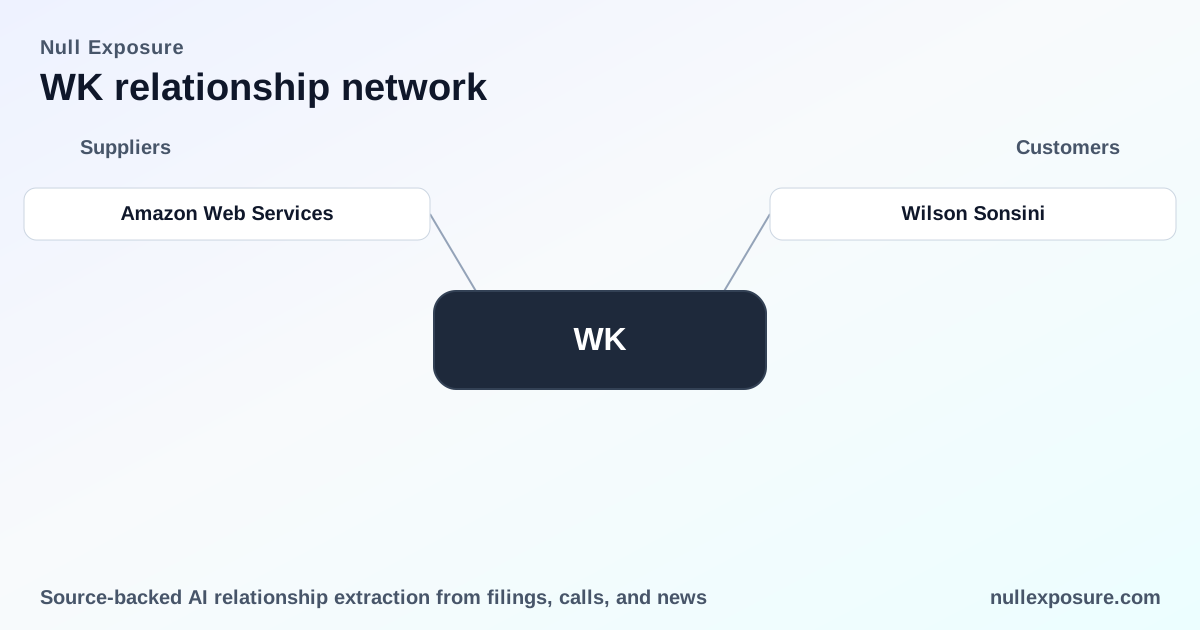
Wilson Sonsini publicized a partnership with Workiva in connection with automating disclosure tasks for companies going public; the advisory relationship was noted in a legal-industry summary of 2021–2022 work. Wilson Sonsini highlighted joint work with Workiva to reduce arduous disclosure tasks for IPO-bound companies (Wilson Sonsini, coverage referencing 2021 activity, reported in 2022). (Wilson Sonsini / National Law Journal coverage, 2022.)
What these relationships collectively imply for growth and risk
The mix of customers and partners in the coverage underlines key strategic facts about Workiva’s go-to-market and product placement.
- Enterprise product-market fit: NIXX’s SEC reporting adoption confirms Workiva’s positioning as a go-to platform for regulated reporting. That use case drives high switching costs and measurable enterprise value.
- Partner-led expansion: CBIZ’s recognition as an emerging partner demonstrates Workiva’s reliance on channel partners to scale implementations and extend service capacity without proportionally expanding internal headcount. Partners lower implementation bottlenecks but create dependency on partner enablement and co-selling dynamics.
- Adjacency to legal/advisory services: Wilson Sonsini’s collaboration on IPO workflows shows Workiva’s product integrating into capital markets and legal processes, broadening total addressable use cases beyond SEC filing to pre-IPO readiness and counsel workflows.
From a risk perspective:
- Concentration of geography (U.S.-heavy revenue) exposes Workiva to domestic macro and regulatory cycles; international growth is necessary for material diversification.
- Implementation intensity creates cost-to-serve pressure even as subscription margins improve; successful scaling of partner channels (like CBIZ) is critical to maintain margin expansion.
- Materiality profile is favorable, with no single customer dominating revenue, which reduces idiosyncratic customer loss risk.
How investors should weigh these signals in a valuation view
Workiva’s financials show recurring revenue and a large enterprise customer base, which justifies premium multiple assumptions relative to on-premise incumbents — but the stock must be priced against execution on international expansion, partner scale, and margin improvement. Watch these readouts closely:
- Net retention / ARR growth: the core driver of long-term valuation.
- Partner-sourced bookings: growth in CBIZ-style relationships signals scalable implementation capacity.
- International revenue mix: movement of EMEA/APAC from ~18% upward validates TAM expansion.
- Churn and implementation timelines: longer-than-expected onboarding for large customers compresses near-term margin flow-through.
For more granular relationship signals and consolidated coverage of customer adoption dynamics, visit https://nullexposure.com/.
Bottom line: durable SaaS economics with execution risks
Workiva operates a subscription-first model selling enterprise compliance software with a clear foothold in SEC reporting and adjacent disclosure workflows. The customer relationships reviewed — NIXX’s platform adoption, CBIZ’s partner recognition, and Wilson Sonsini’s advisory integration — collectively reinforce Workiva’s position in regulated reporting and its push to scale via partners. Investors should reward durable ARR growth and improving margins, while monitoring partner execution, international traction and implementation throughput as the primary execution risks.