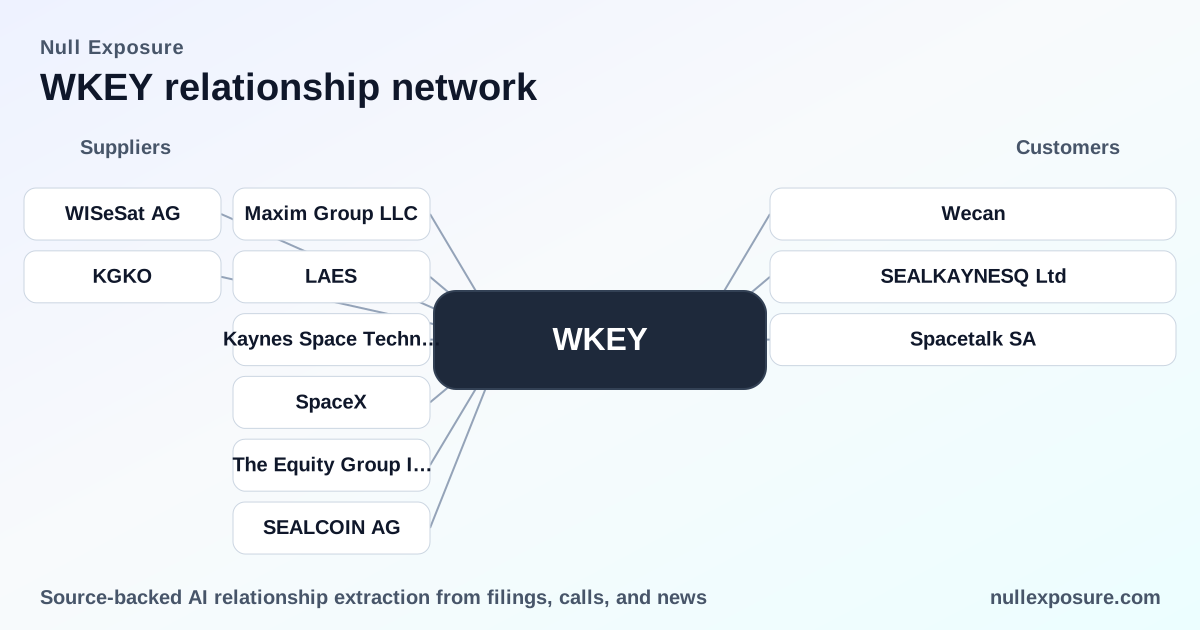
WISeKey (WKEY): Customer relationships that underwrite a cybersecurity-to-IoT revenue story
WISeKey monetizes through digital identity, certificate authority (PKI) services, and post‑quantum security offerings embedded into IoT, space, and enterprise systems; revenue comes from identity issuance, recurring PKI services, licensing of cryptographic IP, and joint‑venture commercial arrangements. Investors should value WKEY as a specialized B2B security provider with clear pathway to recurring, high‑margin service revenue but with early‑stage commercialization risks and thin current revenue base (Revenue TTM ≈ $19.3M; negative EBITDA). Explore a structured view of recent customer relationships and what they imply for growth and risk at https://nullexposure.com/.
What the recent relationships reveal about WISeKey’s go‑to‑market
WISeKey operates as a platform vendor and technology licensor: it sells identities and PKI roots, embeds post‑quantum modules into hardware (robotics, satellites, smart meters), and selectively licenses core IP into joint ventures for regional sovereignty projects. This commercial posture is B2B, partner‑centric, and oriented to regulated or mission‑critical deployments—energy, defense/space, and national digital identity. That positioning creates recurring contract potential but also requires long sales cycles and high trust validation.
- Contracting posture: WISeKey sells both services (certificate issuance, identity management) and licensable IP, favoring long‑term relationships and consortium/JV structures rather than one‑off transactional sales.
- Concentration and criticality: Customers are consortiums, government/defense pilot programs, and sector platforms where PKI/identity is critical to system function, implying high criticality but not necessarily high revenue concentration yet.
- Maturity: The mix of pilots, consortium roles, and JV formation signals a company in scale‑up mode—commercial traction exists, but many deals are strategic proofs, pilots or early joint ventures rather than large, mature enterprise contracts.
Customer relationships: who they are and what they buy
Below are the distinct customer/partner names extracted from public reports and the plain‑English takeaway for each.
LAES — PKI and post‑quantum integration into robotics, AMI, and space pilots
WISeKey is working with LAES/SEALSQ on integrating post‑quantum security into physical AI/robotics (WISeRobot) and providing PKI services that support smart metering and AMI use cases; SEALSQ has also been described as validating quantum‑resilient space communications with Swiss military pilots. According to GlobeNewswire (Jan–Mar 2026) and related industry coverage, these engagements position WISeKey’s root CA and SEALSQ offerings into energy and defense/space ecosystems (GlobeNewswire Jan 26, 2026; GlobeNewswire Mar 30, 2026; Markets Business Insider May 2026; stockstotrade Apr 2026).
Source: GlobeNewswire (Jan 26, 2026; Mar 30, 2026); Markets.BusinessInsider and StockstoTrade coverage (Apr–May 2026).
Wecan — WISeID integration into compliance suites and event visibility
Wecan integrates WISeKey’s WISeID digital identity into its compliance solutions and has been repeatedly cited in WISeKey press releases as a partner advancing post‑quantum security via SEALSQ, including public presentations at UN and Geneva events. These announcements (FY2025–FY2026 press releases) indicate WISeKey’s identity products are used in compliance and public‑sector facing workflows rather than pure consumer apps.
Source: GlobeNewswire press releases (Dec 2025–Feb 2026) and WISeKey year‑end CEO letter (Dec 2025).
Spacetalk SA — Secure access for a neutral space‑traffic coordination platform
WISeSat (WISeKey’s subsidiary) provides personal digital identities via WISeID to Spacetalk’s neutral platform for global space traffic coordination, giving authenticated, trusted access to the Spacetalk system. Press coverage in InvestingNews and Yahoo Finance (FY2026) describes the operational role of WISeSat/WISeID in spacetalk’s platform authentication model.
Source: InvestingNews (Mar 2026) and Yahoo Finance article (Mar 2026).
SEALKAYNESQ Ltd — Exclusive IP licensing into a sovereign Indian JV
Core IP from SEALSQ and WISeKey is being licensed exclusively into SEALKAYNESQ Ltd for the Indian market, while new IP developed inside the JV will be owned by the JV—an arrangement intended to satisfy national sovereignty objectives and local production requirements. Industry reporting (InvestingNews, Mar 2026) frames this as a market‑access and sovereignty‑aligned commercialization path for WISeKey’s post‑quantum semiconductor/cryptography stack.
Source: InvestingNews (Mar 2026).
What these relationships mean for revenue, margins, and risk
WISeKey’s partner set demonstrates a deliberate pivot into high‑trust B2B verticals where identity and PKI are sticky and can produce recurring revenue. The business model combines recurring service fees (certificate/identity issuance), professional services for integration, and licensing/IP‑transfer revenue from JVs. However, the company’s current financials (Revenue TTM ~$19.3M; negative EBITDA) reflect early monetization: revenue is modest and profit conversion is not yet established.
Key implications:
- Revenue quality: High potential for recurring, margin‑rich revenue once PKI roots and identity services are embedded at scale in AMI, space, and platform clients, but current base is small.
- Concentration risk: Customer list shows sector diversification (energy, space, compliance platforms), which reduces single‑customer concentration but concentrates revenue in specialty, long‑cycle contracts.
- Execution risk: JV IP licensing (SEALKAYNESQ) reduces go‑to‑market friction for sovereign markets but transfers some upside to JV ownership; pilots and consortium roles imply a pipeline that must convert into commercial contracts to move financials meaningfully.
Operational constraints and company‑level signals
There are no explicit constraint excerpts in the available feed, so the following are company‑level signals derived from the relationship pattern and public financials:
- Contracting posture: Predominantly long‑term, B2B contracting with consortiums, regulators and government pilots—procurement timelines are extended and require certifications/validation.
- Product maturity: Offerings are commercial but often introduced through pilots, consortium memberships, and JV license transfers—this is consistent with a scale‑up firm transitioning from prototype to broader deployment.
- Criticality: The services provided (root CA, WISeID, post‑quantum modules) are mission‑critical for partner systems; losing a partner would disrupt operations for those platforms, making WISeKey a strategic supplier rather than a commodity vendor.
- Concentration/Ownership profile: The use of JVs and exclusive licensing for specific geographies suggests WISeKey trades some direct revenue for accelerated market access and political alignment in sovereign markets.
Investment takeaways and next steps
- Positive drivers: Clear product fit in regulated verticals, multiple proof‑points across energy, space, and compliance platforms, and a JV strategy that accelerates access to sovereign markets. These relationships underpin WISeKey’s path to recurring revenue growth.
- Risks to monitor: Conversion rate from pilots/consortium roles to commercial contracts, margin profile after JV licensing, and short‑term earnings given current negative EBITDA and modest revenue base.
- For a deeper dossier on how these customer relationships map to contract value and counterparty risk, visit https://nullexposure.com/ for expanded coverage and ongoing tracking.
If you want a concise risk/reward memo tied to these exact partnerships, I can draft a one‑page investor memo that quantifies sensitivity to pilot conversion, JV licensing economics, and recurring revenue ramp scenarios.