Worksport (WKSP): Distribution partnerships and OEM conversations that reshape revenue mix
Worksport designs, manufactures and distributes truck tonneau covers and related portable energy products, monetizing through product sales to distributors, big-box retailers and OEM partnerships while expanding into clean energy accessories for EV pickups. Revenue derives from hardware sales through wholesale and retail channels plus strategic OEM relationships, with the company increasingly positioning COR and SOLIS as both aftermarket accessories and potential OEM options for vehicle manufacturers.
If you want a consolidated feed of these counterparty signals, visit https://nullexposure.com/ for the original aggregation.
How Worksport makes money and why the customer map matters
- Worksport sells physical tonneau covers (hard and soft) and portable energy systems through a network of distributors, wholesalers, private-label partners and online channels. Margins and working capital are tied to inventory and receivables from distribution partners, so distribution scale and partner creditworthiness directly affect cash flow.
- The company is pursuing OEM placements (notably Hyundai) while simultaneously pushing “big-box” retail distribution for its COR system; that dual path increases upside but also raises execution risk around certification, fulfillment and retailer acceptance.
- Concentration is a material company-level constraint. Historically one customer dominated revenue (93% in 2023), although concentration eased in 2024 (one customer at 37% of revenue). Worksport has signaled geographic focus on North America and an expanding government channel after an October 2024 U.S. government order. These are company-level signals that shape contracting posture, counterparty risk and growth runway.
A mid-read on partnerships and distribution footprints — learn more at https://nullexposure.com/.
What investors need from the relationship map
- Contracting posture: Worksport operates primarily as a seller to distributors and retailers with evolving OEM exploratory agreements; most relationships are typical commercial supplier-distributor contracts rather than long-term captive OEM sales, though that could change with successful OEM integrations.
- Concentration and criticality: Customer concentration has been high historically and remains non-trivial, making any major distributor or OEM win or loss highly consequential.
- Maturity: Relationships range from early exploratory OEM agreements to executed distribution deals with initial purchase orders; the company is transitioning from early-stage direct-sales to scaled retail/distribution execution.
Counterparty-by-counterparty: concise relationship notes and sources
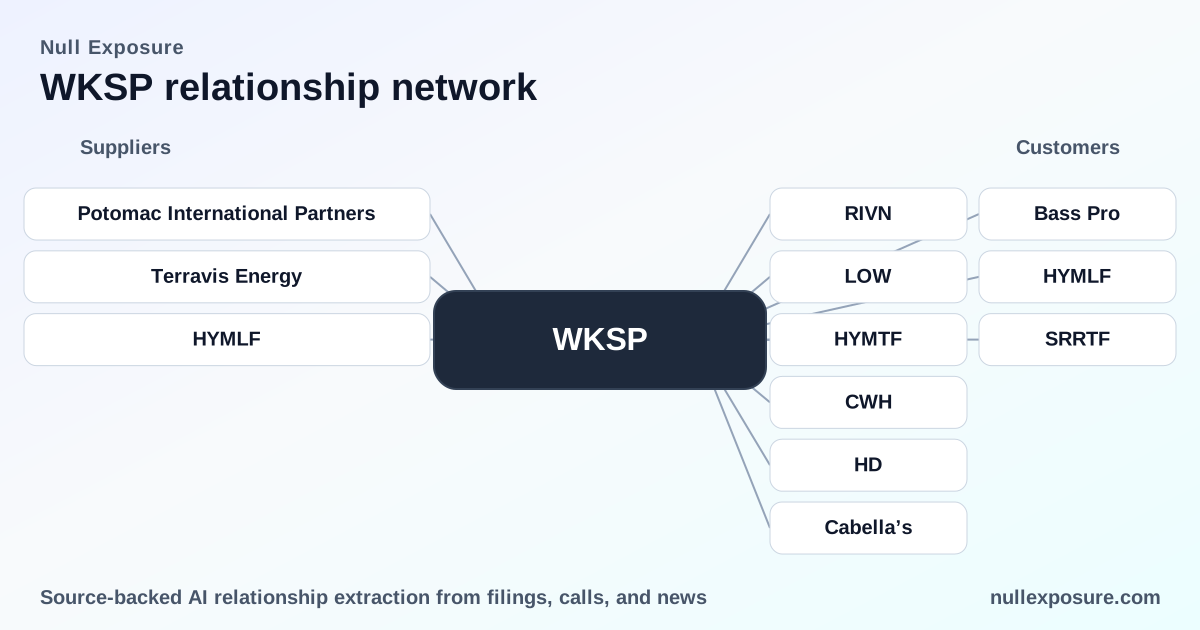
- Hyundai / HYMTF / HYMLF / HYUNDAI.BSE — Worksport has an active, signed agreement to explore SOLIS solar covers for future Hyundai EV pickup applications and lists Hyundai as a developmental OEM partner for SOLIS and COR products. (Press releases and business updates, March–May 2026; multiple distributions including EnterpriseNews and RegisterGuard, March–May 2026.)
- Rivian / RIVN — Worksport has disclosed third‑party accessory applications for the SOLIS cover to Rivian trucks and lists Rivian among EV OEM targets for future conversations. (Worksport FY2026 business update distributed March 10, 2026 via multiple outlets including RegisterGuard and EnterpriseNews.)
- Slate / SRRTF — Worksport cites exploratory conversations with Slate as another EV pickup OEM conversation in its FY2026 updates, positioning SOLIS/COR for evaluation by newer EV OEMs. (Press release distributed March 10, 2026 via App.com and partner feeds.)
- Home Depot / HD — Worksport reports initiated conversations with major big‑box retailers including Home Depot to carry the COR portable energy/tonneau system, targeting broad retail distribution. (Worksport business update, March 10, 2026; RegisterGuard/App.com syndication.)
- Lowes / LOW — Lowe’s is named alongside Home Depot as a retailer where Worksport is pursuing placement of the COR system, indicating parallel big‑box distribution channels under discussion. (Business update syndicated March 10, 2026.)
- Camping World / CWH — Camping World is listed as an intended retail partner for COR distribution conversations, reflecting a channel fit for outdoor/vehicle accessory customers. (Worksport update, March 10, 2026.)
- Bass Pro — Worksport identified Bass Pro as part of its retailer outreach for the COR system, aligning product placement with outdoor and lifestyle retailers. (Press release syndications, March 2026.)
- Cabella’s — Cabela’s is cited with Bass Pro as a target retailer for COR system distribution, reinforcing the company’s retail go‑to strategy in outdoor specialty channels. (Worksport press communications, March 2026.)
- Tri‑State Enterprises, Inc. / Tri‑State Enterprises — Worksport secured Tri‑State as a cross‑regional aftermarket distribution partner with initial purchase orders for a broad SKU set, signaling immediate demand and a multi‑state wholesale ramp for the Nexus and other covers. (Newswire release and New York/Globe & Mail coverage, April 29–May 4, 2026.)
- Patriot Automotive Technologies / Patriot Liner — Patriot has begun distributing Worksport tonneau covers across its network (over 200 dealer locations referenced), representing a strategic dealer-level channel expected to contribute recurring revenue. (NewsfileCorp press release, May 4, 2026.)
- Patomac International Partners (federal/commercial outreach) — Worksport announced a strategic partnership to accelerate federal and commercial market adoption of its clean energy ecosystem, consistent with the company’s entry into government channels after a 2024 government order. (USA Today syndication of Worksport announcement, March 2026.)
- Government (U.S. agency) — Worksport recorded its first direct U.S. government sales order on October 3, 2024, establishing the company as a vendor to public sector buyers and signaling a new contract channel outside retail/distributor routes. (Company disclosure cited in FY2026 constraint excerpts.)
Interpreting the map: what's material for investors
- Distribution wins are binary for cash flow. Early purchase orders from Tri‑State and network distribution through Patriot and others provide tangible revenue channels; converting big‑box conversations (Home Depot, Lowe’s) into shelf placements will materially scale top-line but requires certification, logistics and working capital to execute.
- OEM pathway is transformational but long lead. Hyundai’s exploratory agreement and accessory applications to Rivian represent high‑value, low-frequency opportunities; OEM contracts are larger but take longer and require integration and warranty commitments.
- Concentration remains the dominant counterparty risk. Despite new partners, historical concentration metrics indicate single‑counterparty exposure that investors must monitor; a handful of distributor or OEM outcomes can swing margins and liquidity.
- Credit and receivables risk is tied to the company’s receivables profile; the company lists distributors and wholesalers as primary payors, so partner credit quality and payment terms will influence near‑term working capital needs.
Bottom line Worksport is executing a two-track commercial strategy: scale aftermarket distribution rapidly while advancing selective OEM conversations. For investors, the near-term story is distribution execution and collection; the medium-term upside is OEM adoption of SOLIS/COR on EV pickups. Track retailer placement announcements, Tri‑State/PATRIOT order flow and any OEM contract terms for a clear inflection in revenue quality.
For a consolidated view of these counterparty signals and ongoing updates, visit https://nullexposure.com/.