Wearable Devices Ltd. (WLDS): Customer Map and Commercial Trajectory
Wearable Devices Ltd. builds and sells the Mudra neural wristband and related software that translate subtle finger and wrist movements into digital input for augmented- and mixed-reality platforms. The company monetizes through hardware sales (direct and retail), OEM/embedded partnerships that integrate Mudra into smart-glasses platforms, and distribution agreements for regional market entry, while positioning its Mudra Link software and presets as a recurring commercialization channel to B2B customers.
For a concise investor briefing on customer concentration and partner criticality, see more at https://nullexposure.com/.
How WLDS brings technology to market — practical commercial posture
WLDS operates as a hybrid hardware-plus-platform vendor: product-led monetization (Mudra bands) that is amplified by licensing and partnerships with AR headset OEMs and regional distributors. Public communications across 2025–2026 show a consistent emphasis on device compatibility and co-marketing with smart-glasses manufacturers, plus a retail channel push via Amazon.
- Contracting posture: aggressively partnership-driven — integrations and distribution deals, rather than reliance on direct enterprise contracts alone.
- Concentration: revenue remains small in absolute terms (Revenue TTM $647k) and the firm is early-stage; customer base is therefore high-concentration risk even as the partner list grows.
- Criticality: Mudra is an enabling interface for AR UX; it is strategic to headset user experience but currently an accessory rather than a core platform standard.
- Maturity: WLDS is in commercialization ramp with negative EBITDA and small market cap, indicating early-stage commercial risk but validated product-market fit through multiple OEM integrations.
Detailed relationship walk‑through — every partner surfaced in WLDS’s disclosures
Below are concise, source-backed summaries for each customer/partner named in WLDS’ public materials.
Meta‑Bounds Inc.
WLDS announced a collaboration with Meta‑Bounds to enable intuitive neural control for AR glasses, with a planned enterprise phase that will integrate Mudra as a premium accessory for Meta‑Bounds’ B2B clients. This collaboration was disclosed in an April 20, 2026 GlobeNewswire release describing future cooperation and a two‑phase partnership. (GlobeNewswire, April 20, 2026)
Lenovo
Wearable Devices reported positive results integrating Mudra with Lenovo’s XR headset, indicating successful interoperability tests and early validation on a major OEM platform. The reference appears in market summaries of WLDS activity in 2026. (SimplyWall.st coverage, 2026)
Sky Commerce Co., Ltd.
WLDS secured an exclusive distribution agreement in South Korea with Sky Commerce, positioning the company to access a sizable and strategic wearable market in the region. WLDS highlighted this South Korea market entry in its FY2025 / early‑2026 financial communications. (Sahm Capital summary and GlobeNewswire financial release, March 2026)
RayNeo
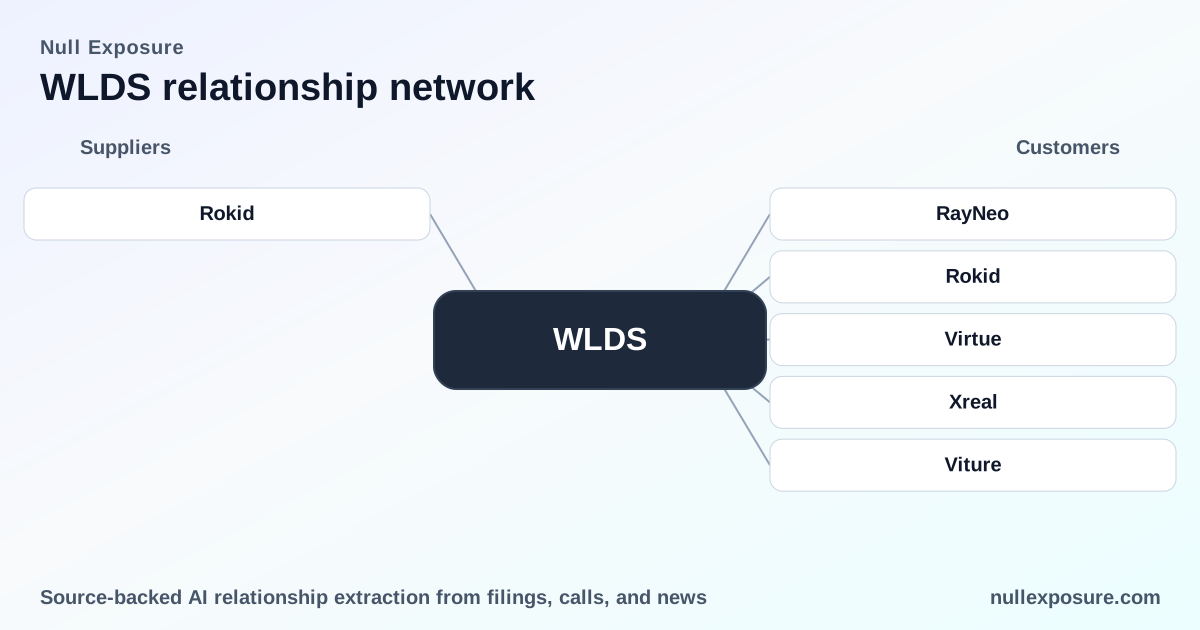
RayNeo is a native‑compatibility partner: WLDS reported Mudra presets and Mudra Link app compatibility with RayNeo smart glasses and co‑promotional product reveals (including CES demonstrations). WLDS has cited RayNeo repeatedly in 2025–2026 as a partner for gesture-mapped AR experiences. (GlobeNewswire releases and SimplyWall.st summaries, Jan–Mar 2026)
Rokid
Rokid is listed among the premier smart‑glasses partners where WLDS introduced native compatibility and onboarding presets, supporting gesture mapping directly on the device for improved immersion. This is part of WLDS’ 2025 compatibility roll‑out noted in MWC and financial communications. (GlobeNewswire, March 2026)
Virtue / Viture
WLDS named Virtue (also spelled Viture in some communications) among select smart‑glasses platforms with native Mudra compatibility, reflecting a strategy of broad OEM support rather than single‑vendor dependency. The compatibility disclosures are part of WLDS’ product updates in early 2026. (GlobeNewswire, March 2026)
Xreal
WLDS introduced custom presets and native Mudra Link app compatibility for Xreal smart glasses, demonstrating working integrations that allow full onboarding and gesture mapping directly on supported glasses. WLDS references Xreal in its 2025 product integration summaries. (GlobeNewswire, February 2026)
OPPO
WLDS demonstrated Mudra neural gesture control with an OPPO MR Glass Developer Edition, showing developer‑level interoperability with a major smartphone/consumer‑electronics OEM. This demonstration is noted in market coverage summarizing WLDS’ ecosystem progress. (SimplyWall.st coverage, 2026)
Amazon
WLDS launched the Mudra Band for consumer purchase on Amazon, adding a mainstream retail channel alongside OEM and distributor strategies and enabling direct consumer traction. The Amazon launch was reported in 2025 operational summaries. (SimplyWall.st coverage, 2026)
What these relationships reveal about WLDS’s business model
Collectively, the partner list signals a go‑to‑market strategy that blends retail hardware sales with OEM integrations and regional distribution, which reduces single-channel exposure while keeping the firm in early commercialization. Key commercial characteristics:
- Platform‑agnostic integration approach. WLDS is deliberately integrating Mudra with multiple headset vendors (Xreal, Rokid, RayNeo, Virtue, Lenovo, OPPO), increasing the total addressable market for a single accessory SKU.
- Hybrid monetization: hardware retail (Amazon), exclusive regional distribution (Sky Commerce), and enterprise accessory positioning with OEM partners (Meta‑Bounds). These channels diversify revenue levers while preserving upside from enterprise deals.
- Scale runway risk: public financials show small revenues and negative margins; therefore, partner announcements are business‑development milestones but not yet material revenue diversifiers. WLDS must convert compatibility and distribution into consistent order flow to improve unit economics.
For a deeper market analysis and partner scoring model, visit https://nullexposure.com/.
Investment implications — decisive takeaways
- Upside: WLDS has validated technical interoperability with multiple credible AR platforms and gained distribution footholds that, if converted to volume, scale hardware revenue quickly given the low-cost accessory nature of Mudra.
- Risk: high execution and concentration risk — small revenue base, negative EBITDA, and a business still dependent on persuading OEMs, distributors, and consumers to adopt Mudra at scale. Partnerships reduce technological risk but not go‑to‑market risk until order flow is visible.
- Catalysts to monitor: shipment volumes through Amazon, revenue contribution from Sky Commerce in South Korea, and any firm commercial orders tied to the Meta‑Bounds collaboration (enterprise accessory roll‑out).
Final verdict for investors and operators
Wearable Devices has built a clearly articulated commercial playbook: prove interoperability, sign distribution and OEM partners, and monetize through hardware plus platform software. The company’s public partner roster in 2025–2026 demonstrates execution on that playbook, but financial metrics confirm WLDS remains an early‑stage commercial company requiring further revenue proof points to justify valuation multiples. Investors should track tangible order and revenue conversion from the named partnerships as the primary readthrough on commercial viability.