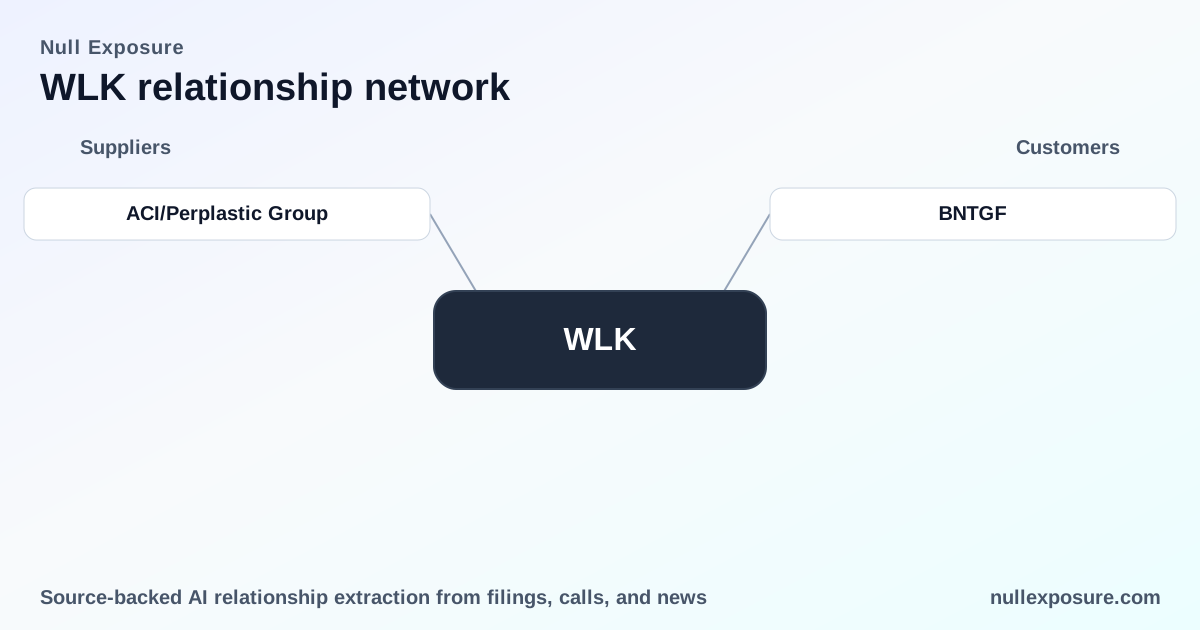
Westlake Chemical (WLK): customer map and what it tells investors
Westlake Chemical is a vertically integrated manufacturer of olefins, vinyls and fabricated building products that monetizes through commodity and specialty polymer sales, branded building-materials distribution, and contractual services to related public partnerships. The company captures value both upstream (ethylene, PVC, chlor-alkali) and downstream (polyethylene pellets, Westlake Royal building products), collects steady cash from branded distribution relationships and third‑party services, and retains upside via product mix and regional exposure. For deeper diligence and source-level monitoring, visit https://nullexposure.com/.
How Westlake makes money and why customers matter
Westlake’s business blends commodity cyclicality with positioning in essential downstream markets. RevenueTTM is $11.17B with EBITDA of $834M, highlighting a margin profile under pressure (negative net margin and EPS), while valuation signals (EV/EBITDA ~35x) indicate market expectations for either stronger margins or asset value realization. The company sells polyethylene and vinyl products directly to industrial customers and through distribution partners; it also operates a services model for partnerships such as Westlake Chemical Partners (WLKP). Customer relationships therefore drive both volume stability and channel economics—in distribution partners Westlake realizes branded product reach, and in service arrangements it captures predictable fee income.
- Business model characteristics: Westlake operates with a seller posture, serving a mix of large enterprise customers and a broad base that includes small contractors—this creates both concentration risk among large processors and resilience from diversified end markets.
- Operational reach: The company is a global operator with critical exposure across North America, Europe and Asia; distribution partnerships extend market access in key regional markets like India.
- Maturity and criticality: Many of Westlake’s relationships involve core products (polyethylene, PVC, fabricated goods) and are active commercial arrangements that underpin ongoing plant throughput and branded sales.
Customer relationships: what the media coverage documents
Below is a concise, source-linked readout of every customer-related relationship flagged in our coverage set. Each item uses the publisher and period cited by the underlying report.
-
Capstone (CAPS) — Capstone strengthens distribution of Westlake’s Cultured Stone brand through acquisition of Eldorado distribution rights, underscoring Capstone’s role as a top-three distributor for the product and expanding Westlake’s premium stone-channel coverage. Source: intellectia.ai news note on Capstone (FY2026, reported May 2, 2026).
-
BlueLinx (BXC) — BlueLinx launched TruExterior® siding and trim by Westlake Royal Building Products, with Westlake sales leadership publicly praising BlueLinx’s market knowledge and support for customer growth; this confirms BlueLinx as a strategic distribution partner for Westlake’s siding and trim business. Source: Markets.FinancialContent press release quoting Westlake sales VP Bill Conlon (FY2026, April 30, 2026).
-
BlueLinx (BXC) — A second mention in earnings and industry communications reiterates BlueLinx’s role introducing Westlake-branded exterior products into its distribution network, reinforcing the distribution partnership in building materials. Source: Quantisnow industry notice (FY2026, May 4, 2026).
-
Westlake Chemical Partners (WLKP) — WLKP reported consolidated cash balances and investments totaling $81 million held with Westlake under their investment management agreement, illustrating close financial operational integration between Westlake and its publicly traded partnership. Source: Q2 2025 earnings call transcript coverage on InsiderMonkey (FY2025).
-
Westlake Chemical Partners (WLKP) — Market commentary notes WLKP is governed by an experienced board and managed day‑to‑day by Westlake under a long‑term services agreement, highlighting the service-fee economics and operational dependence within the partnership structure. Source: MarketBeat note on WLKP governance and management (FY2026, March 28, 2026).
-
Brenntag / BNTGF — Westlake announced an expansion of its India distribution partnership with Brenntag, giving Westlake access to coatings, adhesives and construction markets in that region and extending its commercial footprint in Asia. Source: StocksToTrade industry report (FY2026, February 24, 2026).
-
Brenntag / BNTGF — Financial news coverage similarly recorded the India expansion, underlining that the Brenntag relationship is a deliberate channel strategy to penetrate local B2B chemical markets. Source: FinViz synopsis of analyst commentary (FY2026, March 10, 2026).
(These items collectively reflect each relationship mention in the source set and the dates referenced in the coverage.)
What the relationship set implies for investors
-
Distribution-led growth: Westlake relies on a mix of national distributors (BlueLinx, Brenntag) and specialized channel partners (Capstone) to extend branded product penetration—this lowers capital intensity for market expansion while depending on third‑party execution. Distribution partners are strategic amplifiers of revenue, not simply transactional resellers.
-
Integrated service economics: The WLKP arrangements demonstrate that Westlake captures recurring service and management fees in addition to product margin—these contracts create cash flow linkage between Westlake’s operating platform and listed partnership returns.
-
Global footprint and concentration dynamics: Coverage and corporate disclosures show a global customer base that includes both large enterprise polyethylene buyers and a long tail of smaller construction and fabricator customers; this mix reduces single‑counterparty concentration risk but increases exposure to regional demand cycles.
-
Valuation and margin pressure: Public metrics show negative net margins and EPS alongside a high EV/EBITDA multiple; the customer model will need higher downstream pricing power or improved operational efficiency to justify current enterprise multiples.
Constraints and operating-signals to watch
The signals extracted from company statements and market coverage translate into actionable operating constraints:
- Counterparty type: large-enterprise customers are material, particularly for polyethylene buyers—this implies contract negotiation leverage and credit concentration that investors should monitor.
- Geography: global reach is core—North America, Europe and Asia matter operationally and for demand diversification.
- Relationship role: Westlake functions predominantly as seller and services provider, selling core polymer products and managing partnership operations.
- Relationship stage: Many customer flows are active and core, underpinning current production and throughput.
- Segment: Relationships largely involve core product lines, meaning customer demand directly affects manufacturing utilization and margin realization.
These are company-level signals—investors should not conflate them with any single partner unless the source explicitly names that partner.
Bottom line and next steps
Westlake’s customer network mixes branded distribution and close partnership economics that support broad market access but require margin recovery to sustain valuation. The company’s ties to BlueLinx, Brenntag, Capstone and WLKP provide predictable channels and service revenue, while the global customer base insulates some cyclicality. Key watch items for investors: downstream pricing, utilization trends, and the performance of distribution partners in key regions like India and North America.
For ongoing monitoring of partner-level exposure and source-level signals, explore more on the platform: https://nullexposure.com/.