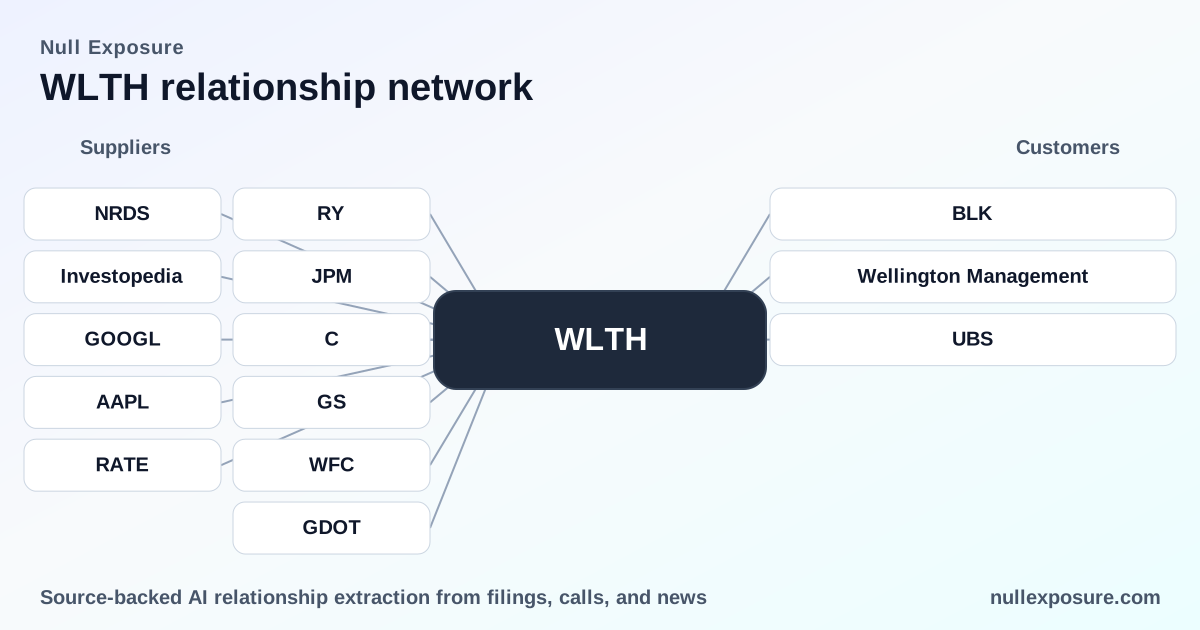
Wealthfront (WLTH) — investor map and what the backers reveal
Wealthfront operates as a digital investment manager and consumer wealth platform headquartered in Redwood City, California, generating revenue from investment management and complementary financial products. The company monetizes primarily through fees tied to client assets and product-level income (cash, lending, and ancillary services), while institutional backers provide validation and capital market support ahead of a public offering. For investors evaluating counterparty and customer relationships, the recent media coverage highlights strategic institutional underwriting and an earlier strategic acquisition attempt, both of which shape Wealthfront’s go‑to‑market confidence and financing posture.
For a structured view of counterparty exposure and relationship provenance, see NullExposure’s mapping at https://nullexposure.com/.
Why the relationship roster matters to an investor
Wealthfront’s cited relationships are not operational vendors; they are institutional investors and past strategic acquirers whose engagement signals market appetite, distribution support, and potential governance influence. BlackRock and Wellington’s participation in an IPO allocation represents short-term capital commitment and credibility; UBS’s previously aborted acquisition speaks to Wealthfront’s strategic optionality and potential negotiating value for future partnerships or exits.
Who shows up in the coverage — the three counterparties
Below I summarize every relationship captured in the reporting and link each fact to its source so you can verify primary coverage.
BlackRock (BLK / BlackRock Inc.)
Funds managed by BlackRock were reported to have agreed to buy as much as $150 million in aggregate of Wealthfront IPO shares, signaling strong institutional appetite from a leading asset manager for the offering. According to WealthManagement and InvestmentNews coverage on March 10, 2026, BlackRock and Wellington were listed as prospective large purchasers of IPO shares (WealthManagement, 2026-03-10; InvestmentNews, 2026-03-10).
Sources: WealthManagement (Mar 10, 2026) — https://www.wealthmanagement.com/financial-technology/robo-advisor-wealthfront-backers-seeking-485m-in-ipo; InvestmentNews (Mar 10, 2026) — https://www.investmentnews.com/equities/robo-advisor-wealthfront-backers-raise-4846-million-in-ipo/263529
Wellington Management
Wellington Management was named alongside BlackRock as a buyer that had committed to up to $150 million of IPO shares in aggregate, providing a second major institutional anchor for the transaction and reinforcing demand from active asset managers. The same March 10, 2026 reports detail Wellington’s participation in the IPO book (WealthManagement; InvestmentNews).
Sources: WealthManagement (Mar 10, 2026) — https://www.wealthmanagement.com/financial-technology/robo-advisor-wealthfront-backers-seeking-485m-in-ipo; InvestmentNews (Mar 10, 2026) — https://www.investmentnews.com/equities/robo-advisor-wealthfront-backers-raise-4846-million-in-ipo/263529
UBS (UBS Group AG)
UBS was previously reported to have agreed in 2022 to acquire Wealthfront for $1.4 billion but later abandoned the deal, a historical transaction that illustrates Wealthfront’s strategic attractiveness to large private banks and creates a reference price for valuation discussions. InvestmentNews’ March 10, 2026 article recalls the 2022 UBS agreement and subsequent abandonment (InvestmentNews, 2026-03-10).
Source: InvestmentNews (Mar 10, 2026) — https://www.investmentnews.com/equities/robo-advisor-wealthfront-backers-raise-4846-million-in-ipo/263529
How these relationships affect the operating and business model signals
There are no formal constraints recorded in the relationship dataset, so the following are company‑level signals derived from the relationship pattern and public metrics:
- Contracting posture (capital markets focus): Institutional allocations from BlackRock and Wellington ahead of an IPO indicate a proactive underwriting and allocation posture — Wealthfront is using institutional demand to support public market access rather than relying solely on retail traction.
- Concentration and governance influence: The presence of a small set of large institutional buyers suggests a moderate concentration of influential shareholders post‑offer; that concentration can accelerate strategic decisions but also concentrate governance influence.
- Criticality of relationships: These ties are financial and reputational, not operational; their criticality is high for funding and market credibility, low for day‑to‑day platform operations.
- Maturity and optionality: The 2022 UBS acquisition attempt evidences strategic optionality—Wealthfront has been on the radar for strategic buyers, which increases exit and partnership alternatives for shareholders.
Financial context that matters to counterparties
Wealthfront’s public financial snapshot ahead of the IPO shows growing revenue (RevenueTTM ~$365M) with negative earnings and operating margins (OperatingMarginTTM -2.239, EPS -0.8), and a relatively high Price-to-Sales posture implied by public comparables (PriceToSalesRatioTTM 4.67). That profile explains why institutional backers would participate — they underwrite growth potential while pricing in near-term profitability gaps.
What investors should watch next
- Book composition after the IPO — whether institutional anchors convert into stable long‑term holders or short-term sellers will affect governance and share price stability.
- Revenue mix evolution — whether Wealthfront shifts mix toward higher-margin products (cash management, lending) will materially affect margin expansion.
- Strategic conversations with large banks — renewed M&A interest from entities like UBS or other custodial partners would alter exit optionality and valuation dynamics.
For a complete relationship map and periodic updates on counterparty signals, visit NullExposure: https://nullexposure.com/.
Bottom line
Wealthfront’s recent coverage outlines institutional underwriting by BlackRock and Wellington and reminds the market of a prior UBS strategic bid. Those relationships deliver credibility, potential distribution support, and a valuation anchor — all of which are material to an investment case that balances growth potential against current negative profitability. Investors evaluating WLTH should focus on shareholder composition after the offering and on the path to consistent margin improvement.