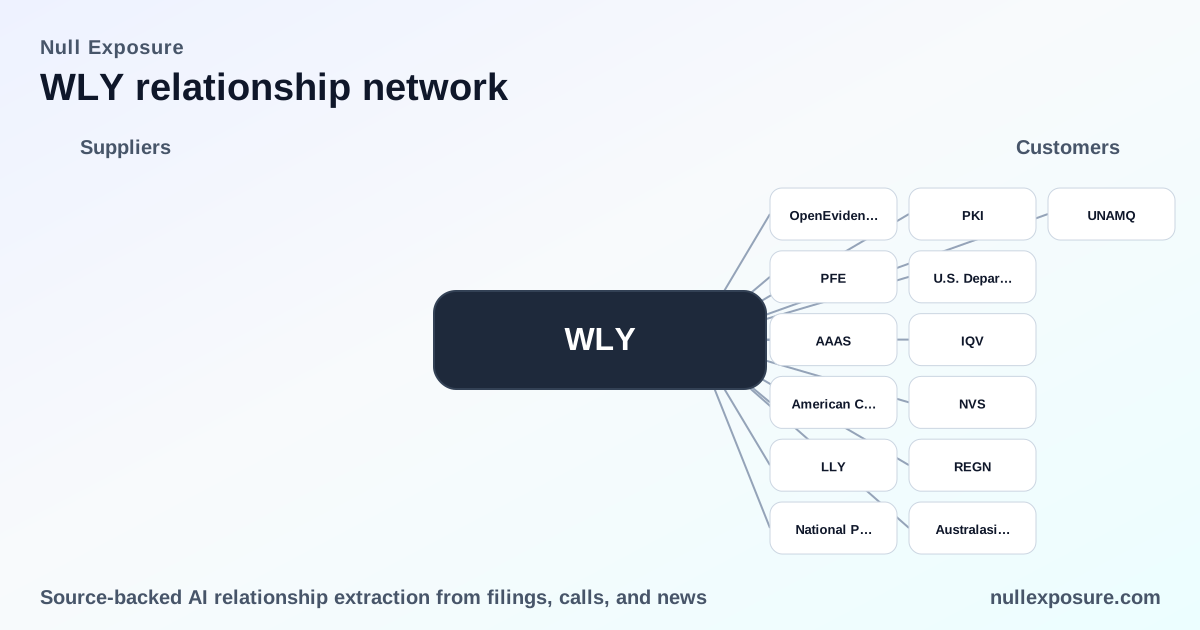
Wiley (WLY) customer map: who pays for its content, platforms and services
John Wiley & Sons monetizes by licensing and selling authoritative scholarly and professional content, subscription access and “read-and-publish” transformational agreements, along with a growing menu of services — recruitment platforms, knowledge hubs, virtual events and managed marketing for corporate and society partners. Wiley converts intellectual property into recurring revenue (subscriptions and multi‑year arrangements) while selling services that generate higher-margin, project-based revenue and upsell opportunities. For a concise, structured view of these customer relationships and how they shape Wiley’s cashflow profile, see more at https://nullexposure.com/.
How Wiley’s operating model drives revenue and creates constraints
Wiley’s core commercial posture is subscription-led and licensor-focused, supported by service delivery where the company acts as a seller and service provider. The company contracts through a mix of multi-year transformational agreements and annual renewal mechanics: transformational “read-and-publish” deals blend traditional journal subscriptions with open-access publishing fees, but Wiley often recognizes revenue on an annual confirmation basis even when arrangements span multiple years. This produces a blend of predictable recurring revenue and periodic negotiating exposure at renewal points.
Geography and customer mix are structural advantages: Wiley sells globally to academic institutions, corporate R&D, government bodies and individual students and researchers, giving it scale and diversified demand. Research products are material to the enterprise (around two‑thirds of consolidated revenue), while Learning contributes the remainder with strong margins — a profile that supports stable EBITDA but concentrates exposure on the scholarly ecosystem. Wiley also functions as a licensor (read/perpetual access), a direct seller (subscriptions and books), and a service provider (managed services, recruitment platforms, events), enabling cross-sell but increasing execution complexity.
Key operational constraints to consider as company-level signals:
- Contracting posture: multi-year arrangements exist, but revenue recognition and renewal dynamics create annual negotiation points.
- Revenue mix: Research is material (~64% of revenue) and Learning is significant (~35%), creating customer concentration by segment rather than by single counterparty.
- Counterparty diversity: customers include governments and individuals alongside corporate and society partners, increasing both scale and procurement complexity.
- Role breadth: Wiley is both a licensor of IP and a service provider, which raises both content risk (licensing, copyright) and operational risk (delivering digital services at scale).
Catalog of customer mentions and what they mean for investors
-
OpenEvidence — Wiley entered a strategic partnership to license scientific and medical content into the OpenEvidence medical AI platform, positioning Wiley content at point-of-care for clinicians. According to a March 2026 press summary on Quantisnow, this expands Wiley’s content licensing into clinical AI environments and includes Cochrane and hundreds of journals (FY2025).
Source: Quantisnow news item (March 2026). -
Eli Lilly (LLY) — Wiley announced an educational content engagement to build four disease-area educational resource hubs with Eli Lilly, showing direct corporate solutions sales into pharmaceutical R&D and medical education (FY2021 earnings call transcript).
Source: Motley Fool transcript of Wiley earnings call (Dec 2021). -
LLY (duplicate entry) — The same earnings-call citation reiterates the Lilly partnership to create disease-focused educational hubs, highlighting an ongoing client relationship with upsell potential in knowledge‑hub products (FY2021).
Source: Motley Fool transcript (Dec 2021). -
PFE / Pfizer — Wiley renewed a partnership to manage Pfizer’s career center, evidencing Wiley’s recruitment and career‑platform service capabilities for large pharma HR and talent acquisition functions (FY2021).
Source: Motley Fool transcript of Wiley earnings call (Dec 2021). -
Pfizer (duplicate entry) — The duplicate transcript entry again notes the career-center renewal with Pfizer, underscoring service‑based revenue continuity from major corporate partners (FY2021).
Source: Motley Fool transcript (Dec 2021). -
AAAS — Wiley’s career centers help major societies such as the American Association for the Advancement of Science generate revenue by connecting members with jobs, confirming society partnerships as a revenue channel (FY2022).
Source: Motley Fool transcript of Wiley earnings call (Sept 2022). -
American Cancer Society — Wiley signed the American Cancer Society as one of six new solutions partners in a quarter, indicating continued traction with large non‑profits for Wiley’s solutions portfolio (FY2022).
Source: Motley Fool transcript (Sept 2022). -
Eli Lilly (FY2022 entry) — In FY2022 Wiley listed Eli Lilly among six new solutions partners, confirming multiple engagements over time and cross-period expansion of the Lilly relationship.
Source: Motley Fool transcript (Sept 2022). -
LLY (duplicate FY2022 entry) — The repeated entry records Lilly again in the FY2022 partner list, reinforcing sustained commercial linkage reported by management (FY2022).
Source: Motley Fool transcript (Sept 2022). -
National Park Service — The National Park Service was named among new solutions partners, illustrating Wiley’s reach beyond pure academia into government agencies for digital solutions and events (FY2022).
Source: Motley Fool transcript (Sept 2022). -
Perkin Elmer (PKI) — Management cited Perkin Elmer as a user of new product offerings like Knowledge Hubs and virtual events, signaling uptake of Wiley’s R&D‑focused marketing and engagement products by life‑science tools vendors (FY2022).
Source: Motley Fool transcript (Sept 2022). -
PFE (FY2022 entry) — Pfizer appears again in FY2022 commentary as a beneficiary of Wiley’s career-center services, showing renewal and continued service engagement into a later period.
Source: Motley Fool transcript (Sept 2022). -
Pfizer (duplicate FY2022) — The duplicate FY2022 citation reiterates Wiley’s relationship with Pfizer tied to talent‑platform services (FY2022).
Source: Motley Fool transcript (Sept 2022). -
PKI (duplicate FY2022) — Perkin Elmer’s repeated mention emphasizes the applicability of Wiley’s Knowledge Hub and event products to R&D suppliers (FY2022).
Source: Motley Fool transcript (Sept 2022). -
AMPCo (Australasian Medical Publishing Company) — In FY2018 Wiley formed a publishing and distribution partnership to publish the Medical Journal of Australia, demonstrating Wiley’s long-term publishing partnerships and regional distribution capabilities (2018 announcement).
Source: Medical Journal of Australia / MJA announcement (2018). -
OpenEvidence (SimplyWall summary FY2022) — A FY2022 industry summary noted Wiley licensed a broad portfolio, including Cochrane content and 400+ journals and books, for use within OpenEvidence’s point‑of‑care platform — an expansion of the OpenEvidence relationship into critical clinical assets.
Source: simplywall.st company summary (FY2022). -
U.S. Department of Energy — Management disclosed the DOE as one of over 41 major customers, indicating Wiley’s penetration into government R&D and public-sector research contracts (FY2022).
Source: Motley Fool transcript (Sept 2022). -
IQV / IQVIA — Wiley signed an agreement with IQVIA to bundle Wiley clinical outcomes content with IQVIA’s clinical research services, positioning Wiley content inside clinical‑trial and outcomes workflows for pharma customers (FY2025 earnings call transcript referenced in Q2 2026 reporting).
Source: InsiderMonkey transcript of Wiley Q2 2026 earnings call (FY2025). -
IQV (duplicate entry) — The duplicate mention of IQVIA in the same FY2025 context reiterates the strategic bundling arrangement with a leading clinical‑research service provider.
Source: InsiderMonkey transcript (FY2025). -
Novartis (NVS) — Management listed Novartis among eight marquee customers for a specified product set, demonstrating direct engagement with top-tier pharmaceutical companies (FY2025).
Source: InsiderMonkey transcript of Wiley Q2 2026 earnings call (FY2025). -
NVS (duplicate) — The duplicate entry for Novartis restates the same list of eight enterprise customers, confirming the company’s cited client roster (FY2025).
Source: InsiderMonkey transcript (FY2025). -
Regeneron (REGN) — Regeneron was named among eight customers, further illustrating Wiley’s penetration into large biopharma accounts for its clinical and research solutions (FY2025).
Source: InsiderMonkey transcript (FY2025). -
UNAM / UNAMQ — Wiley announced its first Read-and-Publish agreement in Latin America with UNAM (Mexico’s largest university), a signal of strategic expansion in open-access transformative agreements in the academic market (FY2022).
Source: Motley Fool transcript of Wiley earnings call (Sept 2022). -
UNAMQ (duplicate) — The duplicate UNAM entry repeats the Read-and-Publish milestone in Latin America, underscoring Wiley’s push into regional transformational contracts.
Source: Motley Fool transcript (Sept 2022).
What investors should take away
- Recurring revenue core: Wiley’s subscription and transformational agreements create durable base revenue, but revenue recognition mechanics concentrate negotiation risk at annual confirmations.
- Services upsell potential: Wiley’s managed services, career platforms and Knowledge Hubs provide higher‑margin growth vectors and create embedded relationships with pharmas, societies and government agencies.
- Client mix mitigates single‑counterparty risk: The breadth of customers (government, corporate, societies, individuals) reduces exposure to any single counterparty, though research revenue concentration is material to corporate performance.
- Strategic content licensing into AI and clinical platforms (e.g., OpenEvidence, IQVIA) increases content monetization but raises dependency on licensing integrity and platform integration execution.
For a deeper customer‑level exposure map and scenario analysis, visit https://nullexposure.com/ — the platform provides structured relationship insights tied to filings and management commentary.
Bottom line: Wiley’s business combines stable subscription cashflows with service-led growth opportunities; investors should underwrite steady recurring revenue while monitoring renewal dynamics, the pace of transformational agreement adoption, and execution on services that convert content into higher-margin offerings.