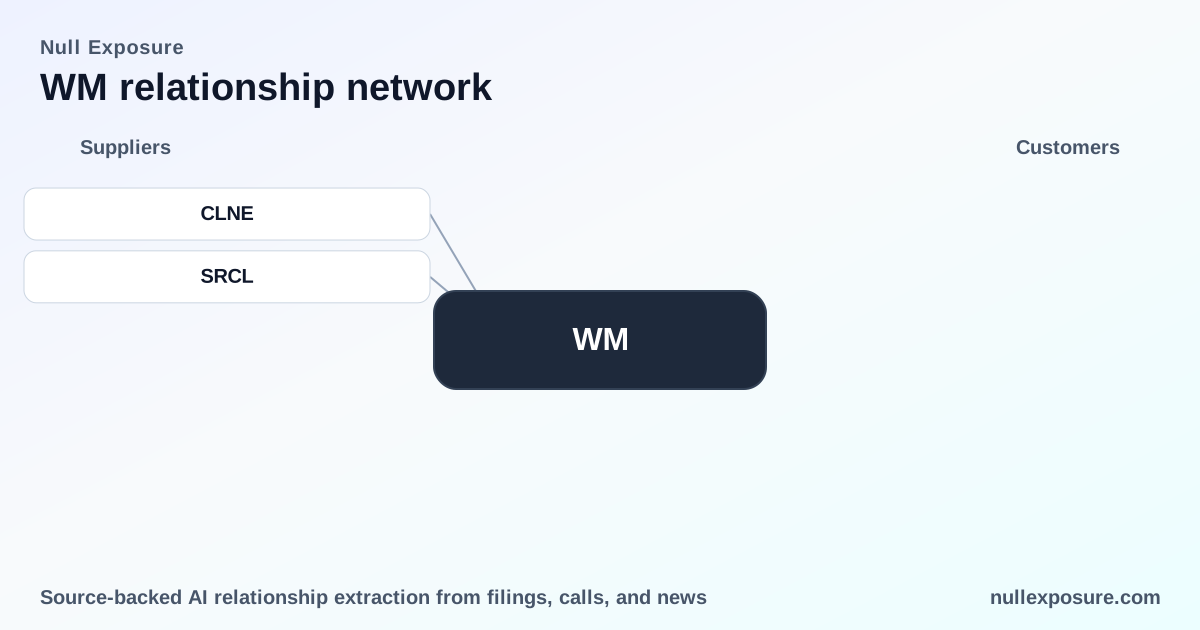
Waste Management (WM): Customer Relationships and What They Mean for Revenue Durability
Waste Management operates and monetizes a broad, asset-heavy environmental services platform across North America and parts of Western Europe. The business generates revenue through a mix of long-term municipal and commercial contracts, recurring healthcare and residential collection agreements, volume- or weight-based disposal fees, landfill gas royalties, and commodity sales from recycled materials. This mix produces durable cash flow, outsized operating margins for an infrastructure business, and a low customer concentration profile. For a deeper look at relationship intelligence and comparable coverage, visit https://nullexposure.com/.
Company snapshot: market cap ~$91.5B, FY revenue ~$25.4B, EBITDA ~$7.66B, trailing P/E ~33, and a dividend yield around 1.5%, underscoring a mature, cash-generative industrial operator.
Why customers matter to the WM investment thesis
Waste Management’s economics are driven by three customer characteristics: contract duration, pricing basis, and counterparty mix. Long-duration municipal franchises and three-year commercial contracts create predictable recurring revenue; usage- and volume-based pricing across industrial and healthcare customers injects variable but indexed flows when volumes change; and a diversified counterparty base—municipalities, large national accounts, small businesses and residential households—reduces single-counterparty risk and underpins steady utilization of physical assets (landfills, transfer stations, processing plants). These attributes explain why WM trades at a premium multiple for a defensive industrial with modest beta (≈0.5) and high institutional ownership.
All recorded customer relationships in this review
The dataset for WM’s customer relationships returned a single third-party mention. I include it below in full.
- Agnico Eagle Mines (AEM): Agnico Eagle Mines Limited was reported to have acquired the Detour East Claims from Wallbridge Mining Company Limited for CAD 8 million. This mention appears in a financial news summary dated May 2, 2026. Source: simplywall.st news item, 2026-05-02 — https://simplywall.st/stocks/us/materials/nyse-aem/agnico-eagle-mines
Note: the only external item cataloged under the "customer" scope in this pull is a third-party mining transaction; it does not alter the company-level signals about WM’s core municipal, commercial, residential, and healthcare customer base documented in corporate filings.
What the constraint signals reveal about WM’s operating model
The extracted relationship constraints—drawn from company disclosures—are best read as company-level operating signals rather than attributes of any single named counterparty. These signals define the contracting posture, counterparty diversity, geography, and revenue drivers that investors should underwrite.
- Contracting posture: predominantly long-term and recurring. Management reports that roughly 30% of total revenue comes from contracts with remaining terms over one year; municipal and commercial collection agreements typically run three to ten years, which produces a foundation of recurring revenue and capital recovery horizons consistent with heavy infrastructure assets (landfills, fleet, facilities).
- Mixed pricing mechanics: subscription and usage-based revenue coexist. Healthcare Solutions and certain commercial services invoice on scheduled (monthly/quarterly) fees while also collecting weight- or volume-based charges, making revenue partially fixed and partially variable to demand.
- Counterparty breadth and low concentration. The largest customer represented less than 5% of 2025 revenues, signaling low single-customer concentration and limited counterparty credit exposure at the top of the book.
- Counterparty types span government to individual households. WM serves municipalities and government entities, large national accounts, and residential customers, which produces a revenue mix with high criticality for municipal services and broad end-market exposure for commodity-linked recycling streams.
- Geographic footprint is primarily North America with targeted Western European exposure. Core operations are across the U.S. and Canada, with Healthcare Solutions and certain recycling/compliance services operating in parts of Western Europe.
- Multiple relationship roles: seller, service provider, and buyer. WM collects fees for services and also sells landfill gas and renewable credits, receives royalties from third-party power and RNG projects, and transacts in RINs/RECs—indicating vertical revenue capture beyond pure collection and disposal.
- Segment exposure leans toward services with regulated and compliance characteristics. Healthcare Solutions provide compliance-based services to hospitals, airports, and government accounts; these services are sticky and compliance-driven, increasing revenue resilience.
Collectively, these constraints describe a mature, low-concentration business with contractual stickiness and mixed pricing that produces predictable cash flow while retaining exposure to commodity and volume cycles.
Relationship-level takeaways and investment implications
Even though the pull returned a single external news mention (Agnico Eagle), the company-level signals drive practical conclusions for underwriting WM.
- Revenue visibility is high for base collection and disposal services because of multi-year municipal and commercial contracts; investors should treat a material portion of cash flow as recurrence rather than spot.
- Variable exposure exists through recycling commodity prices and volume-sensitive industrial customers, introducing cyclical swings to gross margins and reported revenue growth.
- Credit and counterparty risk are muted by diversification: the largest customer is below 5% of sales and institutional ownership is high, supporting stable governance and capital allocation.
- Strategic optionality from landfill gas, RNG royalties, and REC/RIN monetization provides incremental margin expansion and non-linear upside if regulatory credits or renewables pricing improves.
- Geographic concentration in North America reduces regulatory complexity overall, but Healthcare Solutions’ Western European footprint means selective overseas regulatory and compliance risk.
Valuation context and final read
Waste Management trades at a premium multiple (trailing P/E ~33; forward P/E ~27.7) relative to many industrial peers because the market prices in durable contract coverage, low customer concentration, and strong cash conversion (EBITDA margin and ROE metrics reflect that). Analysts are broadly constructive: combined Buy/Strong Buy recommendations outnumber Holds, supporting a consensus target above current prices.
For investors evaluating the company’s customer-side risks and operational durability, the principal axes to monitor are municipal franchise renewals, volume trends in commercial and industrial customers, commodity price cycles in recycling, and the trajectory of landfill-derived renewable revenues.
Explore consolidated relationship intelligence and signals at https://nullexposure.com/ to integrate these customer dynamics into portfolio models.
Conclusion: Waste Management’s customer base and contract architecture create high revenue durability with measured cyclicality, appropriate for investors seeking defensive industrial exposure with steady cash generation and selective growth optionality.