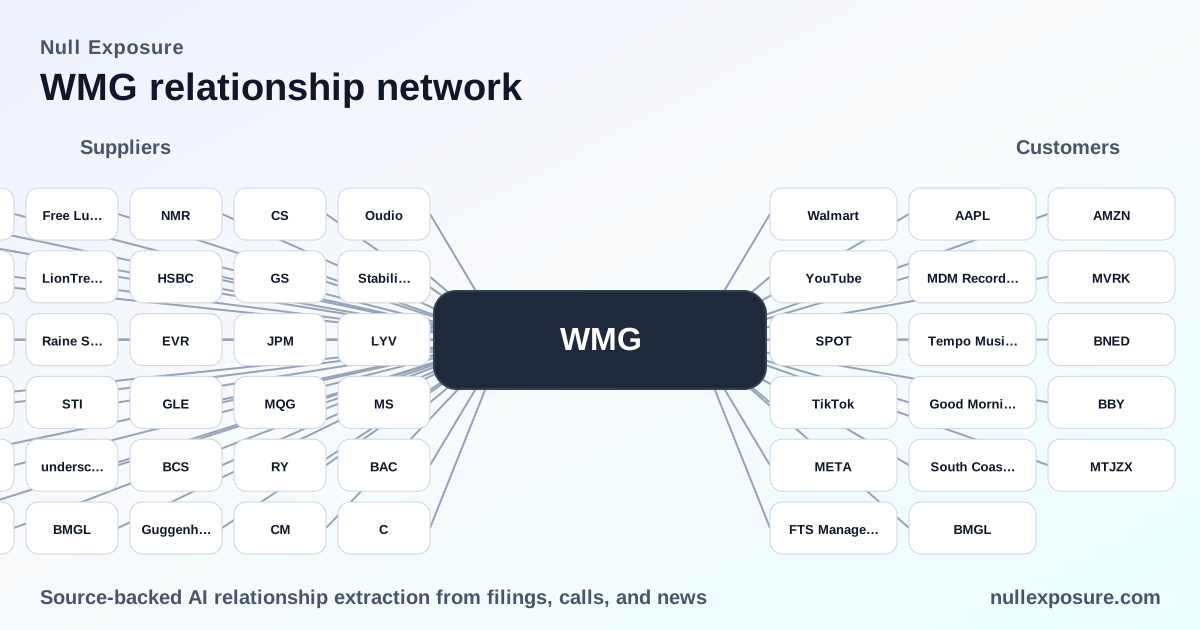
Warner Music Group: Customer Relationships and Commercial Exposure
Thesis: Warner Music Group (WMG) monetizes a global catalog of recorded music and publishing rights through a mix of long‑term digital licensing, usage‑based royalties, physical and online retail distribution, and select short‑term artist services; the company acts both as licensor (granting access to its catalog) and seller/distributor (supplying physical product and digital assets), generating recurring cash flow from streaming platforms, digital services, retailers and catalog licensing. For investors this means revenue durability tied to a small set of large digital partners alongside pockets of higher‑volatility retail and artist services revenue. Explore a mapped view of these relationships at https://nullexposure.com/.
How WMG's commercial model shapes investor risk and upside
WMG’s operating model is a hybrid of long‑dated licensing and usage‑based economics. The company discloses that many digital licensing contracts are long‑term and paid as sales‑ or usage‑based royalties that are typically collected monthly, while artist services and expanded‑rights agreements are often shorter in duration. This creates two investment dynamics: (1) recurring, predictable cash flow from established streaming partners and minimum guarantees embedded in some licenses; and (2) earnings leverage from price changes, platform growth, and catalog renewals that flow through quickly because consideration is typically usage‑based.
WMG also signals global transactional exposure (foreign currency risk), and that a material share of publishing royalties is collected via non‑profit collecting societies — an operational nuance that matters for cash collection timing and counterparty concentration. Finally, WMG’s role as both licensor (ongoing access to evolving content libraries) and seller/distributor (physical and digital distribution channels) increases its bargaining leverage with platforms while keeping the company exposed to platform conduct and renewal cycles.
If you want a concise commercial map for modeling WMG revenue sensitivity, review the relationship annotations below and the company‑level signals discussed above. For a broader view of relationship analytics, visit https://nullexposure.com/.
Customer relationships: who WMG sells to and how those ties work
Below are the relationships surfaced in WMG’s filings and public releases. Each entry gives a plain‑English summary and the original source.
- Walmart — WMG sells physical music products through traditional retail stores such as Walmart, maintaining a legacy retail channel for physical revenue. Source: WMG 10‑K (FY2025).
- YouTube — WMG highlights landmark deals with major digital platforms, naming YouTube among companies with strategic licensing agreements for access and monetization of recorded music. Source: WMG 10‑K (FY2025).
- Spotify (SPOT) — WMG reported that its share of Spotify’s Top 200 playlists rose by about six percentage points year‑over‑year, and that the companies reached an agreement covering recorded music and publishing to shape audio‑visual streaming economics. Source: WMG FY2025 Q4 earnings call (2025Q4) and company press release / GlobeNewswire (Feb 2025).
- TikTok — WMG attributes a measurable uplift in ad‑supported streaming revenue to a TikTok renewal executed in Q4 2023, indicating TikTok is a meaningful contributor to ad‑funded streaming growth. Source: WMG press release reporting results for the quarter ended Dec 31, 2023 (FY2024) and subsequent earnings commentary.
- Tempo Music Investments — WMG partnered with Providence Equity through Tempo to acquire recorded music and publishing catalogs, with WMG responsible for publishing administration and distribution services to the platform. Source: MusicBusinessWorldwide reporting on the Tempo joint venture (FY2019 announcement).
- Good Morning To You Productions Corp — Historical litigation and licensing context: Warner/Chappell collected licensing fees for the “Happy Birthday” song in disputes reported in the media, illustrating WMG’s historical licensing activity and enforcement posture. Source: news coverage of the 2013 suit (Tribune report).
- Netflix (NFLX) — WMG struck a multi‑year deal with Netflix for artist documentaries, indicating expanded sync and audiovisual licensing beyond pure audio streaming. Source: MarketScreener news (Mar 2026 reporting).
- Apple Music (AAPL) — Apple Music is listed among distribution targets for WMG‑owned services and third‑party distribution partners; WMG’s distribution channels reach Apple’s streaming storefronts. Source: MusicBusinessWorldwide coverage of Level Music and digital distribution (FY2024 reporting).
- FTS Management — WMG’s ADA distribution business recently struck new deals with independent label partners such as FTS Management, reflecting ADA’s role in artist and label distribution. Source: MusicBusinessWorldwide reporting (FY2024).
- Instagram (Meta) — Instagram is identified as a destination platform for distributed content (via Level Music and similar services), underscoring social platforms’ role in WMG’s digital distribution mix. Source: MusicBusinessWorldwide reporting (FY2024).
- MDM Recordings — ADA completed a distribution agreement with MDM Recordings, highlighting WMG’s distribution reach into independent label catalogs. Source: MusicBusinessWorldwide reporting (FY2024).
- South Coast Music Group — ADA added South Coast Music Group as a distribution partner, another example of WMG’s independent label distribution footprint. Source: MusicBusinessWorldwide reporting (FY2024).
- BMG (BMGL) — The termination of a distribution agreement with BMG resulted in multi‑quarter impacts to WMG’s recorded music digital and physical revenue, with disclosed figures showing tens of millions of dollars of revenue variance in FY2024–FY2026 quarters. Source: WMG press releases reporting quarterly results (FY2023–FY2026) and related investor commentary.
- Amazon (AMZN) — WMG sells physical music products to online physical retailers such as amazon.com, maintaining e‑commerce physical sales channels. Source: WMG 10‑K (FY2025).
- Maverick / MVRK — WMG collaborates with partners such as Maverick on artist projects and catalog initiatives, reflecting strategic label and management partnerships. Source: press coverage of Madonna/Maverick collaboration (FY2021 report).
- Best Buy (BBY) — Best Buy is cited as a retail destination for WMG’s physical music products, supporting ongoing physical channels. Source: WMG 10‑K (FY2025).
- Barnes & Noble (BNED) — Barnes & Noble is listed among online physical retailers that sell WMG’s music products. Source: WMG 10‑K (FY2025).
- Target (MTJZX) — Target is explicitly named as a traditional physical retail partner for WMG’s music product distribution. Source: WMG 10‑K (FY2025).
Interpreting these ties for modeling and risk
- Contracting posture: WMG’s disclosed mix of long‑term digital licensing and short‑term artist services requires modeling both recurring royalty streams and volatile, event‑driven income. Company disclosures indicate minimum guarantees exist in some licenses, improving downside protection.
- Concentration and criticality: Streaming platforms (Spotify, YouTube, TikTok, Apple Music) are economically critical and concentrated sources of streaming revenue; retailer channels (Amazon, Walmart, Target, Best Buy, Barnes & Noble) contribute physical revenue but at a smaller, more cyclical scale.
- Revenue maturity: Streaming is the dominant and growing part of recorded music revenue; catalog licensing and audiovisual deals (e.g., Netflix documentaries) provide premium monetization opportunities that can be lumpy but high margin.
- Global exposure and collection mechanics: Royalty flows are global and often collected via non‑profit collecting societies, which introduces timing and jurisdictional complexity into cash collection assumptions.
Bottom line for investors
WMG’s customer map reflects a dual nature: stable, contractually anchored streaming income from a handful of global platforms and a secondary layer of retail, distribution and catalog deals that add upside and volatility. Model WMG with a base of recurring, usage‑based streaming royalties and explicit scenario risk around large partner renewals and catalog licensing events. For a deeper, investor‑grade view of these relationships and contract signals, see the relationship analytics at https://nullexposure.com/.