Advanced Drainage Systems (WMS): Customer Concentration and Distributor Dynamics
Advanced Drainage Systems designs, manufactures and sells thermoplastic corrugated pipe and water management solutions and monetizes through product sales to a broad set of distributors, retailers and buying groups across North America and internationally. The company captures value via scale in manufacturing and distribution, selling high-volume core products to large reseller partners while preserving margin through operational leverage. For investors, the story is one of steady margin-driven cash flow with a tangible customer concentration risk tied to a small number of large distributors. Learn more at https://nullexposure.com/.
The investment thesis in one paragraph
ADS operates a capital-intensive, manufacturing-led business that monetizes through B2B product sales into construction and infrastructure channels; revenue is concentrated among distributors, which provides volume stability but leaves the company exposed to shifts at a few large customers. With revenue of roughly $2.99 billion and an operating margin near 21% (TTM), ADS combines scale economics with exposure to cyclical construction end markets—an attractive profile for investors seeking durable industrial returns tempered by channel concentration.
How ADS’s customer model actually functions
ADS sells primarily to distributors, retailers, buying groups and cooperative buying groups rather than to end users directly. This reseller-distributor model is the core of the commercial engine: it delivers volume predictability through broad market coverage (approximately 16,000 active customers) while concentrating revenue in large national distributors. The company operates a global manufacturing and distribution footprint—63 manufacturing plants and 39 distribution centers—to service both domestic and international customers efficiently, supporting its ability to fulfil large reseller orders quickly.
Company-level operating constraints and business model signals
- Concentration is material. ADS discloses that two customers accounted for a combined >25% of net sales across recent years, signaling concentrated counterparty exposure that can amplify revenue volatility if buying patterns change.
- Distributor/reseller contracting posture. Sales are transactional and price-sensitive with established resale agreements and standard commercial terms—this increases bargaining power for large buyers and keeps ADS focused on cost and service differentiation.
- Global, well-established footprint. The operating model is mature and geographically diverse, which supports resilience to local disruptions but also raises working-capital and logistics complexity.
- High spend band for top customers. ADS’s revenue base and disclosed customer shares imply that top customers are economically meaningful (company-level signal consistent with $100M+ annual spend bands at scale).
- Core product dependency. The business is tied to a set of core drainage products; diversification of product adjacencies exists but the core segment drives most sales and margins.
Who the major customers are — the two to know
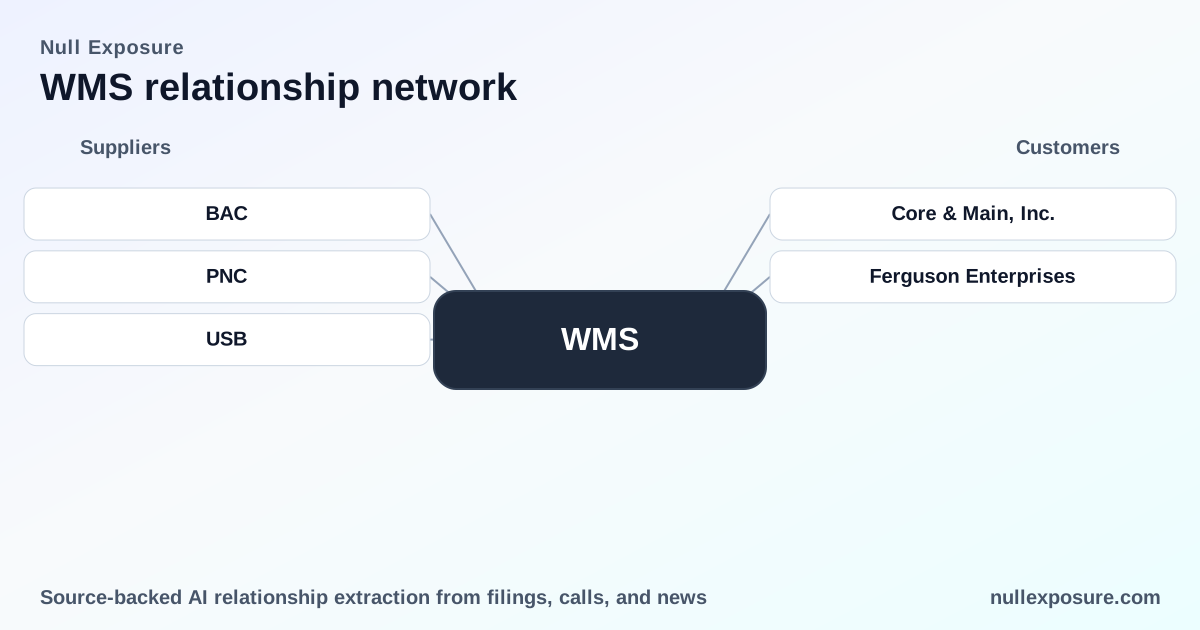
Ferguson Enterprises accounted for 14.3% of ADS’s fiscal 2025 net sales, making it the company’s largest single customer and an essential distribution partner within North America. According to ADS’s FY2025 Form 10‑K, Ferguson’s share is disclosed as a percentage of net sales, reflecting its outsized purchasing footprint in the company’s reseller channel.
Core & Main, Inc. accounted for 12.7% of fiscal 2025 net sales, the second-largest customer relationship identified by ADS. The FY2025 Form 10‑K lists Core & Main alongside Ferguson as representing more than 10% of annual net sales, underscoring the concentration risk concentrated in a small number of national distributors.
(These customer-level shares were reported directly in ADS’s FY2025 Form 10‑K filed for the period ending March 31, 2025.)
Why these relationships matter to valuation and risk
- Revenue sensitivity. With two customers representing roughly a quarter of sales in aggregate (27.0% noted across FY2025), any change in purchasing strategy, pricing pressure or credit stress at these distributors would materially affect ADS’s topline.
- Margin dynamics. Large distributors exert negotiating leverage on pricing and payment terms; ADS’s ability to defend operating margins relies on manufacturing cost leadership and distribution efficiency.
- Contracting posture. The relationships are primarily reseller arrangements rather than long-term fixed-price contracts; that structure increases exposure to cyclical demand and competitive displacement.
- Strategic criticality. While these buyers are concentrated, they are also critical for market reach—losing one would be a near-term shock but retaining them under competitive terms preserves scale advantages.
What this means for investors now
- Key risk to monitor: revenue share trends for Ferguson and Core & Main in quarterly filings and any commentary on contract term renegotiations or customer inventory destocking. ADS discloses customer shares in its annual report, so changes here are leading indicators of concentration risk evolving.
- Operational resiliency is a positive: ADS’s margin profile (operating margin ~21% TTM) and strong return on equity (about 27.6% TTM) provide a buffer against short-term volume shocks, assuming management preserves pricing discipline and cost control.
- Balance of power: the reseller model limits ADS’s direct control over end-market demand but keeps CapEx focused on manufacturing throughput and logistics—investors should track capital allocation that expands distribution capacity versus margin expansion investments.
For deeper signals and tracking tools, visit https://nullexposure.com/.
Practical monitoring checklist for the next 12 months
- Quarterly reports: watch the percentage of net sales attributed to the two largest customers and any shift in the "top two" composition.
- Pricing commentary: monitor management discussion for margin pressure from distributor negotiations.
- Inventory and working capital: large distributors can affect ADS’s days of inventory and receivables—movements here often presage revenue volatility.
- Geographic sales mix: follow international vs. U.S. revenue shifts given ADS’s global manufacturing footprint that can mute or amplify regional cycles.
Bottom line
Advanced Drainage Systems is a market leader in drainage and water management products with scale-driven margins and a distribution-centric go-to-market model. The company's profitability and cash generation are attractive, but investors must price in meaningful customer concentration—with Ferguson and Core & Main representing material shares of revenue—and the attendant counterparty and negotiating risks. Continuous monitoring of customer share disclosures and distributor channel dynamics will be decisive for near-term downside protection and valuation stability.
For ongoing coverage and relationship monitoring on ADS and comparable industrials, see https://nullexposure.com/.