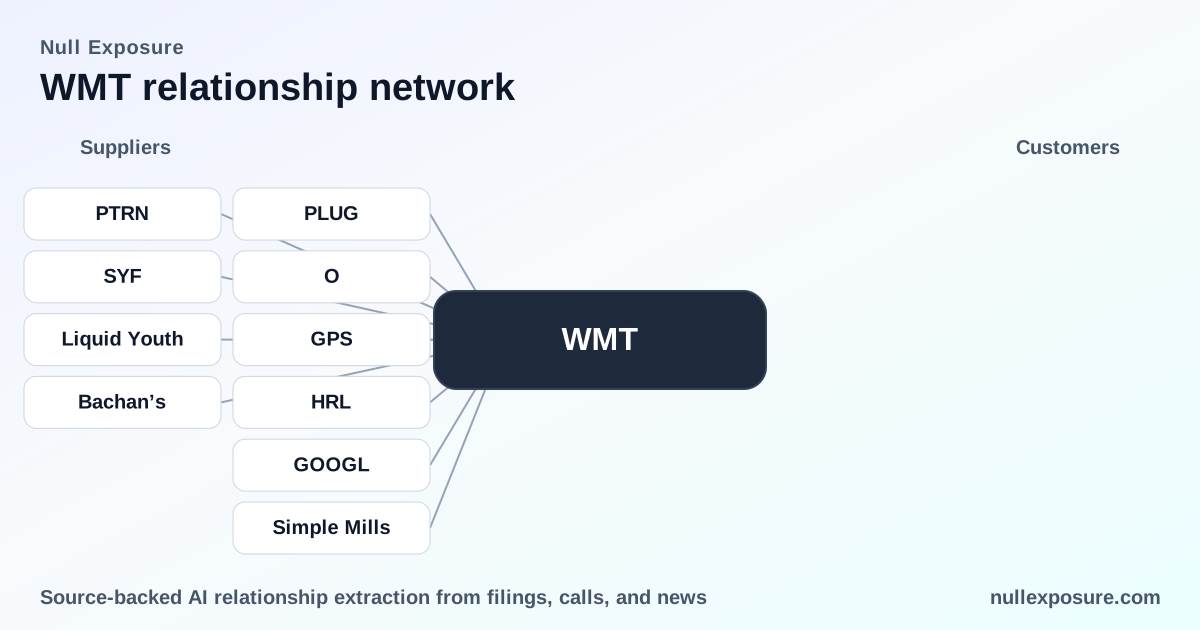
Walmart’s customer relationships: signals investors need to price
Walmart operates a global, omnichannel retail platform that monetizes through high-volume merchandise sales, membership fees (Sam’s Club and Walmart+), advertising (Walmart Connect) and a growing portfolio of logistics and services. For investors evaluating Walmart as a customer to third parties, the key thesis is simple: Walmart’s scale turns vendor integrations into distribution multipliers and its advertising and logistics initiatives create recurring, commercially meaningful relationships that change supplier economics and capital deployment for partners.
Explore the source material and relationship-level signals below, or visit https://nullexposure.com/ for a structured view of customer connections and evidence.
Why these relationship signals matter for valuation
Walmart’s role as a customer is not passive. The company converts first-party shopper data and membership economics into commercial products—advertising inventory and fulfillment capacity—that create annuity-like revenue for partners and new monetization channels for vendors. That has three investor implications:
- Revenue durability: integrations with Walmart Connect and Sam’s Club membership tie partner economics to recurring customer touchpoints rather than one-off promotions.
- Operational leverage: logistics divestitures or asset sales can reshape capital intensity for both Walmart and its vendors.
- Concentration and scale risk: material exposure to Walmart can accelerate partner growth but also concentrates revenue and bargaining leverage.
If you want a consolidated interface to trace how these customer ties show up in filings and market reports, check https://nullexposure.com/ for the compiled evidence.
Company-level operating constraints and what they imply
The available signals paint a coherent operating model for Walmart as a customer:
- Contracting posture — subscription orientation. Sam’s Club operates as a membership business with defined annual fees, which implies partners that integrate with Sam’s Club benefit from a predictable, subscription-backed customer base rather than purely transaction-driven shoppers.
- Geographic footprint — global but U.S.-centric scale. Public filings emphasize service across 19 countries and ~10,750 locations worldwide, while Walmart U.S. remains the largest segment with 4,605 stores; expect partners to gain both domestic scale and selective international exposure.
- Relationship role — seller and platform. Walmart acts as a seller and platform operator (retail + eCommerce + advertising services), which elevates the strategic value of integrations that enhance shopper conversion or fulfillment.
- Lifecycle and stage — active, mature partnerships. The company’s weekly traffic (about 270 million customers) and steady segment disclosures point to high maturity and an active engagement model for partners providing services or advertising.
- Service orientation — beyond goods to services and advertising. Walmart explicitly organizes monetization around services (Walmart+ benefits, advertising through Walmart Connect), making ad-tech and service providers attractive as high-margin complements to retail.
These constraints are company-level signals about how Walmart buys and scales partner relationships; they are not assigned to any single counterparty unless the evidence explicitly names them.
Relationship evidence: what the sources show
Perion (PERI) — creative optimization integrated with Walmart Connect
Perion reports that its AI-powered dynamic creative optimization is integrated with Walmart Connect’s first-party audience and sales insights, enabling creative decisions to be trained on closed-loop sales signals rather than proxies. This integration signals that Walmart Connect is actively expanding partner access to shopper data for ad optimization (Perion comments in Q4 2025 earnings and coverage in early 2026; see Perion’s Q4 2025 remarks reported by InsiderMonkey on March 10, 2026 and a coverage post on PPC.Land on May 3, 2026).
J.B. Hunt Transport Services (JBHT) — acquisition of intermodal assets from Walmart
In its Q4 2025 earnings call, J.B. Hunt stated that the company prefunded capacity growth by purchasing Walmart’s intermodal assets, positioning itself to scale without incremental capital outlays. That disclosure indicates Walmart is reshaping its logistics footprint through asset transfers that can materially change vendor capacity needs and capital allocation for logistics partners (JBHT Q4 2025 earnings call, March 7, 2026).
Groupon (GRPN) — promotional distribution through Sam’s Club
Groupon has run promotional offers tied to Sam’s Club memberships, with a 2023 report noting Groupon offered discounts connected to Sam’s Club membership channels. This shows Walmart’s membership chains are distribution outlets for digital coupon and membership partners, reinforcing the promotional and member-acquisition role that Sam’s Club plays for third-party consumer services (InvestorPlace coverage, January 2023).
EyeCare Providers / NVI supplier agreement (EYE) — termination of a supplier master services agreement
EYE’s FY2024 10‑K discloses that the Walmart Master Services Agreement and an Amended and Restated Supplier Agreement between NVI and Walmart were terminated as of the termination date, documenting a formal end to that supplier relationship. This illustrates that contractual relationships with Walmart can be decisively restructured or terminated, which has direct consequences for supplier revenue and transition planning (EYE FY2024 10‑K filed December 28, 2024).
Investment implications and risk checklist
- Growth lever: advertising integrations are high-ROI for partners. Perion’s integration with Walmart Connect demonstrates how access to first-party sales signals translates into differentiated ad product performance and recurring ad spend.
- Capital and operational shifts: logistics asset transfers are strategically meaningful. The J.B. Hunt disclosure shows Walmart will reallocate capital and operations in logistics in ways that can either accelerate partner growth or compress supplier margins.
- Concentration risk: suppliers and vendors face binary contract outcomes. The EYE filing is evidence that contractual termination can abruptly remove revenue streams; investors should stress-test partner cashflows for loss of Walmart as a customer.
- Distribution value: membership channels expand reach. Groupon’s use of Sam’s Club underscores the promotional and member-acquisition value offered to third parties through Walmart’s membership ecosystem.
Final takeaways for investors and operators
- Walmart is a platform buyer: its advertising and membership products create recurring commercial relationships with measurable economics. Partners that secure integrations into Walmart Connect or Sam’s Club can convert that access into predictable revenue streams.
- Strategic but consequential: partner success depends on product-market fit with Walmart’s services stack and resilience to contract restructuring. Investors should value the growth optionality from Walmart exposure against concentrated counterparty risk.
- For a consolidated, evidence-backed view of these and other Walmart customer relationships, visit https://nullexposure.com/.
By focusing on how Walmart monetizes shopper data, membership economics, and logistics, investors can better price the upside and downside of companies that list Walmart as a customer.