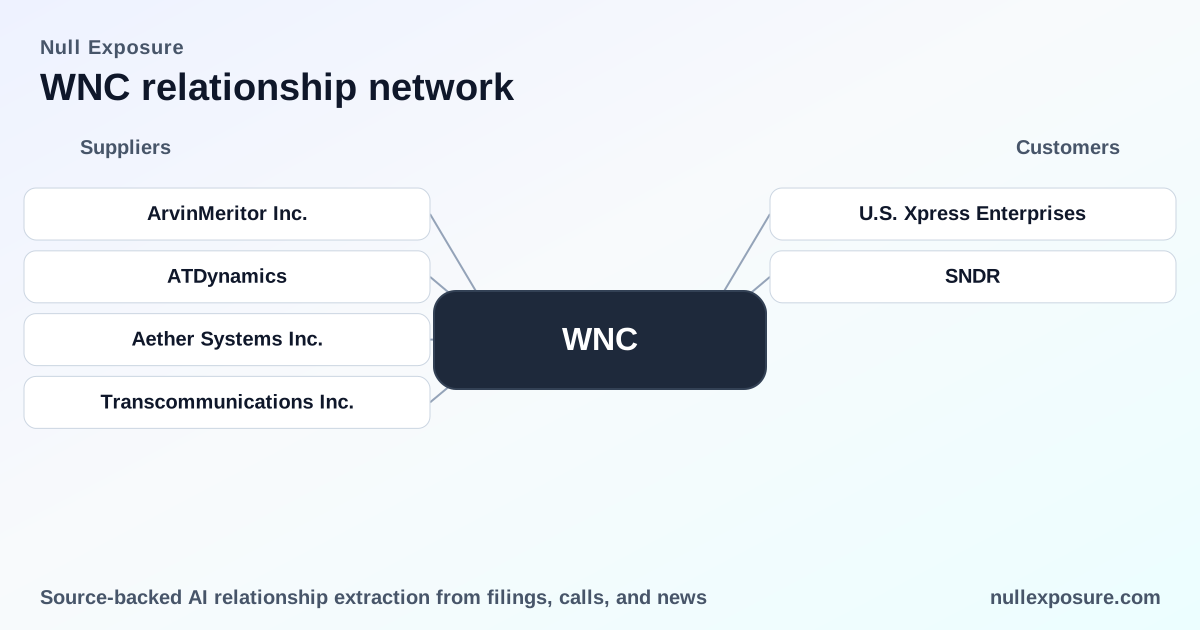
Wabash National (WNC): Customer relationships that underpin durable trailer revenue
Wabash National designs, manufactures and sells transportation equipment and complementary parts and services, monetizing through unit sales of trailers (engineered products) and recurring aftermarket parts and service contracts. Revenue is driven by large, fleet-level factory-direct relationships and an extensive dealer network across North America, with an emphasis on long-lived product lines (DuraPlate) and parts & services revenue. For a concise view of Wabash’s customer footprint and implications for investors, see https://nullexposure.com/.
How Wabash makes money — a concise thesis
Wabash operates two commercial pillars: manufacturing engineered trailers and systems, and selling parts & services and upfitting solutions. The company’s economics rely on high-volume orders from large carriers, recurring aftermarket demand, and long service lives that create spare-parts and service revenue over many years. Recent press coverage and transactional disclosures reinforce that Wabash’s commercial model is fleet-focused and North America-centric.
Customer relationships that move the top line
U.S. Xpress Enterprises — large fleet, multi-year factory order
Wabash (together with ArvinMeritor) signed a three-year agreement with U.S. Xpress for more than 7,000 Wabash DuraPlate trailers, reflecting the company’s ability to secure multi-year, high-volume factory-direct orders from national truckload carriers. (TruckingInfo, March 10, 2026: https://www.truckinginfo.com/news/wabash-arvinmeritor-announce-120-million-us-xpress-order)
Schneider National (SNDR) — an entrenched, long-term adopter
Schneider National has used the DuraPlate trailer as standard fleet equipment since 1997, demonstrating a multi-decade relationship that validates product durability and creates a steady aftermarket and replacement cycle. (TruckingInfo, March 10, 2026: https://www.truckinginfo.com/news/wabash-produces-200000th-duraplate-trailer)
Heartland Express (HTLD) — recurring purchases and fleet refresh activity
Heartland Express’s filings and reporting note repeated purchases of Wabash trailers and active fleet upgrades, including early-2026 upgrades and historical fleet purchases, signaling recurring OEM demand from regional carriers as they refresh and standardize fleets. (TruckingInfo coverage, March–May 2026: https://www.truckinginfo.com/news/heartland-express-net-income-up-143-for-quarter; https://www.truckinginfo.com/news/income-up-24-for-heartland-express; https://www.truckinginfo.com/news/heartland-express-operating-revenues-up-41-for-quarter)
Aurora Trailer Holdings, LLC — buyer of leasing, rental and wholesale parts assets
Wabash completed the sale of substantially all assets of its trailer leasing and rental and wholesale aftermarket parts distribution businesses to Aurora Trailer Holdings, a structural transaction that changes how Wabash participates in leasing/rental and parts distribution moving forward. (TruckingInfo, May 4, 2026: https://www.truckinginfo.com/news/wabash-national-completes-sale-to-aurora)
(For a concise company overview and relationship dataset, visit https://nullexposure.com/.)
What these relationships reveal about Wabash’s commercial posture
The customer evidence maps to a clear, repeatable commercial playbook:
- Contracting posture: factory-direct, high-volume agreements. The U.S. Xpress multi-year order demonstrates the ability to secure large, committed production runs rather than one-off sales.
- Customer concentration: skewed to very large and large fleets. Wabash’s customer base historically includes major truckload common carriers, leasing companies and large private fleets, which concentrates sales but simplifies commercial engagement and product standardization.
- Criticality: products are integral to fleet operations and create aftermarket annuity. Long-standing use by carriers such as Schneider since 1997 underlines replacement cycles and spare-parts demand.
- Geographic maturity: North America-dominant. Wabash discloses international sales under 10% of net sales for recent years, reinforcing exposure primarily to U.S. and Canadian freight markets.
- Business model balance: manufacturing + services. The company runs both capital-intensive manufacturing operations and a parts & services business that captures recurring revenue; the sale to Aurora adjusts the firm’s exposure to leasing/rental and wholesale parts distribution going forward.
Key investment implications — drivers and risks
-
Drivers
- Stable, fleet-level demand from large carriers produces predictable high-volume production cycles and aftermarket revenue.
- Durability of product platforms (DuraPlate) supports long tail of parts and service sales, improving revenue visibility beyond initial unit sale.
- Commercial relationships with major carriers reduce customer acquisition cost and enable multi-year orders.
-
Risks
- Concentration in North American carriers exposes Wabash to cyclical freight demand and regulatory shocks in a single region.
- Customer concentration among very large fleets amplifies revenue volatility if major accounts pause ordering.
- Strategic asset sales (leasing/rental and parts distribution to Aurora) change revenue composition and could reduce vertical integration benefits from aftermarket channels.
Quick checklist for analysts and operators
- Confirm the pace at which large carrier orders (e.g., U.S. Xpress) convert to production revenue and parts annuity.
- Reconcile the impact of the Aurora transaction on reported parts & services revenue going forward.
- Track renewal cadence with long-tenured customers (Schneider) as a signal for aftermarket longevity and spare-parts demand.
Bottom line
Wabash’s commercial strength is its large-fleet, factory-direct relationships and a durable product platform that spawns aftermarket revenue; however, the company is concentrated in North America and dependent on a relatively small set of very large carriers. The recent sale of leasing and wholesale parts assets to Aurora reweights how Wabash will generate and capture aftermarket economics, making contract-level disclosure and order timing even more important for near-term revenue forecasting.
For a concise, investor-oriented digest of customer evidence and how it drives Wabash’s commercial profile, visit https://nullexposure.com/.