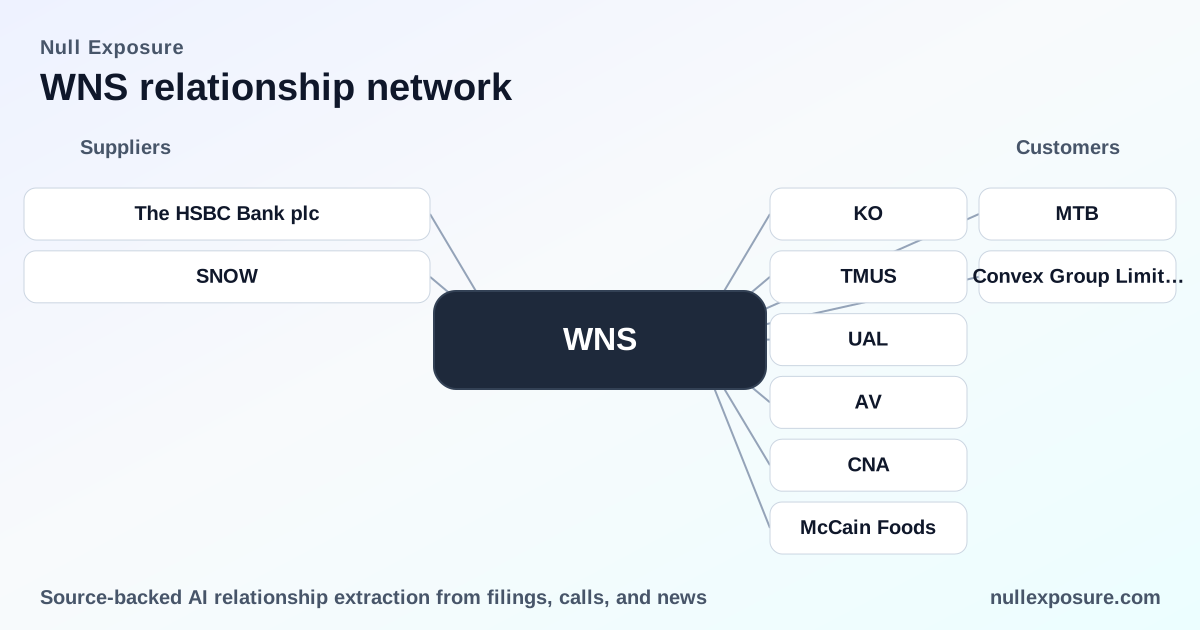
WNS customer relationships: what the client roster tells investors about durability, concentration and delivery risk
WNS operates as a global Business Process Management (BPM) and digital transformation services firm that monetizes through multi‑year service contracts, subscription and transaction‑based billing, and outcome‑linked arrangements for large enterprise customers across insurance, travel, consumer goods, telecom and financial services. Investors should value WNS as a services platform whose revenue stability derives from long-duration, operationally embedded relationships and a diversified global footprint; downside risk stems from client concentration and occasional contract terminations that trigger impairment. Learn more at https://nullexposure.com/.
Major customers and what they signal
The news flow and industry reporting consistently list a set of blue‑chip clients that illustrate WNS’s go‑to‑market and execution profile. Below are every customer relationship recorded in the sources provided, each summarized in plain English with the originating reference.
United Airlines (UAL)
WNS provides business process and data analytics services to United Airlines as part of its travel and leisure client portfolio, demonstrating WNS’s capability to handle large, transaction‑intensive airline processes. This client listing is referenced in multiple press reports covering WNS’s strategic positioning (Euronews and SiliconANGLE, July 2025) and takeover interest coverage (VCCircle, 2025).
Coca‑Cola / Coca‑Cola Co. (KO)
Coca‑Cola is cited as a long‑standing enterprise client that uses WNS for BPM and data analytics, underscoring WNS’s traction in consumer goods and high‑volume back‑office functions (Euronews and SiliconANGLE, July 2025; Outsource Accelerator, 2025).
T‑Mobile / T‑Mobile USA Inc. (TMUS)
T‑Mobile is named among major customers receiving customer‑experience and back‑office services, reflecting WNS’s work with large telecom operators that require scale, SLAs and near‑real‑time processing (Euronews, SiliconANGLE and Outsource Accelerator, July 2025).
Aviva (AV)
Aviva is listed as a client within insurance and financial services, illustrating WNS’s footprint in regulated, data‑intensive verticals where compliance and domain expertise are critical (Financier Worldwide, 2025).
M&T Bank (MTB)
M&T Bank is cited among financial‑services customers, indicating WNS handles banking back‑office processes and supports medium‑to‑large regional banks with compliance and transaction processing workloads (Financier Worldwide, 2025).
Centrica (CNA)
Centrica appears on the client list, showing WNS’s penetration into utilities and energy sector operations where meter, billing and customer‑service processes are candidates for outsourcing (Financier Worldwide, 2025).
McCain Foods
McCain Foods is referenced as a food‑industry client that leverages WNS’s BPM and analytics capabilities, signaling relevance to supply‑chain and manufacturing back‑office needs (Financier Worldwide, 2025).
Convex Group Limited
WNS was selected by Convex to design and implement a Platform + BPM‑as‑a‑service operating model for a specialty insurer/reinsurer, which highlights WNS’s ability to deliver platform solutions and managed services in specialty insurance (ReinsuranceNews, FY2019).
British Airways (IAG)
Early‑stage client relationships include British Airways, cited as one of the initial airline customers when WNS launched its BPO proposition, demonstrating legacy experience in travel sector outsourcing (Simply Wall St, FY2025).
How the customer mix shapes WNS’s operating model
The customer roster and corporate disclosures together outline a clear operating posture:
- Contracting posture: WNS generally signs multi‑year engagements that are operationally embedded; contract language often supports three–five year horizons even if termination clauses with short notice periods exist. This structure drives recurring revenue but allows clients to exit with a modest notice period, creating a measured churn risk.
- Pricing mix: The business combines subscription and usage/transaction‑based billing, with increasing use of outcome‑linked constructs. That hybrid pricing preserves revenue predictability while aligning WNS incentives to client KPIs.
- Customer profile and scale: The client list is dominated by large enterprises across regulated and high‑volume industries—insurance, airlines, telecoms and consumer goods—consistent with the company’s positioning as a service provider for complex, scale‑dependent processes.
- Global delivery footprint: Revenue and operations are geographically diversified across North America, EMEA and APAC with delivery centers in India, the Philippines, Poland, Romania and elsewhere, enabling cost arbitrage and geographic risk mitigation.
- Materiality and concentration: The company reports that no single client represented 10%+ of revenue in FY2025 while also acknowledging that a handful of major clients account for a significant share of revenue; this produces a dual signal of broad client dispersion but meaningful concentration risk at the top end.
- Relationship lifecycle: Most client relationships are active and mature, supported by the scale and switching costs of outsourced processes; the firm also records isolated terminated relationships that have resulted in impairment charges—evidence that top‑end client losses produce measurable earnings volatility.
- Service orientation: WNS is definitively a service provider (BPM, analytics, customer experience and platform‑led managed services), not a product vendor, so margins and growth are driven by utilization, automation uptake and client retention.
- Spend bands: The company reports a material number of clients in the $1–$10 million annual spend range, indicating substantial mid‑sized engagements underpinning the revenue base.
Investment implications — what investors should watch
WNS’s client roster underpins both the investment case and the risk profile.
- Durability and embeddedness are strengths. Blue‑chip customers across airlines, consumer goods and financial services illustrate the company’s ability to win large, complex engagements that generate recurring cash flows. The Capgemini acquisition rationale published in industry press also reflects the strategic value of these customer relationships to larger systems integrators (Euronews and SiliconANGLE, July 2025).
- Concentration is the principal operational risk. Even though no single client crossed the 10% revenue threshold in FY2025, impairments tied to the termination of a large HCLS client demonstrate that losing a top client can compress margins and trigger write‑downs.
- Contract design will drive earnings variability. The mix of long‑term contracts, subscription fees and per‑transaction billing means revenue can be predictable for base subscriptions but sensitive to transaction volumes and client decisions to re‑price or terminate services.
- Automation and platform delivery will matter. WNS’s growth trajectory depends on migrating clients to higher‑value, outcome‑linked contracts and platform offerings (as illustrated by the Convex engagement), which improves margins but requires continued investment in IP and delivery capabilities.
- Geopolitical and regulatory exposure is non‑trivial. Concentration of client domicile and revenue in the US, UK, Europe and Australia exposes the company to local outsourcing regulations and economic cycles.
Conclusion and next steps
WNS’s customer relationships present a classic BPM profile: large enterprise client base, multi‑year engagements with mixed pricing models, global delivery scale, and non‑trivial top‑client concentration risk. For valuation and credit work, model scenarios should stress top‑client attrition and pricing erosion while recognizing that platform‑led subscription growth is a plausible path to margin expansion.
For a deeper breakdown of customer signals across other public companies and to monitor client‑level changes as they happen, explore further research at https://nullexposure.com/.