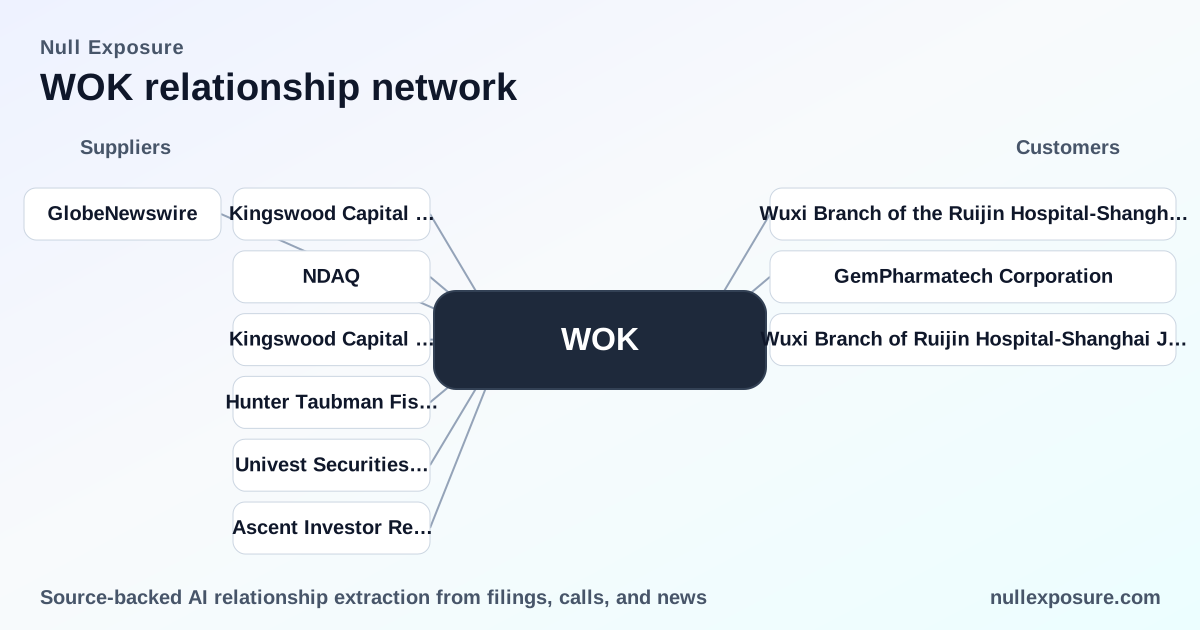
WORK Medical (WOK): Customer Relationships Decode — where revenue, validation, and distribution intersect
WORK Medical Technology Group Ltd (WOK) designs and commercializes AI-enabled medical devices and related services. The firm monetizes through product sales, exclusive distribution agreements, and fee-for-service contracts delivered by subsidiaries, while strategic hospital partnerships provide clinical validation and channel access. Recent announced customer and partner arrangements reinforce a mixed go-to-market: small professional services fees, short-term exclusive distribution for new AI devices, and strategic hospital collaboration for product adoption. For more structured tracking of WOK’s commercial footprint, see https://nullexposure.com/.
How WORK makes money and what the numbers tell investors
WORK’s financial profile shows product-led revenue with ongoing losses: trailing twelve‑month revenue of about $9.85 million and gross profit near $2.34 million, but negative EBITDA and deeply negative EPS reflect ongoing investment and scale limitations. The company’s go-to-market blends direct commercialization with third‑party distribution and paid services through subsidiaries, which implies a contracting posture that is transactional and short-duration for some customers (service work orders) and partner-dependent for market expansion (exclusive distributors and hospital partners).
Key operating signals:
- Revenue concentration and scale risk: overall revenue is modest relative to public comparables in medical devices, increasing sensitivity to each commercial agreement.
- Contract maturity: recent distribution deals are term-limited (one year in at least one disclosed case), indicating early-stage commercialization rather than long-duration, recurring contracts.
- Criticality of partner relationships: hospital partnerships for clinical validation are strategically critical to product credibility and adoption; service contracts are complementary but immaterial in size.
- Contracting posture: a mix of fixed-fee services, sales-based distributor targets, and strategic collaboration, suggesting flexible, opportunistic commercial arrangements rather than entrenched, recurring revenue.
Explore a concise snapshot of customer activity at the company level on our homepage: https://nullexposure.com/.
What the recent deals reveal about execution and risk
The company’s disclosures and press reports over FY2025–early 2026 outline three distinct customer relationships that illustrate WORK’s commercial strategy: a small paid services contract with a CRO/biotech vendor, a one‑year exclusive distributor appointment in East China for a new AI analyzer, and strategic hospital partnerships to advance hospital informatization and AI pilots. Each relationship contributes differently to revenue, validation, and scalability.
GemPharmatech Corporation — small, fee-based service work order
WORK’s subsidiary Neologisc secured a service contract with GemPharmatech for US$114,000 under work orders associated with the agreement. According to GlobeNewswire (November 4, 2025), the arrangement is fee-based professional services paid to the subsidiary; the amount is roughly 1% of WOK’s reported TTM revenue, so it is revenue-accretive but not transformational. Finviz also reported the retention of this contract in a related March 2026 aggregation of news items.
Sources: GlobeNewswire press release (Nov 4, 2025) and a Finviz news aggregation (March 10, 2026).
Shanghai Benke Medical Technology Co., Ltd. — exclusive East China distribution for an AI analyzer
WORK’s affiliate Hunan Saitumofei entered a one-year exclusive distribution agreement with Shanghai Benke to promote and distribute an AI‑Automated Blood Cell Morphology Analyzer (CM-B600) in East China throughout 2026. GlobeNewswire reported the agreement on December 29, 2025, positioning the company to leverage local distributor capabilities for rapid market penetration in a defined geographic territory. This is a classic early commercial scaling move: exclusive, short-term, and target-driven.
Source: GlobeNewswire press release (Dec 29, 2025).
Wuxi Branch of Ruijin Hospital — strategic hospital partnership for AI and informatization
WORK signed a collaboration with the Wuxi branch of Ruijin Hospital (Shanghai Jiao Tong University School of Medicine), also referenced as Xin Rui Hospital, to support hospital informatization and apply AI-enabled medical products. GlobeNewswire announced the strategic partnership on September 22, 2025; ACN Newswire carried a related report in March 2026 describing WORK’s support for the hospital’s informatization efforts. This relationship is validation- and adoption-focused, delivering clinical use-cases and integration pathways that measure higher strategic value than small service contracts.
Sources: GlobeNewswire press release (Sep 22, 2025) and ACN Newswire (March 10, 2026).
How to read these relationships for investment decisions
Each disclosed customer relationship maps to a distinct value lever:
- Revenue dilution vs. strategic value: Small service contracts (e.g., GemPharmatech) deliver near-term cash but negligible scale impact; exclusive distribution and hospital partnerships address growth and clinical adoption respectively. Investors should weigh near-term revenue against the strategic optionality of hospital validation and distributor reach.
- Commercial maturity is limited: Short, one-year exclusive distribution agreements indicate early-market commercialization rather than entrenched recurring revenue streams. Forecast models should assume modest near-term churn risk unless converted to multi-year or sales-based earnouts.
- Concentration and operational execution: Given modest revenue scale, individual commercial wins or losses materially affect annual outcomes. Management’s ability to convert pilot hospital relationships into product sales through trained distributors will determine the path to profitability.
- Contracting posture: The disclosed documents show a willingness to contract on fee-for-service work orders and short-term exclusivity — a pragmatic posture that enables rapid deployments but leaves realization risk on distributor performance and hospital procurement cycles.
Constraints and company-level signals
The relationships data provide no explicit contractual constraints or long-term obligations disclosed in the reviewed items. At the company level, this absence is itself a signal: no embedded long-duration, high-value customer constraints were identified in the available releases, which reinforces the view of a flexible, early-stage commercial model rather than a contractually locked recurring revenue base.
Bottom line and investor takeaway
WORK is executing a mixed commercialization strategy: fee-based services for immediate cashflow, exclusive short-term distribution to accelerate channel deployment, and hospital partnerships to secure clinical validation. Financials show modest revenue but continued operating losses, so the company’s near-term performance will hinge on converting distributor agreements and hospital pilots into repeatable sales. For investors, the key questions are execution on distributor targets, the conversion rate of hospital pilots to purchase orders, and whether management can lengthen contract durations or secure larger recurring-service agreements.
For a structured tracker of WORK’s customer disclosures and to monitor new filings, visit https://nullexposure.com/.