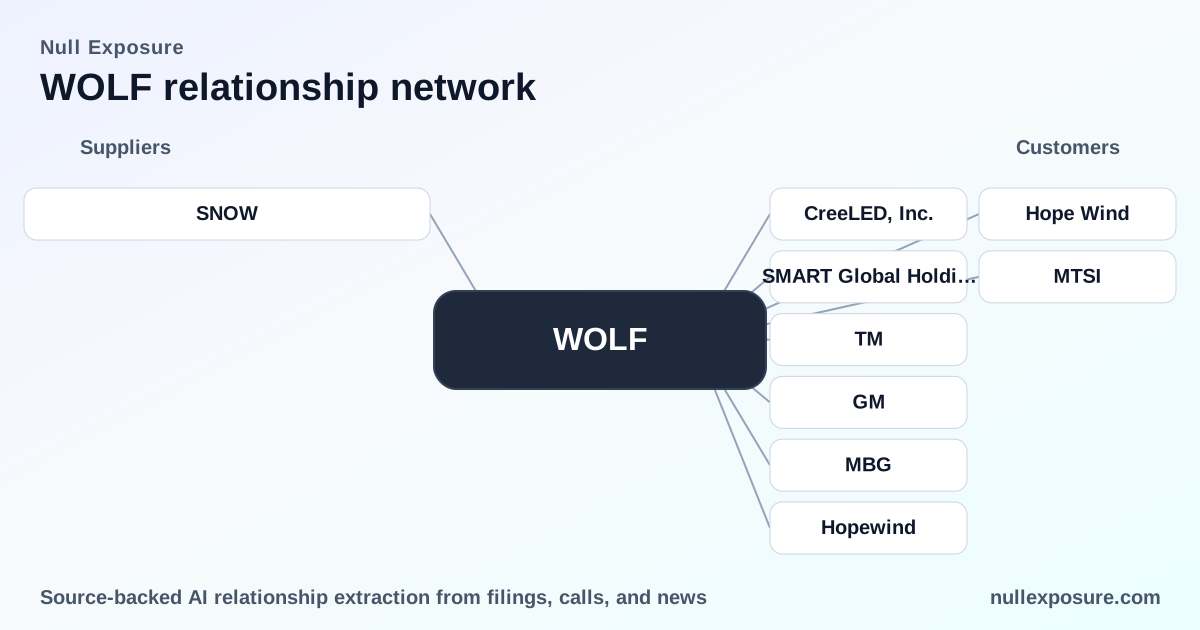
Wolfspeed (WOLF) — Customer Map and What It Means for Investors
Wolfspeed manufactures and sells advanced silicon carbide (SiC) and gallium nitride (GaN) semiconductors, monetizing through wafer and device sales to OEMs, distributors and industrial manufacturers across automotive, energy and communications markets. Revenue is driven by long‑lead manufacturing capacity and strategic OEM wins (notably in automotive and renewable energy), while a significant portion of sales flows through distributors that inventory and resell Wolfspeed product. For a deeper view of customer exposures and operating constraints, see Null Exposure’s research hub: https://nullexposure.com/.
Quick read: high‑level investor thesis
Wolfspeed’s commercial model is a hybrid of direct OEM programs and channel distribution. OEM relationships (e.g., automotive onboard charging) are high‑value and strategic, while distributors supply breadth and cadence to industrial and infrastructure markets. That mix supports margin scaling as Wolfspeed ramps 300mm SiC production, but it also concentrates revenue among a few large customers and exposes the company to international demand cycles and distributor inventory dynamics.
Complete run‑through of reported customer relationships
SMART Global Holdings, Inc.
Wolfspeed sold its former LED Products segment — including certain assets and subsidiaries — to SMART Global Holdings on March 1, 2021, signaling a past divestiture of non‑core LED operations. This is recorded in Wolfspeed’s FY2025 Form 10‑K. (Wolfspeed 10‑K, FY2025)
CreeLED, Inc.
CreeLED, the wholly owned subsidiary of SMART Global Holdings, was the acquiring vehicle for Wolfspeed’s LED Products assets on March 1, 2021, reflecting Wolfspeed’s strategic exit from legacy LED product lines. (Wolfspeed 10‑K, FY2025)
Toyota Motor Corporation (TM / Toyota)
Wolfspeed has an announced supply relationship to provide automotive‑grade SiC MOSFETs for Toyota’s next‑generation BEV onboard charging systems, a strategic OEM win that advances Wolfspeed’s footprint in high‑volume automotive programs. Multiple press reports and Wolfspeed’s Q2 FY2026 commentary reference the Toyota arrangement (FinancialContent TokenRing, Jan 21, 2026; Wolfspeed Q2 FY2026 release, Feb 4, 2026).
General Motors (GM)
Wolfspeed supports automotive programs with major OEMs including General Motors, evidencing a customer base that includes legacy automakers as Wolfspeed diversifies end markets beyond EV‑only narratives. This placement is noted in market commentary and company disclosures around FY2025. (ts2.tech outlook, Dec 6, 2025; Carolina Journal, FY2025 reporting)
Mercedes‑Benz (MBG / Mercedes‑Benz)
Mercedes‑Benz is listed among Wolfspeed’s automotive customers, underlining Wolfspeed’s engagement with premium OEM programs that require rigorous quality and qualification processes. The mention appears in press coverage summarizing FY2025 customer relationships. (ts2.tech Dec 6, 2025; Carolina Journal, FY2025)
Hopewind / Hope Wind (Hopewind)
Wolfspeed announced collaborations with Hopewind to supply SiC components for high‑performance industrial and renewable energy inverters and to advance wind power applications, indicating targeted traction in energy infrastructure markets outside automotive. This partnership shows up in Wolfspeed’s Q2 FY2026 communications and related press coverage. (Wolfspeed Q2 FY2026 release, Feb 4, 2026; InsiderMonkey transcript, FY2026)
MTSI (as referenced)
Wolfspeed’s FY2025 filing documents completion of an RTP fab transfer on July 25, 2025, which is recorded in the 10‑K and linked to counterparties including MACOM and related entities such as MTSI in the disclosure. This reflects operational asset reallocation relevant to capacity and customer fulfillment. (Wolfspeed 10‑K, FY2025)
MACOM
The FY2025 Form 10‑K notes that Wolfspeed and MACOM completed an RTP fab transfer on July 25, 2025, an operational milestone that affects manufacturing capacity and the company’s ability to meet customer programs. (Wolfspeed 10‑K, FY2025)
How Wolfspeed’s customer footprint shapes operational constraints
Wolfspeed’s disclosures and recent press coverage spell out several company‑level constraints that drive commercial and risk dynamics:
-
Geographic reach and dependency: Wolfspeed reported that 82% of revenue in FY2025 came from outside the U.S., and the company disaggregates revenue across Asia Pacific, Europe and North America, with Europe representing roughly 20% and the United States around 17.9% in FY2025. Wolfspeed also maintains sales and support offices in North America, Asia and Europe, illustrating a truly global commercial footprint. (Wolfspeed 10‑K, FY2025)
-
Customer concentration: For FY2025 Wolfspeed had two customers that each represented more than 10% of consolidated revenue (19% and 18%), reflecting meaningful revenue concentration that intensifies the financial impact of any large‑customer disruption. (Wolfspeed 10‑K, FY2025)
-
Channel mix and distributor reliance: Approximately one‑third of revenue in FY2025 came through distributors, which stock inventory and resell Wolfspeed products; the company sells on account to manufacturers, distributors and others and generally requires no collateral. This structure supports market reach but introduces distributor inventory and payment risk. (Wolfspeed 10‑K, FY2025)
-
Contracting posture and maturity: Wolfspeed sells on account and works through long qualification cycles with OEMs (particularly automotive), which creates multi‑quarter revenue ramp profiles tied to wafer capacity and fab throughput. The RTP fab transfer completed in July 2025 with MACOM is a material operational event that influences capacity maturity and customer fulfillment timelines. (Wolfspeed 10‑K, FY2025)
Collectively, these constraints imply a high‑leverage operating model: revenue upside from capacity scaling is significant, but so is downside if key OEM ramps slip or if distributor channels destock.
Investment implications — read this before you size a position
-
Upside drivers: Strategic OEM wins (Toyota, GM, Mercedes‑Benz) and energy‑sector partnerships (Hopewind) validate secular demand for SiC in EVs and renewable infrastructure; capacity expansion (300mm SiC) positions Wolfspeed to capture higher‑margin, high‑volume programs. (FinancialContent; Wolfspeed FY2026 commentary)
-
Key risks: Customer concentration and distributor dependence increase sensitivity to large‑customer contract timing and channel inventory cycles; high international revenue introduces forex and geopolitical exposure. Operational milestones like the RTP fab transfer materially affect the company’s ability to convert bookings into revenue. (Wolfspeed 10‑K, FY2025)
If you want a concise analytic brief or a custom exposure map for portfolio stress testing, Null Exposure has detailed investor products and research at https://nullexposure.com/.
Bottom line
Wolfspeed is structurally positioned to monetize the global shift to SiC/GaN power electronics through a mix of strategic OEM contracts and a substantial distributor channel, but investors must weigh that growth path against concentration risk, channel dynamics and the operational timetable for capacity expansion. The coming quarters will test the company’s ability to translate announced OEM wins into recurring, diversified revenue streams.