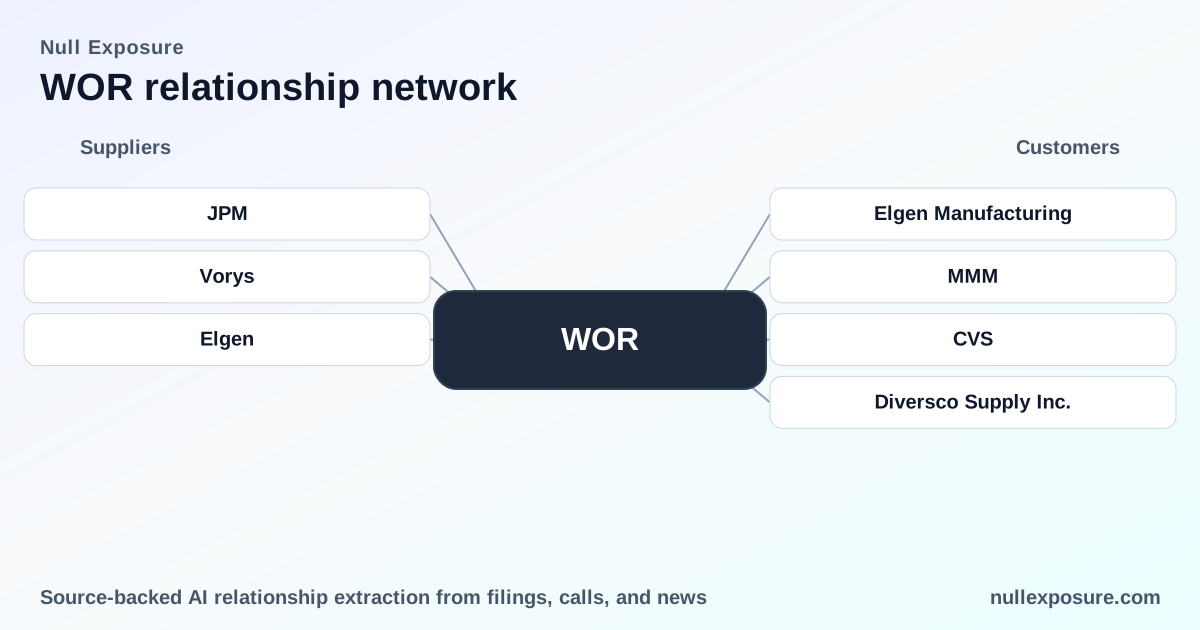
Worthington Industries (WOR) — customer map and commercial implications
Thesis: Worthington Industries operates as a North America‑focused manufacturer and branded consumer-products seller, monetizing through two reportable segments — Consumer Products (retail‑facing metal and gas cylinders, tools, outdoor/celebration products) and Building Products (value‑added metal fabrication for construction and industrial end markets). Revenue comes from direct manufacturing sales to mass merchandisers, retailers and distributors, with higher concentration in the Consumer Products channel and recurring retail placement driving margins and working‑capital dynamics. For dealmakers and credit analysts, the most actionable signals are retail concentration, distributor partnerships, and selective product wins that convert manufacturing capability into shelf presence. Learn more about how we surface relationship signals at https://nullexposure.com/.
What the relationship data shows — a quick read for investors
The relationship results yield a mix of clear Worthington customer ties and several entries that reference external engineering firms (Worley) rather than Worthington itself. Interpret the list as two practical buckets: (1) confirmed retail and distributor relationships that directly affect Consumer Products distribution and sales; and (2) news items that reference other engineering contractors and should be treated as indirect or noisy matches in the customer harvest. Below I walk through every relationship record returned in the results and the underlying source for each entry.
Direct retail and distributor relationships that move dollars
Elgen Manufacturing (earnings call, Mar 2026)
Worthington announced an acquisition of Elgen Manufacturing in its 2025 Q4 earnings call, describing the team as “new colleagues” and signaling integration of the acquired operations into its manufacturing footprint. This is a strategic bolt‑on to expand product or capacity in targeted product lines. (Worthington 2025 Q4 earnings call, March 2026)
CVS (earnings call, Mar 2026)
Management stated that Worthington has begun a partnership with CVS to distribute the Balloon Time product suite in CVS stores nationwide, representing a direct retail channel expansion that increases shelf access and consumer reach. (Worthington 2025 Q4 earnings call, March 2026)
Diversco Supply Inc. (LP Gas Magazine, Mar 2026)
Worthington plans to leverage Diversco Supply Inc. as a Canadian distribution partner to broaden availability of refurbished propane tanks, indicating a distributor strategy to deepen Canadian market penetration for gas products. (LP Gas Magazine, March 2026)
3M / MMM — PowerCore cylinder usage (earnings call, Mar 2026)
Worthington’s PowerCore cylinder was identified by management as part of the solution 3M used to develop its Fastbond water‑based adhesives, a product that subsequently won an industry innovation award; this indicates product design wins with large industrial OEMs that can validate technology and open B2B channels. (Worthington 2025 Q4 earnings call, March 2026)
3M / MMM (duplicate entry — same earnings call, Mar 2026)
The results contain a second entry for MMM (3M) citing the same PowerCore mention in the Q4 earnings call; it reinforces the same product‑level collaboration highlighted by management. (Worthington 2025 Q4 earnings call, March 2026)
Items in the results referencing Worley and third‑party engineering contracts (treat as indirect mentions)
NG / NOVAGOLD — buried pipeline (GlobeNewswire, May 2026)
A GlobeNewswire press release covering NOVAGOLD’s FY2026 engineering awards states that Worley was contracted to design a 316‑mile buried natural gas pipeline from Cook Inlet to a power plant; this press item appears in the WOR customer results but names Worley as the contracting engineer rather than Worthington. Treat this as an external‑contractor mention that surfaced in the relationship crawl. (GlobeNewswire press release, March 12, 2026)
NG / NOVAGOLD — covered in additional outlets (Bitget & InsiderMonkey, May 2026)
The same NOVAGOLD pipeline work assigned to Worley is cross‑reported by Bitget and a transcript aggregator; these carry the identical fact pattern about Worley’s engineering scope and reiterate the external‑contractor role. These entries are duplicates of the GlobeNewswire coverage and reflect media pickup rather than a direct Worthington commercial link. (Bitget summary and InsiderMonkey transcript, May 2026)
PSX / Phillips 66 — Humber carbon‑capture integration (Business Live, Mar 2026)
Business Live reported that Worley will integrate Shell’s carbon‑capture technology into Phillips 66’s Humber Refinery, designing export and storage infrastructure; this press mention also surfaced in the WOR results but pertains to Worley’s EPC role, not a stated Worthington contract. (Business Live, March 10, 2026)
What the relationship mix implies about Worthington’s operating model
- Contracting posture: Worthington operates primarily as a seller and manufacturer to retailers, mass merchandisers and distributors, not as an engineering EPC firm; relationship excerpts consistently describe retail placement and distributor arrangements.
- Geographic concentration: The business is domestically focused (North America) with material U.S. sales and targeted Canadian distribution initiatives, consistent with management commentary on net sales by region.
- Concentration and materiality: Customer concentration is material — management disclosed that one retail customer accounted for roughly 12% of consolidated net sales and that the largest customer represented approximately 28% of Consumer Products net sales in fiscal 2025; this elevates counterparty and negotiating‑channel risk.
- Channel criticality and maturity: The product portfolio is mature, retail‑driven and reliant on shelf placement and distribution partners; product wins with large OEMs (e.g., 3M) provide technical validation but retail placement (e.g., CVS) drives recurring consumer revenue.
- Relationship stage: Most reported relationships are active commercial arrangements (retail distribution, distributor partnerships, recent acquisition), indicating current revenue impact rather than speculative prospects.
Learn more about how these relationship signals are extracted at https://nullexposure.com/.
Investor implications — where to focus due diligence
- Concentration risk is the dominant commercial vulnerability; under a slowdown in orders from the top retail customer, cash flow and working capital could tighten quickly given the disclosed revenue share.
- Retail distribution wins such as CVS materially increase volume but also raise dependency on promotional spend and slotting economics; validate margins and return on incremental promotion.
- Distributor strategy in Canada (Diversco) reduces go‑to‑market friction but requires monitoring of inventory, refurbishment economics and service quality.
- M&A and bolt‑ons like Elgen expand capability and capacity; confirm integration timelines and expected synergies in management guidance.
- Be wary of false positives in broad media searches: multiple results in the relationship feed reference Worley and third‑party EPC contracts (NOVAGOLD, Phillips 66) — these are not direct Worthington customers and should be treated as noise or indirect context unless explicit contract disclosure links Worthington to the project.
Final read
Worthington’s commercial profile is anchored in manufacturing and retail distribution, with clear strengths in product design validation and expanding shelf presence, but with material concentration risk that undercuts operating leverage in downside scenarios. For analysts and operators, the next steps are confirming incremental margin from new retail placements, monitoring the Elgen integration, and stress‑testing top‑customer exposures against promotional cycles and inventory dynamics. For a concise, actionable view of how relationship data informs counterparty risk and concentration, visit https://nullexposure.com/.