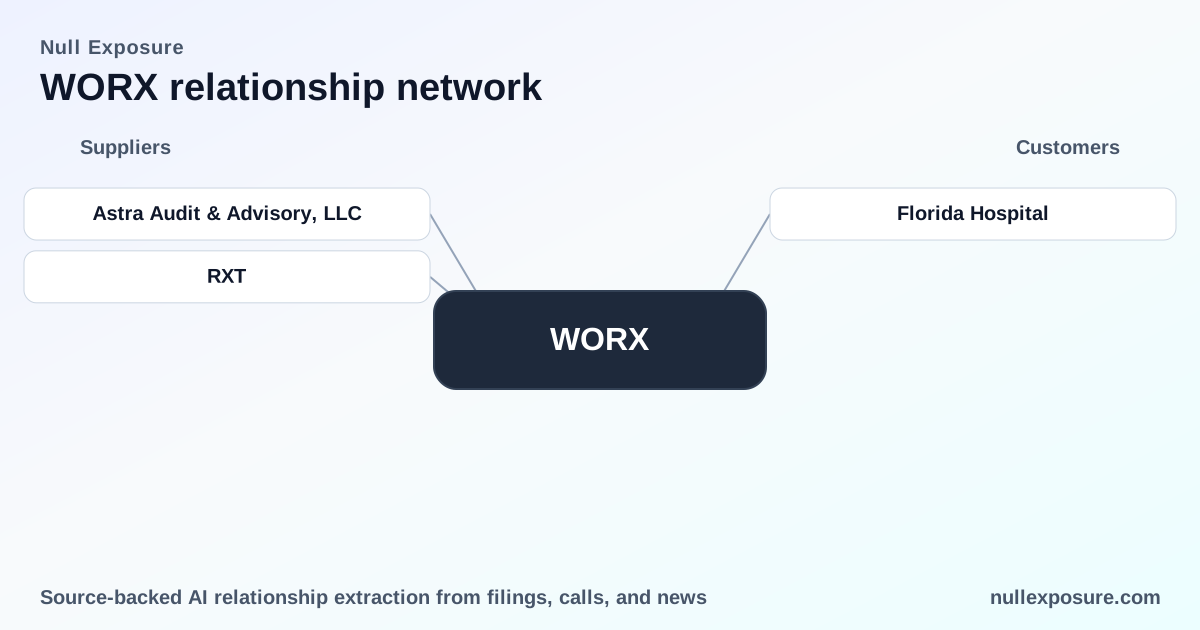
WORX: Scworx Corp’s customer relationships through the Florida Hospital engagement
Scworx Corp (WORX) is a healthcare data software and services provider that monetizes primarily through SaaS subscriptions, maintenance agreements and professional services that normalize, repair and enable interoperability of clinical data for hospitals and health systems. The company delivers hosted software (AWS / Rackspace) under a mix of annual to multi‑year subscription contracts and month‑to‑month maintenance agreements, and derives a concentrated share of revenue from a small number of large customers—making each major client relationship a meaningful driver of near‑term cash flow and valuation. For the full company profile and relationship tracking see https://nullexposure.com/.
Quick read for investors: what the Florida Hospital win signals
Florida Hospital’s selection of Scworx to support data management for a Workday implementation is a clear commercial validation of WORX’s enterprise positioning: large health systems are buying SCWorx to solve complex data‑normalization and integration problems tied to major operational projects. Market reaction to the announcement has been immediate and visible in news flow. A Finviz headline captured the stock move after the GlobeNewswire release, highlighting investor sensitivity to material customer wins (news first seen 2026‑05‑04).
Customer relationships reported (full coverage)
Florida Hospital — FY2026 report (GlobeNewswire via Finviz, first seen 2026-05-04)
Florida Hospital selected SCWorx for data management associated with a Workday implementation, representing a strategic, project‑level engagement that pairs SCWorx’s data platform with a large enterprise systems rollout. This announcement was picked up in a Finviz news summary referencing a GlobeNewswire release and corresponded with notable market interest in WORX shares. (Source: Finviz news item citing GlobeNewswire, first seen 2026‑05‑04.)
Florida Hospital — FY2025 mention (MarketScreener, first seen 2026-03-10)
A MarketScreener article noted the same Florida Hospital selection in the context of company news and regulatory filings, indicating the engagement was referenced in public company communications and media coverage during FY2025. The listing in MarketScreener underscores that Florida Hospital has been a visible customer win across multiple reporting touchpoints. (Source: MarketScreener coverage of SCWorx company news, first seen 2026‑03‑10.)
How SCWorx contracts work — practical implications for revenue and renewal risk
Company disclosures describe two parallel contracting postures that shape revenue predictability:
- A portion of revenue comes from fixed‑term SaaS subscriptions (typically three‑to‑five‑year terms) where the software is hosted in SCWorx data centers (AWS or Rackspace) and accessed via secure connections—this structure supports multi‑year revenue visibility and higher switching costs.
- At the same time, SaaS and maintenance contracts often contain termination‑for‑convenience clauses and are in practice treated as month‑to‑month agreements, producing a tranche of revenue with materially lower retention guarantees.
This mixed contracting posture creates a bifurcated revenue profile: some contracts deliver durable, multi‑year cash flows while others behave like recurring but cancellable subscriptions. Investors must value the company with both the durable ARR component and the more volatile month‑to‑month maintenance pool in mind. (Source: company filing language describing SaaS delivery and termination clauses.)
Concentration, criticality, and customer maturity
SCWorx explicitly states a highly concentrated customer base, where one or a few customers can represent a substantial portion of consolidated revenues (examples in notes show customers at 20% and 15% of revenue). That concentration produces two clear investor signals:
- Upside: Winning or expanding a relationship with a large system like Florida Hospital materially lifts revenue and credibility with peer systems.
- Risk: Loss or non‑renewal of a single large customer creates outsized downside to near‑term revenue and receivables.
The corporate disclosures and note references position large hospital customers as material and critical to short‑term performance rather than immaterial beta accounts. (Source: company financial statement notes and significant customer disclosures.)
Commercial role and go‑to‑market footprint
SCWorx sells directly to hospitals and health systems across the United States and leverages distribution and reseller partnerships for broader reach. The company operates as both a software vendor and professional services provider, combining productized SaaS offerings with implementation and data services that are often required for complex EHR or ERP integrations. SCWorx’s customer base is geographically U.S.‑centric and dominated by institutional buyers in healthcare. (Source: company sales channel disclosures.)
Financial context and what the numbers imply for customers
SCWorx is small by market cap and scale (market capitalization in the data payload is listed at 489,580), with TTM revenue of approximately $2.88 million and negative operating metrics. The commercial relationships therefore carry outsized importance: each new material customer or expansion can meaningfully improve unit economics, while any churn or delayed payments can pressure an already loss‑making P&L. Investors should evaluate customer wins like Florida Hospital not only for headline value but for likely contribution to contracted revenue, implementation‑timing risks, and professional services upsell potential. (Source: company financials and market data.)
Read the constraints on the business model — what to watch next
The company‑level signals embedded in public filings provide practical monitoring points for investors:
- Contracting posture: Mixed—multi‑year fixed‑term SaaS exists alongside month‑to‑month maintenance agreements.
- Revenue model: Subscription + services—SaaS for platform access, services for implementation and normalization work.
- Geography: United States‑focused sales to hospitals and systems.
- Concentration: Material—single customers can exceed 10% of revenue.
- Relationship stage: Active—SCWorx continues to provide data solutions to established healthcare providers.
- Segment mix: Software and services—both elements are integral to delivery and margin profile.
These constraints imply a business that is commercially mature enough to secure large system contracts but operationally fragile given concentration and mixed contract tenors. (Source: consolidated company disclosures and exhibit notes.)
Investment implications and tactical takeaways
- Positive catalyst: Large systems wins (Workday integration with Florida Hospital) validate SCWorx’s product fit for enterprise ERP and EHR data migrations and have triggered market attention. (News reaction documented in market coverage.)
- Key risk: Revenue concentration and the coexistence of cancellable maintenance revenue create meaningful renewal and receivable risk; diligence should focus on contract terms, booked ARR, and the split of durable vs cancellable revenue.
- Operational focus: Investors should monitor implementation progress on material projects—professional services timing will drive near‑term cash flow and margin swings.
For a deeper review of reported relationships and constraints across the portfolio, visit https://nullexposure.com/ for the full tracking page and source links.
Bottom line — what to watch this quarter
- Track renewal or expansion language in upcoming filings related to Florida Hospital and other large customers.
- Monitor billed vs recognized revenue on multi‑year contracts and any disclosures that quantify recurring ARR versus cancellable maintenance.
- Watch cash flow and receivable trends closely; with modest scale and concentrated customers, working capital swings will drive stock volatility.
Key takeaways:
- SCWorx sells enterprise SaaS and services to U.S. hospitals; large customers drive a material share of revenue.
- Contracts are mixed—some multiyear SaaS, but many agreements are effectively month‑to‑month, creating renewal risk.
- The Florida Hospital engagement is both a validation and a short‑term revenue catalyst; investors must balance that upside against concentration and margin pressures.