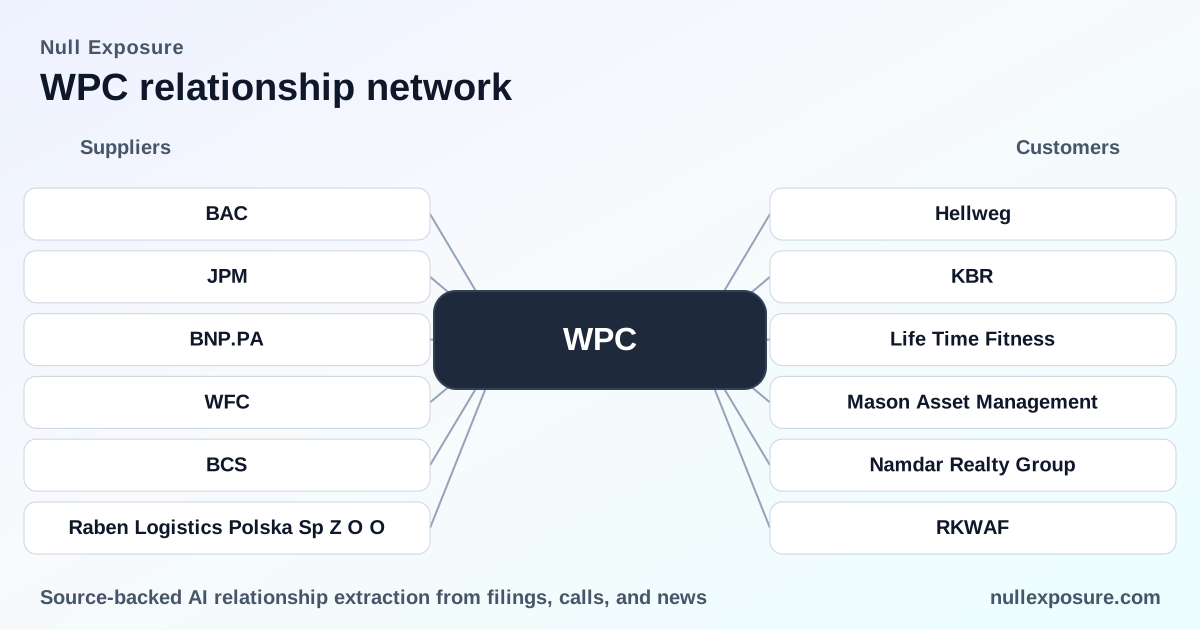
W. P. Carey: customer relationships that drive predictable cashflows and advisory income
W. P. Carey operates as a large, diversified net-lease REIT that monetizes through long-term triple‑net leases on operationally critical real estate and through advisory and asset-management fees generated by externally managed vehicles. The business couples a capital‑intensive owner/operator model (stable lease cashflows) with a service revenue stream from advisory contracts, producing both yield and fee income for investors. For a consolidated view of customer counterparties and contract dynamics, see more at https://nullexposure.com/.
How W. P. Carey structures customer exposure — the operating model in plain terms
W. P. Carey’s core monetization is straightforward: the company purchases or originates real estate and leases it on a long‑term, net basis so tenants pay operating costs while WPC collects contractual rents. Filings and filings‑derived reporting consistently characterize the portfolio as long‑term, single‑tenant net leases with built‑in escalators and geographic diversification across North America and Europe. According to the company’s disclosure, roughly 61% of contractual minimum annualized base rent (ABR) is U.S.‑based and about 33% is Europe‑based (as of December 31, 2025), underscoring a transatlantic footprint.
Key operating characteristics derived from company disclosures and recent reporting:
- Contracting posture: long‑term net leases dominate, which supports predictability of cashflows and underwriting of investment yields (per WPC 2025 Form 10‑K).
- Concentration and counterparties: the portfolio includes large enterprise tenants and many single‑tenant assets; where WPC acts as an external advisor (notably NLOP), it deals with corporate counterparties and collects management fees.
- Criticality: the firm stresses that many assets are operationally critical to tenants, which makes lease performance material to WPC’s revenue stream.
- Maturity and stage: relationships are generally active and long‑dated; the company also runs an advisory business with multi‑year arrangements for external REITs.
For investors focused on fee diversification and counterparty risk, note that WPC’s advisory relationships produce a mid‑single‑digit million dollar fee stream for the externally managed vehicle example documented below, which is material enough to be disclosed separately.
If you want a consolidated portal for these relationship insights, visit https://nullexposure.com/.
What the filings and news say — relationship map, one by one
Hellweg
WPC restructured a lease with tenant Hellweg in Q1 2024 that included rent abatement from January 1, 2024 to March 31, 2024 and a reduction in annual base rent, reflecting active workout and lease renegotiation activity. This is disclosed in W. P. Carey’s 2025 Form 10‑K.
Net Lease Office Properties (NLOP)
WPC (through wholly‑owned affiliates) externally manages NLOP under advisory agreements and receives management fees and expense reimbursements; filings show NLOP paid WPC roughly $8.6 million in fees and reimbursements for the year ended December 31, 2025. Separately, quarterly payments to WPC for asset management and administrative services were reported at approximately $2.0 million in a recent quarter, illustrating the recurring fee nature of the advisory arrangement (see StreetInsider/DEF 14A disclosures and a Globe and Mail press release highlighting the quarterly advisory charge, FY2026). The NLOP portfolio itself was described at spin‑off as 59 office properties leased primarily to corporate tenants, which supports the classification of those counterparties as large enterprises (NLOP SEC disclosures, FY2023–FY2025).
Life Time Fitness
WPC made a roughly $322 million investment in Life Time Fitness properties, and that investment elevated Life Time to the company’s third‑largest tenant by annual base rent, indicating large single‑tenant exposure tied to leisure/fitness real estate (InsiderMonkey reporting, Q1 2026 commentary).
KBR
A 1 million‑square‑foot downtown Houston office building, formerly the KBR headquarters, was sold by a WPC‑advised REIT (NLOP) to an outside buyer for $66 million; news reports identify this disposition as part of portfolio trimming and capital allocation decisions (TheRealDeal, Jan 26, 2026).
Mason Asset Management
Mason Asset Management was identified in county records and industry reports as one of the purchasers of the Houston office asset formerly occupied by KBR in the NLOP disposition, signaling third‑party market interest in select large assets (TheRealDeal, Jan 26, 2026).
Namdar Realty Group
Namdar Realty Group was reported alongside Mason as a purchaser of the same Houston office tower sold out of the NLOP portfolio, underscoring active secondary market trades for office assets managed by WPC affiliates (TheRealDeal, Jan 26, 2026).
Go Auto
WPC completed a US$210 million sale‑leaseback of 14 premium auto dealerships in Western Canada leased to Go Auto, which caused Go Auto to become WPC’s 22nd largest tenant by annualized base rent; this transaction underscores WPC’s use of sale‑leasebacks to deploy capital into specialty retail/automotive portfolios (Zacks/TradingView and SimplyWallSt, Q1 2026 reports; Q1 2026 earnings commentary).
Marriott
WPC noted the expiration of the final tranche of net‑leased Marriott assets in 2025, representing approximately $5 million of ABR, which indicates modest near‑term lease run‑off in the hospitality segment (InsiderMonkey earnings transcript, Q1 2026).
RKW / RKWAF
WPC acquired a 235,000 sq ft industrial manufacturing facility in Germany in a sale‑leaseback with plastic film manufacturer RKW (also referenced as RKWAF in some reports), demonstrating WPC’s industrial footprint expansion in Europe through captive corporate sale‑leaseback transactions (RealAssets / IPE, March 2026).
Cornerstone
Cornerstone was identified as a tenant representing roughly 60 basis points of WPC’s ABR, a small but disclosed concentration noted in WPC’s earnings commentary (InsiderMonkey earnings transcript, Q1 2026).
Robin
Following the Robin acquisition, Poland became WPC’s #1 international exposure by country, highlighting how M&A can materially shift geographic concentration in the portfolio and increase density risk in certain European markets (InsiderMonkey transcript discussion, Q1 2026).
Constraints and what they tell an investor about risk and optionality
- Long‑term contract bias: WPC’s primary contracting posture is long‑term net leases with rent escalators; this underpins predictable cashflows and credit underwriting. (Company 2025 10‑K excerpts.)
- Geographic diversification with regional concentration: The portfolio is global but concentrated in North America and Europe (approx. 61% U.S., 33% Europe ABR), so macro shocks to either region will have asymmetric portfolio impact. (10‑K disclosures, FY2025.)
- Materiality and criticality of tenants: Revenue dependence on tenant stability is explicit; many properties are “operationally critical” to tenants, making tenant solvency a first‑order risk for cashflow continuity. (10‑K text.)
- Role diversification: WPC is both a licensor/buyer of real estate and a service provider through advisory agreements; the advisory business introduces fee revenue but also concentration into managed vehicles. (10‑K and NLOP advisory disclosures.)
- Relationship stage: Most tenant leases are active and long‑dated, but the firm periodically restructures credit‑stressed relationships (e.g., Hellweg). (10‑K and company commentary.)
- Spend/significance of advisory relationships (NLOP): NLOP advisory fees sit in the mid‑single‑million annual band (initially ~US$7.5m specified, with $8.6m actually paid in 2025), which is material to fee revenue but limited versus consolidated rent income. (NLOP advisory agreements and DEF 14A / 2025 reporting.)
Investment takeaways
- WPC’s earnings mix is hybrid: strong, predictable rent rolls from long‑term net leases complemented by an advisory fee stream that can amplify earnings variability when assets are sold or advisory relationships change.
- Concentration and geography are watchpoints: Europe (and, after recent acquisitions, Poland specifically) represents a material share of ABR; investors should track country‑level exposure and tenant credit quality for signs of stress.
- Active portfolio management creates optionality and execution risk: dispositions (such as the KBR/Houston tower) show WPC will trade assets to manage capital, which can crystallize losses or free capital depending on timing.
For a deeper, consolidated view of WPC’s counterparty relationships and the linkages between advisory fees and portfolio cashflows, explore additional analysis at https://nullexposure.com/.