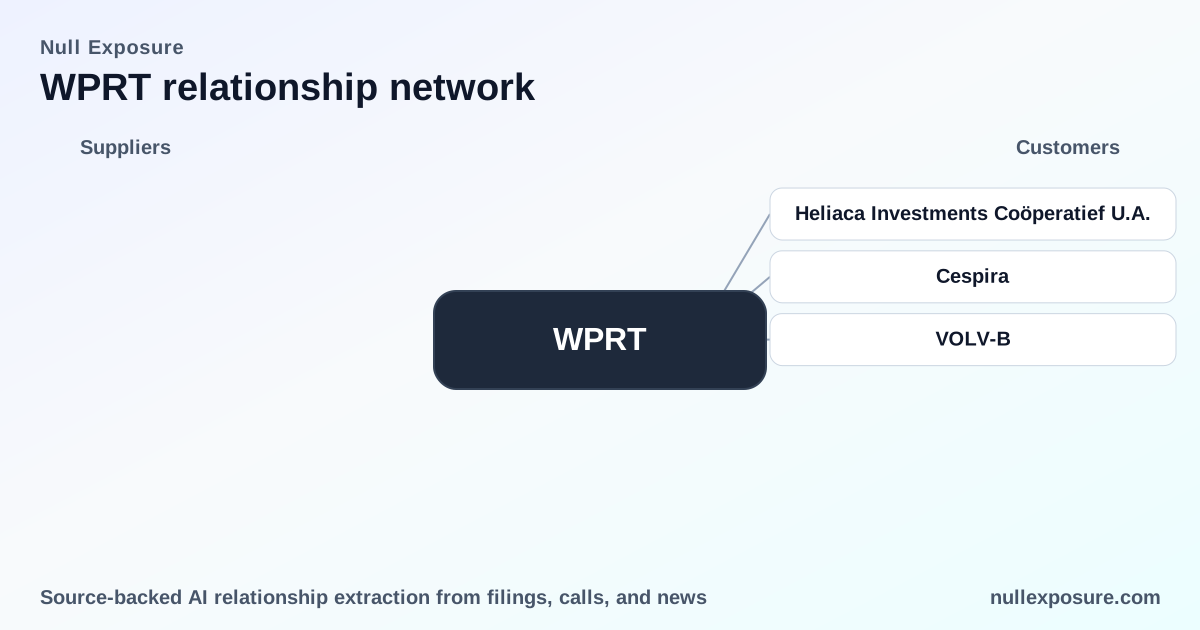
Westport Fuel Systems (WPRT): Customer relationships driving a leaner, partnership-first model
Westport Fuel Systems designs and supplies alternative-fuel systems and components for transportation and power generation; it monetizes through product sales, engineering services, transitional manufacturing agreements and selective asset sales or joint ventures that convert technology into upfront proceeds and contingent performance-based payments. Recent activity shows Westport pivoting from direct manufacturing footprints toward strategic partnerships and divestitures that crystallize value while preserving technology royalties and joint-venture upside. For a consolidated view of this intelligence, visit https://nullexposure.com/.
Why the customer map matters now
Westport’s revenue base and commercial posture are changing from direct customer manufacturing toward licensing, joint ventures and carved-out sales. That shift compresses near-term manufacturing revenue but unlocks liquidity and reduces capital intensity. Key investment implications: concentration risk is shifting from manufacturing contracts toward a smaller set of strategic partners whose performance and commercial adoption will determine upside.
Company-level operational signals to factor into valuation
With no formal constraints extracted in the source set, the following observations act as company-level signals for investors assessing counterparty and operational risk:
- Contracting posture: Westport is actively deploying divestitures and structured deals rather than pursuing organic scale across all segments, indicating a preference for capital-efficient monetization.
- Concentration: As manufacturing support agreements end and assets transfer to partners, revenue volatility will increase in the near term, though long-term cash flow could stabilize if JV and licensing streams scale.
- Criticality: Technology transfers and joint ventures concentrate value in a smaller number of partners; commercial execution by those partners becomes critical to Westport’s upside.
- Maturity: The company is moving from a broad OEM supplier to a technology licensor and partner, signaling a different risk/return profile for investors.
Customer relationships and recent disclosures — what the record shows
Below are plain-English summaries of every customer or partner relationship captured in public sources, each with a direct source citation.
Green Day Holding B.V.
Green Day Holding B.V. completed the acquisition of Westport Fuel Systems Italia S.r.l. and its main subsidiaries, taking full ownership of that European manufacturing arm previously controlled by Westport. This transaction was reported as completed in early May 2026 (Leaders League, May 4, 2026). Source: https://www.leadersleague.com/fr/actualites/green-day-holding-b-v-executed-the-acquisition-of-westport-fuel-systems-italia-s-r-l
Heliaca Investments Coöperatief U.A. (light-duty segment sale — announcement)
Westport reported that on July 29, 2025 it agreed to sell the Light-Duty segment to a vehicle of Heliaca Investments Coöperatief U.A. for total consideration of $60.0 million, a transaction that converts a business unit into cash proceeds. Source: InvestingNews, Westport 2025 results (reported July 29, 2025) — https://investingnews.com/westport-reports-fourth-quarter-and-full-year-2025-results/
Heliaca Investments Coöperatief U.A. (closing notice)
Westport announced the closing of the previously announced Light-Duty segment divestiture to a Heliaca Investments vehicle, formalizing the transfer of the business and its associated operations. Source: InvestingNews, transaction closing notice (March 10, 2026) — https://investingnews.com/westport-announces-closing-of-previously-announced-light-duty-segment-divestiture/
Heliaca Investments Coöperatief U.A. (deal reaffirmation)
Prior to close, Westport publicly reaffirmed its commitment to the pending sale to Heliaca Investments, emphasizing the company’s strategic intent to complete the divestiture first announced in March 2025. Source: InvestingNews, Q2 2025 results & divestment update (press release) — https://investingnews.com/westport-to-issue-q2-2025-financial-results-on-august-11-2025-and-provides-an-update-on-the-divestment-of-the-light-duty-segment/
Cespira (transitional services and manufacturing support)
Multiple investor communications attribute a material year-over-year revenue decrease to the end of Westport’s transitional service agreement with Cespira for inventory and contract manufacturing, indicating that manufacturing support revenues were significant but temporary. Source: InvestingNews, full-year 2025 results (discussion of $16.3M reduction) and earnings transcripts (Q4 2025) — https://investingnews.com/westport-reports-fourth-quarter-and-full-year-2025-results/ and https://www.insidermonkey.com/blog/westport-fuel-systems-inc-nasdaqwprt-q4-2025-earnings-call-transcript-1748845/
Cespira (Q2 2025 commentary)
Westport noted earlier in Q2 2025 that revenue declines for the period related to a slowdown in manufacturing support to Cespira, reinforcing that the partnership included tangible manufacturing services that have since wound down. Source: InvestingNews, Q2 2025 financial results (August 2025 release) — https://investingnews.com/westport-reports-second-quarter-2025-financial-results/
Suspira
Company commentary also referenced the end of a transitional service agreement with Suspira as a driver of a 43% revenue decrease in a reporting period, highlighting that multiple third-party manufacturing or inventory arrangements were phased out in the same timeframe. Source: SAHM Capital transcript of Westport Q4 2025 earnings call (April 24, 2026) — https://www.sahmcapital.com/news/content/transcript-westport-fuel-systems-q4-2025-earnings-conference-call-2026-04-24
Volvo Group / VOLV-B / VOLV / VOLVF (HPDI technology and testing)
Volvo Group executed a deal with Westport around the high-pressure direct injection (HPDI) fuel system: Volvo acquired HPDI-related assets for US$28 million up front plus up to US$45 million in performance-based payments, and is using Westport’s HPDI technology in on-road hydrogen truck testing. This establishes Volvo as a commercialization partner and strategic counterparty for Westport’s core heavy-duty technology. Sources: TruckNews coverage of the JV/asset sale (March 2026) and The Globe and Mail press release about on-road testing, plus earnings call transcripts noting active vehicle testing — https://www.trucknews.com/sustainability/westport-volvo-hpdi-joint-venture-provides-compelling-way-to-eliminate-emissions/1003186933/ and https://www.theglobeandmail.com/investing/markets/stocks/WPRT-T/pressreleases/1085162/ and Westport earnings transcript (April 24, 2026).
Kohler Rollco / Kohler / Rehlko (high-pressure controls customers)
Westport reported active supply relationships into the power-generation market through its High-Pressure Controls business, naming customers historically associated with Kohler and Rehlko (and a Kohler Rollco reference), indicating a presence in stationary power OEM supply chains beyond heavy-duty transport. Source: SAHM Capital transcript and InsiderMonkey earnings-call coverage (April 24, 2026 and Q4 2025 transcript) — https://www.sahmcapital.com/news/content/transcript-westport-fuel-systems-q4-2025-earnings-conference-call-2026-04-24 and https://www.insidermonkey.com/blog/westport-fuel-systems-inc-nasdaqwprt-q4-2025-earnings-call-transcript-1748845/
Investment implications and risk checklist
- Liquidity via divestitures: Converting businesses into cash (Heliaca sale, Green Day Italy transaction) improves the balance sheet and reduces capital intensity, changing the profile from capital-heavy OEM supplier to a leaner technology owner.
- Execution-dependent upside: The Volvo HPDI asset sale and performance payments tie material upside to partner execution and market adoption; investors must model contingent receipts and JV commercialization timelines.
- Near-term revenue volatility: The winding down of transitional service agreements (Cespira/Suspira) creates near-term top-line compression but clarifies the company’s longer-term revenue mix.
- Customer-criticality shift: As manufacturing contracts end, Westport’s revenue becomes more dependent on a smaller set of strategic partners to deliver royalties, milestone payments and JV returns.
For researchers and operators evaluating counterparties, these disclosures provide a clear roadmap: Westport is monetizing assets and reorienting toward partner-led commercialization rather than maintaining broad manufacturing exposure.
If you want a single place to monitor these relationship signals and related corporate actions, visit https://nullexposure.com/ for consolidated tracking and analysis.
Bottom line
Westport is executing a deliberate pivot: trading manufacturing scale for liquidity and partner-driven commercialization. That strategy reduces capital intensity and concentrates upside in fewer counterparties; investors should underwrite partner performance, contingent payments and the company’s ability to capture licensing or JV economics when updating forecasts.