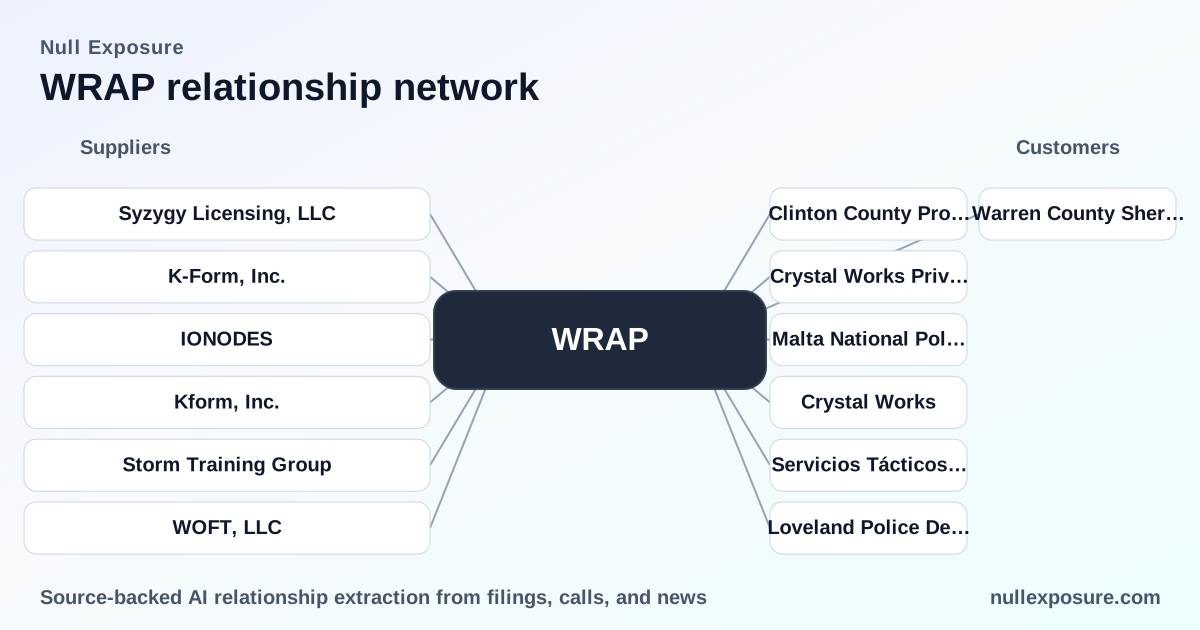
WRAP Technologies: Customer Relationships Drive a Recurring, Government-Centric Growth Path
Thesis: Wrap Technologies sells non‑lethal response devices (BolaWrap), immersive training (WrapReality) and adjacent hardware (drones, MERLIN systems) to law enforcement, healthcare security and international distributors; the company monetizes through product sales, recurring WrapReality subscriptions and distributor channels, and lifecycle support contracts that create predictable deferred revenue and upgrade cycles. Learn more at https://nullexposure.com/.
Why customers matter: the revenue model under the headline
Wrap’s revenue mix blends one‑time device sales with subscription and service economics tied to its VR training platform and lifecycle support. The company reports deferred revenue driven by WrapReality subscriptions, which converts single purchase events into multi‑year revenue streams and creates recurring cash inflows. At the same time, Wrap’s go‑to‑market relies on both direct government buyers and channel distributors, which drives concentration risk when a small number of distributors account for material shares of revenue. That duality—product spikes plus subscription stickiness—defines both upside (scalable recurring revenue) and downside (dealer concentration and modest backlog).
Quick operational constraints investors should internalize
- Contracting posture: Mix of product orders and subscription contracts; deferred revenue explicitly tied to WrapReality subscriptions.
- Counterparty profile: High exposure to government buyers and public safety agencies globally, which produces long sales cycles but high retention once deployed.
- Geographic footprint: North America is the principal revenue engine by dollars, while the company retains an explicit global distribution strategy.
- Concentration & materiality: Two distributors represented about 23% and 14% of 2024 revenues, a clear concentration that increases counterparty risk even as it accelerates market coverage.
- Relationship maturity and criticality: Multiple renewals, department‑wide deployments and instructor certifications indicate active, operational deployments that are mission‑critical to customers’ training and response programs.
- Spend profile: Current disclosed backlog is modest (approximately $64k delivered in Q1 2025), implying most growth comes from new purchase orders rather than large contracted backlogs.
Customer roll call: who is buying WRAP today
- Las Vegas Metropolitan Police Department (LVMPD) — LVMPD renewed a five‑year WrapReality contract for academy training and lifecycle support, underscoring long‑term institutional adoption of the VR platform (GlobeNewswire, Apr 22, 2026).
- Northern York County Regional Police Department (NYCRPD) — NYCRPD upgraded to BolaWrap 150 and is the first in Pennsylvania to implement WrapTactics LMS, combining devices and training software in an integrated rollout (SAHMCapital / Investing.com, Mar–May 2026).
- Loveland Police Department — Loveland completed a department‑wide deployment of the BolaWrap 150, making the device available to all sworn officers and signaling standardization at the municipal level (GlobeNewswire / Investing.com, Feb–May 2026).
- Carolina Beach Police Department — The department issued a purchase order for BolaWrap devices as part of a domestic adoption push for non‑lethal response capabilities (GlobeNewswire, Apr 24 / May 1, 2026).
- Warren County Sheriff’s Office — Warren County deployed WrapReality as a foundational component for recruit and ongoing professional development training (QuiverQuant, Mar 2026).
- Clinton County Probation Services — Clinton County implemented WrapReality to improve decision‑making and training realism for probation officers and jail staff (QuiverQuant / Yahoo Finance, Mar 2026).
- Malta National Police Force — Wrap completed instructor retraining and certified new instructors in Malta, reflecting international training expansion and post‑sale services (GlobeNewswire / The Globe and Mail, Feb–Mar 2026).
- University of Pittsburgh Medical Center (UPMC) Healthcare System — UPMC deployed WrapReality across multiple sites as part of an enterprise‑wide security training initiative, marking an expansion into healthcare security customers (GlobeNewswire / MarketScreener, Apr 16, 2026).
- Professional Security Products Corporation (PSP Corp) — PSP Corp, a Canadian distributor, placed an inventory purchase order to expand Wrap’s presence in the Canadian public safety market, illustrating the importance of channel inventory replenishment (QuiverQuant / MarketScreener, Mar 11, 2026).
- Crystal Works Private Limited — Wrap signed a strategic distribution agreement for India and announced pre‑orders (including DFR‑X drones and BolaWrap 150), establishing a commercial foothold in a large defense and law enforcement market (GlobeNewswire / Bitget / QuiverQuant, Feb–Mar 2026).
- Advanced Blast & Ballistic Systems Group — Advanced Blast & Ballistic placed a purchase order for 20 MERLIN‑1 counter‑UAS systems for the U.K. public safety market, reflecting demand for Wrap’s drone portfolio in allied markets (MarketScreener, Apr 2026).
- Servicios Tácticos de Seguridad S.A. (STS) — STS formed an exclusive partnership to distribute BolaWrap 150 and related products in Panama, creating a local commercialization channel in Central America (Intellectia / SAHMCapital, Mar 2026).
- Vector (VETTF) — Vector partnered with Wrap to integrate non‑lethal technologies into unmanned systems for defense and public safety, a collaboration that expands Wrap’s addressable market through platform OEM relationships (TechBuzzNews, 2026).
What these relationships mean for investors
The customer list shows two parallel growth engines: municipal/state/federal public safety agencies buying hardware and training, and international/distributor partnerships that scale geographic reach. Renewals (LVMPD), department‑wide rollouts (Loveland) and enterprise healthcare deployments (UPMC) indicate product maturity and operational integration—factors that translate into recurring lifecycle revenue and cross‑sell opportunities. However, distributor concentration and modest backlog suggest revenue volatility tied to the timing of purchase orders.
Consider the balance: devices drive headline sales and margins; WrapReality produces deferred and recurring revenue that improves visibility once subscription penetration increases. The company’s strategy—sell devices, embed training, then capture recurring services—is a classic hardware+software cadence that increases lifetime customer value.
If you want a consolidated view of these customer dynamics and how they map to commercial risk, see detailed coverage at https://nullexposure.com/.
Investment risks and mitigants
- Concentration risk: Two distributors represented a combined ~37% of 2024 revenue; a distributor failure or payment delay would be material. Mitigant: active direct deployments and a growing global distributor footprint reduce single‑point dependence over time.
- Sales cadence risk: Government procurement cycles and export controls create timing volatility. Mitigant: subscription and lifecycle support create ongoing revenue streams that smooth device sale seasonality once adoption scales.
- Geographic exposure: North America dominates revenue by dollars, exposing the company to U.S. budget cycles. Mitigant: recent deals in India, Panama, U.K. and Malta show deliberate international penetration.
Bottom line: where customer evidence points
Wrap’s customer activity in FY2026 demonstrates active, mission‑oriented deployments and expanding channel reach. Renewals and department‑wide adoptions signal that the core products have reached operational acceptance, while distributor pre‑orders and OEM partnerships accelerate addressable market access. Investors should value Wrap as a hybrid hardware company with growing subscription characteristics, but underwrite revenue volatility tied to distributor concentration and procurement timing.
Final action: for a deeper commercial-risk model and ongoing customer surveillance, visit https://nullexposure.com/ for our institutional coverage and data integration options.