WRB-P-G: Program partnerships sharpen distribution while underwriting stays central
W. R. Berkley Corporation operates as a commercial lines property & casualty insurance holding company that monetizes through underwriting profit, premium volume from specialty program business, fee income from program administration, and investment income on float. Its operating model emphasizes a network of rated insurance subsidiaries and program-focused distribution partners to access niche markets efficiently while preserving capital discipline.
For a concise overview of WRB-P-G customer signals and partnership exposure, visit https://nullexposure.com/ for related coverage.
Why this partnership matters to investors: program reach, not headline revenue
The published customer relationship highlights a targeted underwriting arrangement rather than a material corporate M&A or capital event. Berkley’s use of program managers and underwriting partners is a strategic channel to scale specialty lines with controlled underwriting oversight, improving returns on capital relative to broad-market distribution. That distribution leverage is the primary commercial upside to monitor for holders of WRB-P-G.
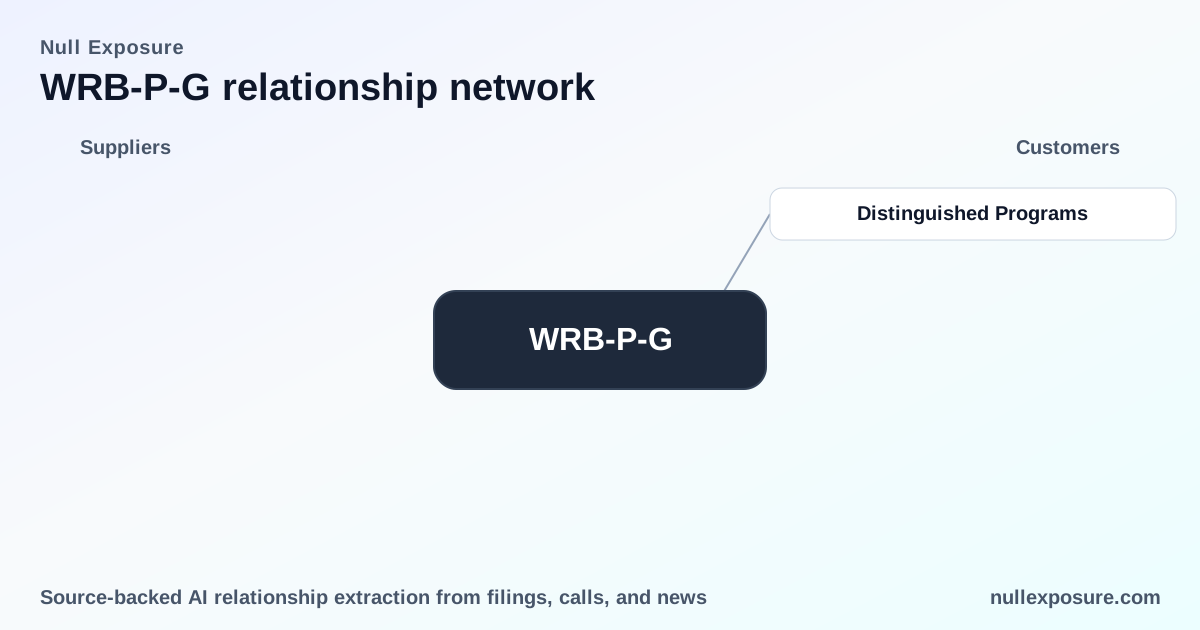
Relationship snapshot: Distinguished Programs and Berkley Program Specialists
Distinguished Programs, a national insurance program manager, announced a new underwriting partnership with Berkley Program Specialists, a member company of W. R. Berkley Corporation, to provide package coverage for community associations. According to a PR Newswire release dated March 10, 2026, Berkley Program Specialists will underwrite the program, and the Berkley insurance company subsidiaries involved are rated A+ (Superior) by A.M. Best. (PR Newswire, March 10, 2026 — https://www.prnewswire.com/news-releases/distinguished-programs-and-berkley-program-specialists-partner-to-offer-package-coverage-for-community-associations-301782486.html)
This relationship is distribution-first: Berkley supplies underwriting capacity and brand/credit through its rated subsidiaries, while Distinguished Programs supplies niche access to community association risks and program administration.
Every customer relationship in the record — concise, plain-English
- Distinguished Programs: Berkley Program Specialists has entered an underwriting partnership to offer package coverage for community associations; the arrangement leverages Berkley’s rated insurance subsidiaries to provide capacity and credibility to the program manager’s distribution (PR Newswire, March 10, 2026 — https://www.prnewswire.com/news-releases/distinguished-programs-and-berkley-program-specialists-partner-to-offer-package-coverage-for-community-associations-301782486.html).
Constraints and company-level operational signals
NullExposure’s relationship constraints list for WRB-P-G contains no explicit constraint entries. Treat the lack of listed constraints as a company-level signal: there are no flagged contract limitations, exclusivity clauses, or concentration warnings surfaced in this data set.
From an operating-model standpoint, several clear signals emerge:
- Contracting posture: Berkley leverages underwriting partnerships and program business to distribute risk; contracts emphasize capacity provision and rating support rather than upstream acquisition of distribution platforms.
- Concentration: Absent constraint data, program relationships imply incremental concentration by line or niche (e.g., community associations) but not single-counterparty dependency at the corporate level, given Berkley’s diversified subsidiary structure.
- Criticality: Program managers are important distribution conduits rather than balance-sheet counterparties; their performance affects premium growth and loss selection more than capital adequacy directly.
- Maturity: Berkley’s program model is established and credit-bearing, as evidenced by the A+ rating cited in the partnership release, indicating a mature underwriting operation that investors can treat as a steadying factor in underwriting volatility.
What investors should watch next
- Premium cadence and term rollout: Monitor whether the Distinguished Programs partnership produces measurable premium volume and whether Berkley expands similar program arrangements across other specialty niches.
- Underwriting performance: Program business scales premium quickly; loss ratio trends on program lines will determine whether distribution translates into sustainable underwriting profit.
- Counterparty operational quality: Program managers deliver policy issuance, renewal, and claims intake; operational failures at the program manager level create earnings and reputational risk for the carrier, so diligence on partner capabilities is essential.
- Rating and capital management: The A+ rating cited in the announcement underpins pricing power and broker acceptance; maintaining that rating will be critical to supporting continued program underwriting capacity.
A short checklist for analysts:
- Track premium and loss reporting tied to program vehicles in quarterly filings.
- Evaluate the number and diversity of program manager partners to gauge concentration risk.
- Monitor commentary from A.M. Best and capital adequacy metrics in insurer-level disclosures.
For ongoing signals tracking and to view related customer relationship coverage for other tickers, see https://nullexposure.com/.
Bottom line for WRB-P-G holders
This customer relationship is incremental distribution-driven business that aligns with Berkley’s established program-underwriting model. For preferred-stock investors focused on downside protection and steady credit profile, the key positives are Berkley’s rated subsidiaries providing capacity and the disciplined use of program partners to grow specialty premiums. The primary risk vector is underwriting and operational execution within the program channel — a performance lever that directly influences retained earnings and, over time, credit metrics.