Warby Parker (WRBY) — Customer Relationships That Drive Scale and Retail Reach
Warby Parker operates as a vertically integrated eyewear and vision-services platform that designs, manufactures and sells branded prescription and non-prescription eyewear through e-commerce and a growing physical retail footprint, monetizing through product margins, optical services and ancillary accessories. The company leverages direct-to-consumer economics, retail expansion and managed-care partnerships to scale revenue per customer and broaden distribution without relying on third‑party brands. For investors, the firm’s customer relationships signal a hybrid retail‑services model with consumer transaction economics at its core and strategic partnerships that accelerate reach.
For deeper research and benchmarking on customer contracts and partner exposure, visit the Nillexposure investor hub: https://nullexposure.com/
What the relationship set reveals about Warby Parker’s commercial posture
Warby Parker’s customer relationships are oriented around retail transactions with individuals and network access through partner channels. The available disclosures show two clear patterns: (1) retail distribution scaleouts with national retailers to increase physical reach, and (2) insurance/in‑network partnerships that expand addressable market and reduce friction for insured patients. These relationships reinforce a business model where product sales are the primary revenue driver, complemented by optical services that enhance lifetime value.
- Contracting posture: The company recognizes revenue at point of delivery or service completion, consistent with predominantly spot, transaction-level revenue recognition for sales and exams.
- Counterparty concentration: The core buyer base is individual consumers through stores and digital channels; strategic partners like national retailers and payors are distribution multipliers rather than replacement revenue engines.
- Criticality and maturity: Retail partnerships and payor in‑network status are strategically important for scale but do not indicate sole dependence on any single counterparty in the disclosures provided.
- Geographic footprint: Operations and revenues are concentrated in North America—primarily the U.S., with a small Canadian presence—which simplifies supply chain and customer acquisition assumptions but creates regional exposure.
Relationships in the public record (straightforward summaries)
Below are every counterpart listed in the sourced relationship results, each summarized in plain English with source attribution.
Target Corporation (TGT)
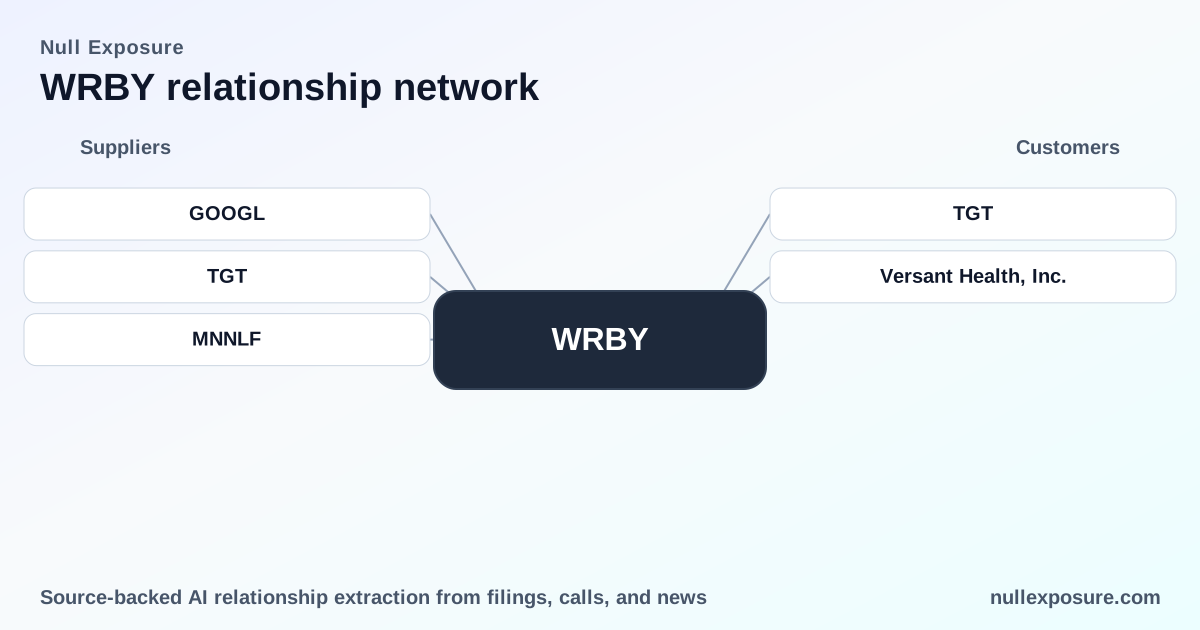
Warby Parker announced a partnership to open five Warby Parker shop‑in‑shops inside Target stores in 2025, with the stated option to expand the program in subsequent years; the company cited this initiative in its FY2024 results release. The same expansion was reiterated in Warby Parker’s first‑quarter 2025 update, which also linked the partnership to its broader store‑opening cadence and omnichannel growth plan (BizWire press release, Feb. 27, 2025; First‑quarter 2025 release, May 8, 2025).
Versant Health, Inc. (wholly‑owned by MetLife)
Warby Parker reported that an expanded relationship with Versant Health increased its in‑network coverage to over 30 million lives, improving planholder access to Warby’s retail and service offerings and likely supporting utilization of eye exams and prescription purchases. This in‑network expansion was referenced in coverage of the company’s 2024 annual reporting (Vision Monday coverage of the annual report, 2026).
How these relationships translate into commercial advantages and risks
Warby Parker’s Target shop‑in‑shop deal and payor network expansion illustrate two complementary growth levers: physical distribution scale and insured demand capture.
- Distribution leverage: The Target partnership accelerates physical footprint growth without the same capital and operational burden as standalone store openings, improving brand visibility in high‑traffic mass retail locations. This supports top‑line expansion and cross‑sell into Target’s broad customer base (BizWire; May 2025 investor release).
- Demand amplification through in‑network status: Expanding in‑network coverage with Versant Health reduces consumer friction for paying for eye care and eyewear, potentially increasing exam conversion rates and prescription sales. Increased in‑network lives is a direct pathway to higher traffic into stores and online channels (Vision Monday; FY2025 commentary).
However, these benefits are balanced by operational and margin considerations: shop‑in‑shop rollouts require tight integration of inventory and point‑of‑sale systems; in‑network arrangements can pressure pricing and margins depending on reimbursement terms. Warby Parker’s unit economics depend on product margins and service throughput, so partner arrangements that materially change either input require active management.
Key takeaways investors should weight
- Core revenue remains retail and direct sales. The company’s disclosures continue to position product sales and optical services as the primary revenue sources, with partners serving as distribution multipliers rather than primary buyers.
- Retail expansion is hybrid. Warby blends standalone stores with embedded shop‑in‑shops to accelerate presence while limiting real estate and operating overhead.
- Insurance and network coverage are growth enablers. In‑network relationships like Versant Health materially increase the addressable insured population and can lift store traffic and conversion.
- Geographic concentration in North America simplifies scaling assumptions but concentrates macro and reimbursement risk regionally.
For investors tracking partner cadence and contractual exposure, Nillexposure provides structured insights and ongoing monitoring: https://nullexposure.com/
Final read: positioning and risks
Warby Parker’s customer relationships documented in public filings and press coverage show a deliberate strategy to combine owned retail economics with partner distribution and payor access. This hybrid model produces diversified channels for revenue growth while preserving control over product design and customer experience. Key risks to monitor include margin pressure from partner arrangements, execution risk in rapid shop‑in‑shop rollouts, and regional demand cyclicality given North American concentration.
Bold, active partner development—Target for distribution and Versant Health for network access—is central to management’s growth plan and should remain focal points for due diligence and quarterly monitoring.